
Want to improve worker retention and performance in skilled labor? Start with a well-designed incentive program. Here’s the gist:
- Why it matters: High turnover costs time and money. Incentives tied to performance can boost engagement, safety, and quality.
- Key components: Use a mix of monetary rewards (bonuses, profit-sharing) and non-monetary perks (flexible schedules, career growth).
- Metrics to track: Focus on productivity, safety, quality, and reliability. Avoid subjective criteria to maintain trust.
- Tech tools: Platforms like ABLEMKR simplify tracking, payouts, and compliance.
- Rollout tips: Test with a pilot program, train supervisors, and gather worker feedback for adjustments.
Bottom line: Incentive programs aligned with clear metrics and supported by technology can reduce turnover, improve safety, and increase project efficiency.
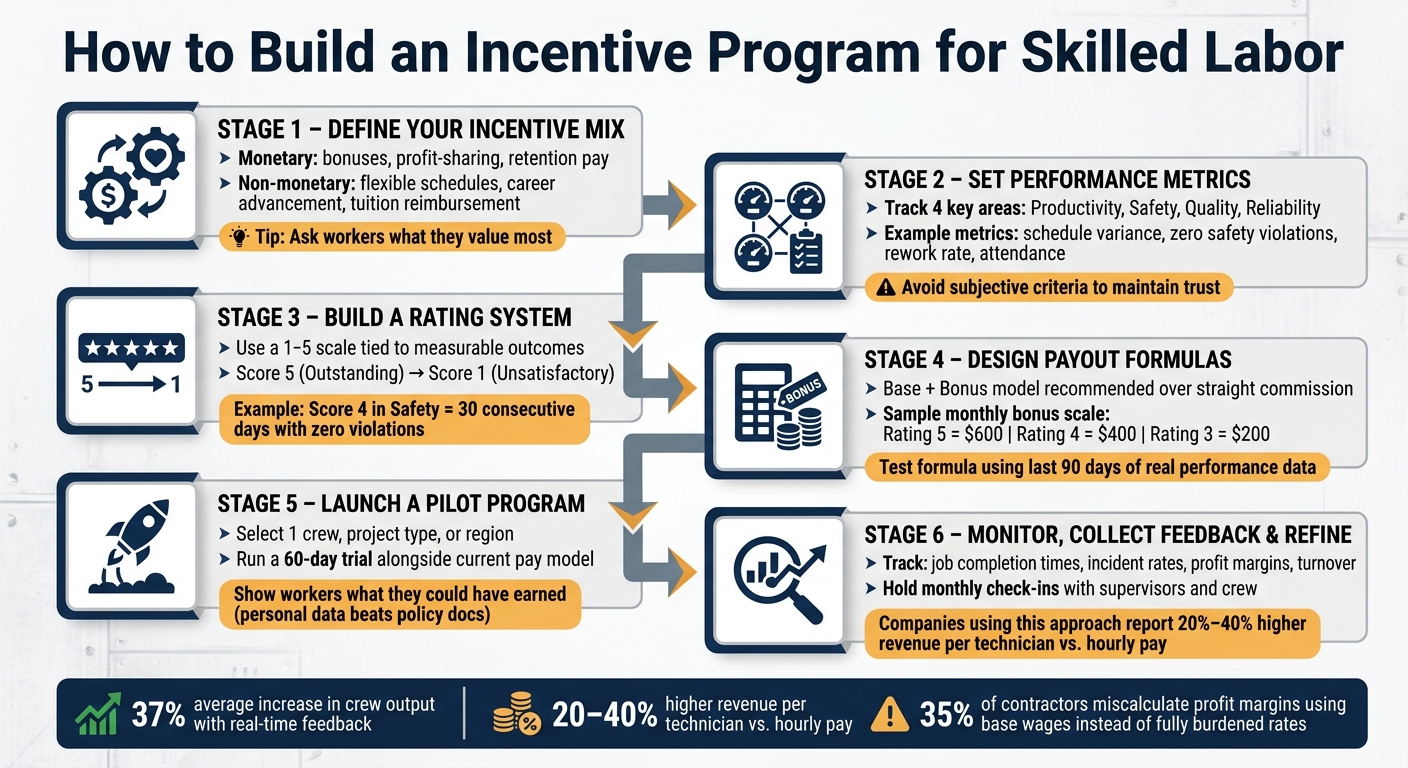
How to Build an Incentive Program for Skilled Labor: Step-by-Step Guide
Core Components of Incentive Programs for Skilled Labor
What Are Incentive Programs?
Incentive programs are designed to reward workers for going beyond the basics – like just showing up – by meeting specific performance goals. In industries like construction and energy, these programs typically fall into three main categories:
- Monetary rewards: Think bonuses or profit-sharing.
- Non-monetary perks: Options like flexible work schedules or opportunities for greater responsibility.
- Benefits-based incentives: This can include things like tuition reimbursement or childcare support.
The right mix of incentives largely depends on what your workforce values. For example, pipeline welders might prefer cash bonuses, while urban utility teams could lean toward flexible schedules or career advancement opportunities. A key takeaway? Engaging workers in the design process – by asking them what matters most – can make the difference between a program that truly motivates and one that workers ignore. This approach also lays the foundation for understanding why linking incentives to performance metrics is so important.
Why Link Incentives to Performance Ratings?
Tying rewards to clear productivity, safety, and quality metrics eliminates the guesswork and builds trust. If bonuses are based on subjective evaluations, workers quickly pick up on inconsistencies, leading to frustration and disengagement.
The impact of performance-based pay systems is well-documented. Studies show these systems can boost average crew output by 37%. Additionally, labor costs – typically ranging from 11% to 18% of revenue – can stabilize into a more predictable percentage when tied to measurable performance metrics.
"When contractors know their compensation depends not just on hours but on results, they act more like partners and not just hired hands." – Rabiya Farheen, Content Strategist, Kyro.ai
However, it’s crucial to balance these metrics. A program that rewards only speed might push workers to cut corners. The most effective programs evaluate performance across multiple dimensions – like operations, safety, quality, and financial outcomes – to ensure no single area is prioritized at the expense of others. Once these metrics are in place, technology becomes essential for managing and tracking results.
How Technology Supports Incentive Program Management
Managing performance data manually for dozens – or even hundreds – of workers is a logistical nightmare. Digital tools simplify this process by providing real-time updates on progress and earnings, so workers aren’t left guessing until payday.
Platforms like ABLEMKR are built to handle this complexity. These tools centralize data on worker certifications, safety training, and compliance, giving employers the ability to run objective, auditable programs across job sites. By integrating performance metrics with digital systems, companies can streamline the entire process and make faster, fairer payout decisions.
"The most effective performance pay systems are transparent, data-driven, and designed to give employees real-time feedback on how their efforts translate into earnings." – per4mance.io
The results speak for themselves. Companies that use technology to tie compensation to measurable outcomes report 20% to 40% higher revenue per technician compared to traditional hourly pay structures. Real-time dashboards also foster trust by showing workers exactly how their performance impacts their pay.
sbb-itb-aa28329
How to Set Performance Metrics and Rating Systems
Choosing the Right Metrics for Skilled Labor
The metrics you select will directly influence how workers perform on the job, so it’s crucial to get them right. In industries like construction and energy, the most effective programs focus on four key areas: productivity, safety, quality, and reliability.
Each of these metrics ties back to essential business goals. For instance, productivity metrics – like schedule variance and job completion times – help keep projects running smoothly. Safety metrics, such as maintaining zero safety code violations over a specific period, not only protect workers but also reduce liability. Quality metrics, like minimizing rework, save money by avoiding unnecessary corrections. Lastly, reliability metrics – such as consistent attendance and hitting project milestones – ensure a dependable workforce.
"Incentive contracts such as cost-plus–incentive-fee (CPIF) or shared-savings models reward contractors for efficiency, quality, and timely delivery, not just hours worked." – Kyro.ai
Balancing all four categories ensures a fair and effective program. These metrics also integrate effortlessly with digital tools, enabling real-time tracking and setting the stage for the incentive programs discussed in later steps.
Building a Clear and Consistent Rating System
After defining your metrics, the next step is to create a rating system that turns performance data into actionable scores. A 1-to-5 scale often works well in skilled labor settings, where 1 represents performance far below expectations and 5 signifies consistently outstanding results.
It’s important to base ratings on measurable outcomes. For example, a score of 4 in safety might mean 30 consecutive days without any safety code violations, while a 3 in quality could reflect a rework rate below 5%. Avoid subjective criteria like “good attitude” or “team player,” as these can introduce bias and undermine trust.
"As long as a task is measurable and within the employees’ power, it is suitable for benchmarking." – GoCodes
Using visual dashboards to display performance data in real time can boost engagement far better than waiting for periodic reviews. Once your scale is defined, the focus shifts to ensuring fairness and consistency in how it’s applied.
Keeping the System Fair and Compliant
Even the best-designed rating system can fail if it’s applied inconsistently. To maintain trust and transparency, all workers must be evaluated using the same criteria, with clear and consistent documentation.
Two elements are critical here: written criteria and audit trails. Clearly outlining the terms of incentives – such as posting goals in shared spaces like break rooms – eliminates confusion about expectations. Documenting every evaluation in detail ensures that decisions about payouts can be justified if challenged.
"Clear documentation, audit trails, and fair payout mechanisms help avoid disputes." – Kyro.ai
It’s also important to account for factors beyond workers’ control. Issues like supply chain delays, regulatory obstacles, or weather disruptions shouldn’t unfairly affect someone’s rating. Allowing for these exceptions keeps employees motivated and engaged over the long run.
How to Design Incentives That Support Business Goals
Types of Incentives for Skilled Labor
Once your rating system is in place, the next step is choosing the right mix of monetary and non-monetary incentives. For industries like construction and energy, these typically fall into two main categories: monetary rewards and non-monetary perks.
Monetary incentives – such as performance bonuses, profit-sharing, and retention pay – are straightforward ways to reward results. On the other hand, non-monetary incentives, like flexible schedules, career advancement opportunities, or tuition reimbursement for trade schools, can be equally impactful, particularly for retaining workers long-term or attracting talent in a competitive market.
A "Base + Bonus" model is often more effective than straight commission in field trades. This approach reduces income uncertainty while still motivating top performers. For team-based projects, like those in utility or pipeline work, a shared-savings model can align group and individual goals. This model rewards teams with a portion of the savings achieved by completing projects under budget or ahead of schedule, fostering collaboration rather than competition.
It’s crucial to balance speed-focused incentives with quality-driven measures. Companies that lack quality-related rewards often face callback rates as high as 14%, compared to the industry standard of 3% to 5%. For instance, offering a $300 monthly bonus for maintaining low callback rates can keep quality a priority without adding unnecessary complexity.
Once you’ve decided on the types of incentives, the next step is to create clear and straightforward bonus structures.
How to Build Payout Formulas
The best payout formulas are simple enough for workers to calculate on their own. Tying dollar amounts directly to your established 1-to-5 rating scale is a practical starting point.
Here’s an example for a field technician:
| Performance Rating | Monthly Bonus |
|---|---|
| 5 – Outstanding | $600 |
| 4 – Above Average | $400 |
| 3 – Meets Expectations | $200 |
| 2 – Below Expectations | $0 |
| 1 – Unsatisfactory | $0 |
For roles tied to specific projects, like superintendents or lead operators, milestone bonuses are often a better fit than monthly payouts. Bonuses ranging from $500 to $1,500 can be linked to key project phases – such as structural enclosure or final closeout – directly connecting rewards to business outcomes.
Before rolling out any bonus formula, test it using data from the past 90 days. This ensures the structure is both clear and trusted by your team.
"Retention in construction is a risk decision. It is tied directly to execution, schedule control, and margin protection." – Brian Binke, Founder & CEO, The Birmingham Group
When determining the size of your bonus pool, consider fully burdened labor costs. For example, a technician earning $25 per hour can cost an employer between $40 and $55 per hour after factoring in taxes, insurance, and benefits. Many contractors – nearly 35% – miscalculate profit margins by using base wages instead of fully burdened rates.
A well-designed payout formula not only motivates employees but also integrates seamlessly with payroll systems.
Connecting Incentives to Payroll Systems
To make sure performance rewards are timely and transparent, integrate your bonus structure with automated payroll workflows. Workers need to trust that their bonuses are calculated correctly and paid on time. Paying bonuses separately from regular paychecks can also make the reward feel more tangible.
"Incentive programs often work more effectively if employees realize the benefits immediately and apart from regular payroll checks." – Nadine Penny MA, Reviewer, GoCodes
This is where tools like ABLEMKR come into play. ABLEMKR combines real-time performance tracking with embedded payroll workflows, allowing employers to calculate bonuses and process payments without juggling multiple systems. For companies managing crews across various job sites or energy corridors, this level of automation minimizes errors and prevents disputes, which can undermine worker trust.
The ideal system ensures that the process – from tracking performance to issuing payments – is quick, transparent, and automatic. When workers can see their performance scores update in real time and know exactly when their bonuses will arrive, the incentive becomes a powerful motivator for improved performance.
How to Roll Out an Incentive Program
Start with a Pilot Program
Before launching an incentive program across all job sites, it’s smart to test it on a smaller scale first. Pick one crew, project type, or region where you have reliable performance data and a trusted supervisor to oversee things. This way, you can minimize risks and make adjustments if needed.
Before kicking off the pilot, make sure you’ve secured budget approval and clearly defined its scope. Lay out which roles will be involved, the metrics you’ll track, and how long the test will run. A 60-day trial period usually provides enough data to evaluate the program’s effectiveness. During this time, run the incentive system alongside your current pay model. This allows workers to see the potential benefits without worrying about losing their existing income. To make it even more convincing, use the last 90 days of performance data to show workers what they could have earned under the new plan. For example, showing a technician they would’ve made an extra $500 last month is far more persuasive than handing them a policy document.
"Personal data beats general reassurance every time." – Ryan Shank, Founder, ShareWillow
Once the pilot is structured, ensure your leadership and crews are fully prepared to implement it smoothly.
Train Supervisors and Workers
An incentive program can only succeed if everyone understands it. Start by training supervisors, as they’ll be the ones explaining the program to field workers.
Hold weekly crew reviews where supervisors compare actual hours worked to project targets. Keep these discussions focused on specific tasks rather than abstract policies – it helps workers connect the dots. Workers should also be able to calculate their bonuses on their own. Simplify the bonus formula enough that it can be explained in under two minutes.
A practical approach is to highlight each worker’s effective hourly rate, which combines their base pay and performance bonuses. For instance, if someone’s base pay is $20 per hour but their performance bumps it up to $32 per hour, make sure they can see that figure clearly and regularly. When workers see the difference in real time, the incentive becomes more tangible.
Take Bell Plumbing and Heating in Colorado as an example. In late 2024, CEO Tom Teynor shifted the nearly century-old union shop from hourly wages to a commission-based pay structure. By collaborating with union representatives and legal experts, they ensured the new system met union requirements. Despite a 20% drop in call volume in 2024, every service technician earned a higher W2 income by the end of 2025 than under the old system.
"It’s been a win-win-win. Customers won. We’ve won. The unions have won. The techs have won." – Tom Teynor, CEO, Bell Plumbing and Heating
Use Digital Tools to Support the Rollout
Once your supervisors and workers are on board, digital tools can make the rollout smoother and more efficient. Manual tracking often leads to mistakes and can erode trust. When bonus calculations don’t match expectations, it’s usually because the data isn’t clear. Digital tools eliminate this problem.
Platforms like ABLEMKR are designed to simplify workforce management. They provide real-time visibility into worker status, integrate payroll workflows, and track compliance – all in one place. This automation is especially useful for managing performance data and bonus payouts across multiple job sites, ensuring consistency and avoiding disputes.
Beyond payroll, digital tools can enhance the program with features like gamification and transparency. Leaderboards and performance dashboards let workers see how they’re doing in real time, tapping into their competitive drive while keeping everything measurable. Studies show that crew output increases by an average of 37% when real-time feedback and transparency are applied consistently.
How to Monitor and Improve Your Incentive Program
Defining Success Metrics for the Program
To gauge the effectiveness of your incentive program, focus on four key areas: operational, quality/safety, financial, and human capital.
For operational performance, keep an eye on job completion times and how closely schedules align with project milestones. In the quality and safety category, track incident rates, safety code violations, and the frequency of rework – an issue that can eat up around 5% of total construction costs. Even small improvements in this area can have a noticeable impact on your bottom line. Financially, look at estimate accuracy and project profit margins to ensure the program is delivering a return on investment. When it comes to workforce stability, monitor turnover rates, especially for critical path roles like superintendents and lead tradespeople. Losing these key team members mid-project can significantly disrupt schedules and budgets.
It’s also essential to strike a balance. Prioritizing speed over safety or quality can backfire. Keep callback rates in check – aim for 3%–5%, and avoid spikes above 14%. To ensure fairness, tie bonuses to a mix of outcomes rather than focusing solely on throughput.
Once you’ve established these metrics, gather input from those directly involved in the work to gain a broader perspective.
Collecting Feedback from the Field
Numbers tell part of the story, but direct feedback from your team fills in the gaps. Supervisors and crew members can help identify issues that metrics might overlook, like whether performance goals are realistic for complex projects.
The simplest way to gather this input? Just ask. Nadine Penny, a reviewer for GoCodes, emphasizes this approach:
"Asking employees what is important to them and using this input to design an incentive program points out not only that you want to perform your job as a manager well, but also that you care enough about the workforce to listen to its members."
Regular, short check-ins – monthly or after each project phase – work better than annual surveys. Ask your team if the goals feel attainable, if the timing of payouts aligns with their efforts, and whether they’d prefer alternative reward types, like flexible scheduling instead of cash bonuses. That last question often uncovers surprising preferences.
Adjusting the Program Based on Results
Refining your program should be both data-driven and transparent. If the numbers or team feedback highlight problems, make adjustments accordingly.
For instance, if quality metrics drop or burnout becomes an issue, consider revising targets or adding new incentives. You might introduce a bonus for achieving zero-callback months or prorate goals to factor in paid leave. Just ensure calculations include fully burdened labor rates (covering taxes, insurance, and benefits), which typically range from $40–$55 per hour for a $25/hour technician. Skipping this step is a common mistake – about 35% of contractors miscalculate profit targets because they overlook it.
If workers resist changes, use their own data from the past 90 days to show how the adjustments could affect their earnings. Personal examples tend to be far more convincing than a generic policy explanation. Companies that consistently link pay to measurable outcomes report 20%–40% higher revenue per technician compared to those using straight hourly pay. That’s a benchmark worth aiming for as you fine-tune your program over time.
How to Create Incentive Programs That You and Your Employees Will Love
Conclusion: Steps to Build an Incentive Program for Skilled Labor
To build an effective incentive program, start with the basics: calculate fully burdened labor costs, establish clear and measurable benchmarks, choose the right pay structure, and implement quality safeguards. These steps lay the groundwork for a program that motivates your team while ensuring fairness and accountability.
Once the foundation is set, focus on execution and refinement. Begin with a pilot program, train your supervisors thoroughly, and actively gather feedback from the field. Use both the data and input from your crew to fine-tune the program. Companies that adopt this method often see higher revenue per technician compared to traditional hourly pay models. This approach combines performance metrics, equitable pay, and streamlined digital tools into a single, well-rounded system.
"Financial incentive programs for the construction labor force are not only feasible but that they could materially raise productivity, lower production costs, shorten construction time and increase the earnings of the workers." – Laufer and Borcherding, University of Texas Study
Accurate performance tracking is the backbone of any incentive program. Without reliable data, even the best-designed plans can fall apart. Tools like ABLEMKR provide real-time insights, automated payroll, and compliance tracking, making it easier for construction and energy companies managing multiple sites to confidently implement performance-based systems. By pairing technology with clear incentives, you create a structure where productivity and safety improve across all projects.
When workers understand how their efforts directly impact their pay, they become more engaged, work more safely, and are less likely to leave – benefiting every project they contribute to.
FAQs
How do I pick metrics that don’t push unsafe shortcuts?
To steer clear of encouraging unsafe shortcuts, it’s crucial to emphasize clear, measurable performance metrics that put safety compliance front and center. Make sure incentives are evenly distributed across key areas: safety, quality, schedule, and cost, with safety always being a top priority.
Engage both workers and managers in creating realistic goals. Incorporate safety-focused metrics, such as tracking incident-free days, to reinforce the importance of safe practices. Regularly review these metrics to confirm they promote safe behaviors and prioritize long-term quality over rushing to meet deadlines.
What’s the simplest bonus formula crews will actually trust?
The easiest bonus formula is one that’s straightforward, measurable, and simple to grasp. Good examples include bonuses linked directly to performance goals, like finishing a project under budget, ahead of schedule, or meeting safety standards. Another common method is offering a bonus equivalent to one to two weeks’ pay, calculated as a percentage of net profit. Clear communication and transparency are essential for earning trust in this process.
How do I calculate fully burdened labor cost before setting payouts?
To determine the fully burdened labor cost, you need to account for more than just base wages. This includes direct and indirect expenses such as payroll taxes, workers’ compensation, employee benefits, vehicle expenses, tools, and overhead costs. For instance, while a worker earning $25 per hour might seem affordable, their actual cost could range between $40 and $55 per hour once all these additional expenses are factored in.
The formula to calculate this is straightforward:
(Base hourly rate + burdening percentage) × hours worked + additional costs
This approach helps ensure payouts reflect the true cost of labor, covering every expense tied to employing workers.


