
A paper card is easy to fake. A digital credential tied to a worker ID and checked against a tamper-proof record is much harder to alter.
If I had to sum up the article in plain English, it’s this: blockchain-based credential checks help me confirm who issued a worker’s training record, whether it’s still valid, whether it was revoked, and whether the file was changed – all before hiring, onboarding, or gate entry. That matters when some checks still take up to 72 hours, and some digital onboarding pilots cut the process from 3 days to 30 minutes.
Here’s the full picture in a few points:
- What it is: digital training and license records linked to one worker profile
- What stays on-chain: hashes, timestamps, issuer ID, credential type, and status
- What stays off-chain: names, SSNs, dates of birth, I-9 files, addresses, and scans
- How it works: scan a QR code, then check issuer, dates, revocation, and record match
- Where it helps: hiring, dispatch, onboarding, and site access
- What to set up first: issuer rules, worker IDs, expiration alerts, and gate/dispatch checks
- What to watch: wallet use, issuer participation, privacy controls, and revocation rights
The bottom line: I’d use this first for the credentials that most often slow mobilization – HAZWOPER, confined-space, high-voltage, crane, and site-specific safety records – then connect those checks to dispatch and gate decisions so expired records stop causing delays or risk.
How the System Works: Digital Records, Identity Links, and Certificate Checks
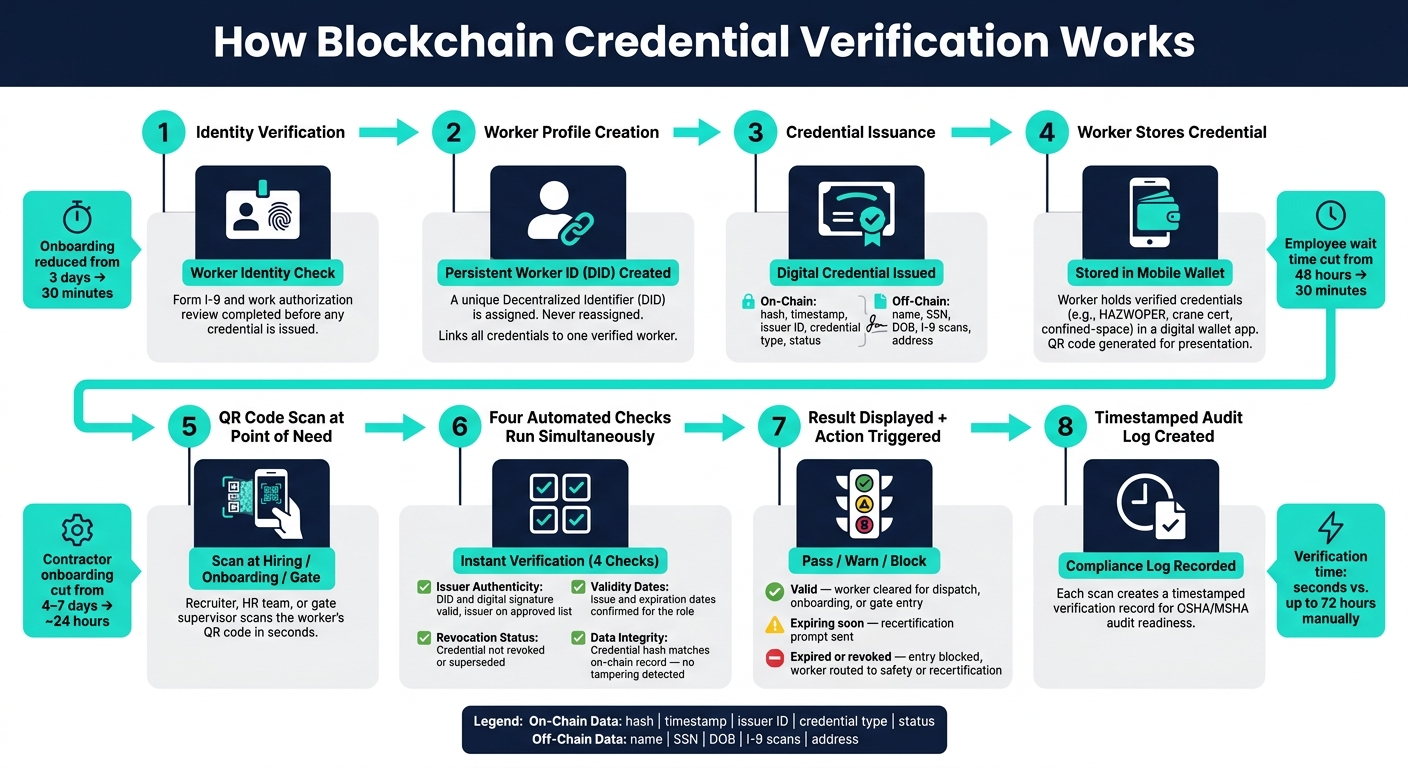
Blockchain Worker Credential Verification: How It Works Step by Step
Digital Credentials and What Data Gets Stored
Most systems follow the W3C Verifiable Credentials model: issuer, holder, and verifier.
Each credential contains the issuer’s identity and public key, the worker’s unique identifier, the certification name and scope, issue and expiration dates, and a cryptographic signature that makes tampering easy to spot later.
Sensitive details should stay off-chain in secure storage. That includes full names, SSNs, dates of birth, I-9 scans, addresses, and contact details. On-chain, the system stores only the credential hash, timestamps, issuer ID, credential type, and status. That setup cuts privacy risk while still giving verifiers cryptographic proof that the record hasn’t been changed.
How Credentials Are Linked to a Worker’s Identity
Before a credential is issued, the worker’s identity is checked through Form I-9 and any required work authorization review.
After that check, the system creates a persistent worker ID, often a DID, that connects all credentials to one verified worker. That ID is never reassigned to someone else. In high-risk job sites, that matters a lot. A bad identity link can turn into a safety problem fast.
That same link follows the worker across hiring, onboarding, and recertification. So whether the person has an NCCCO crane certification, an MSHA training credential, or a refinery confined-space module, each credential points back to the same DID as the credential subject.
The worker keeps those credentials in a mobile wallet. I-9 records and license scans remain off-chain. The blockchain only needs the identifier and the credential hash.
How Certificate Verification Works at the Point of Need
Verification happens in seconds when it’s time to make a decision. A worker shows a QR code, and the recruiter, onboarding team, or gate supervisor scans it.
At that moment, the system checks four things before the worker is cleared:
| Check | What It Confirms |
|---|---|
| Issuer authenticity | The issuer’s DID and digital signature are valid and the issuer is on the approved list |
| Validity dates | Issue and expiration dates are valid for the role |
| Revocation status | The credential has not been revoked or superseded |
| Data integrity | The credential hash matches the on-chain record, so no tampering is detected |
Each scan also creates a timestamped verification log for compliance review.
The result shows up as a simple status: green for valid, yellow for expiring soon, and red for expired or revoked. Gate supervisors can also view a photo, name, and credential summary to confirm that the person showing the credential matches the holder on file.
If a critical credential has expired, like H2S for a sour gas site assignment, the system can block that worker from the role right away and send a recertification prompt instead of waiting for a manual check. In ABLEMKR workflows, that same verification step can route only in-scope workers into dispatch and site-access queues.
Those verification results feed hiring, onboarding, and site-access decisions without another manual review.
sbb-itb-aa28329
Where Blockchain Credential Verification Fits in Hiring, Onboarding, and Site Access
Hiring and Shortlisting Workers With Verified Qualifications
Once a credential is verified, it shouldn’t just sit in a file. It needs to shape hiring, onboarding, and site access from that point forward.
Before a company hires or dispatches someone, the staffing team has to confirm that the person holds the right credentials for the job. Blockchain verification makes that step automatic. Employers set credential rules by role. For example, a refinery turnaround role might require current HAZWOPER and confined-space authorization, while a crane job may call for a current crane certification or signal-person credential. Only workers whose verified records match those rules move ahead.
On ABLEMKR, workers are matched based on certifications, safety training, availability, and geolocation. So the credential screen happens before dispatch.
Onboarding and Compliance Review Without Manual Rechecks
After a worker is selected, that same verified record moves straight into onboarding. HR, safety, and operations teams can all look at one current profile instead of asking the worker to send the same certificates again.
In one onboarding pilot, verifiable credentials cut onboarding from 3 days to 30 minutes and reduced employee wait time from 48 hours to 30 minutes.
That shifts the focus of orientation. Teams can spend time on site-specific rules, PPE needs, and access permissions instead of rechecking documents that were already confirmed.
Site Access and Recertification Control
The last checkpoint is site access. Access-control teams confirm identity and credential status before a worker enters the site. If a credential has expired, the system blocks entry and sends a recertification prompt instead of leaving it to a supervisor to spot by hand.
And here’s the part that often gets missed: a worker can begin a project fully qualified and still run into an expiration date halfway through the assignment. Continuous monitoring and expiration alerts update the profile right away, so gate access and dispatch rules stay current.
Step-by-Step Implementation for U.S. Construction and Energy Teams
Step 1: Audit Current Credential Workflows and Failure Points
Start by mapping how credentials move through your operation today. Look at where each credential lives, who checks it, how long that check takes, and where things tend to break.
Most teams run into the same problems: no expiration tracking, uneven gate checks, and slow document retrieval. When an OSHA or MSHA audit shows up, those weak spots are hard to miss.
Catalog the credentials tied to each role, including OSHA, MSHA, welding qualifications, state licenses, respirator fit tests, and drug and alcohol testing. For each one, note:
- where it’s stored
- who validates it
- how long validation takes
- where delays have recently cost time or created compliance risk
That list becomes your priority map for setup.
Use this audit to decide which credentials the system needs to issue, verify, and monitor.
Step 2: Set Up Issuers, Worker Profiles, and Verification Rules
Once you know where the gaps are, decide who can issue credentials in your system and what rules those credentials need to follow. Define approved issuers, such as external training providers and internal safety teams, and document their authority to issue digital credentials.
Link each worker profile to a verified off-chain identity. Keep only credential proofs on-chain.
Set verification rules at the role, project, and site level. Add clear expiration alerts and escalation steps. Then connect those rules to dispatch so the same verified credential status shows up during matching and deployment on ABLEMKR.
After that, tie the rules into dispatch and gate access so checks happen automatically instead of relying on manual review.
Step 3: Connect Verification to Dispatch, Onboarding, and Gate Entry
Build credential checks into dispatch, intake, and gate entry.
In dispatch, when supervisors need welders or electricians, the system should return only workers with valid credentials for that job. It uses the same worker profile and the same rule set from Step 2. During candidate intake, workers link their digital credential profile so the system flags missing or expired credentials right away, not at the gate on day one.
At the gate, workers present a mobile credential, and the access control system returns a pass/fail result against the site’s verification rules in seconds. If a respirator fit test has expired, the system blocks entry and routes the worker to safety instead of the work area. On remote sites with limited connectivity, verification results can be cached locally and synced once the network is back.
Teams that shift checks to digital pre-arrival workflows cut contractor onboarding from 4–7 days to about 24 hours.
Benefits, Risks, and Conclusion
Operational Gains and Governance Tradeoffs
Once the workflow is live, three things matter most: speed, control, and privacy.
Blockchain verification can cut checks from hours or days down to seconds. It also makes issuer-signed records tamper-evident, which gives teams a level of fraud resistance that paper cards and PDFs just can’t match. But there’s a catch. The system only works well if people use wallets, issuers take part, and the rules are clear from the start. You need to decide who can issue records, who can revoke them, and who can view them before launch, not once problems show up.
A digital wallet also changes the day-to-day experience for workers. Instead of getting the same credentials checked again and again, they can carry verified records from one project to the next. That matters a lot in construction and energy, where OSHA, MSHA, confined-space, and HAZWOPER records often need to move with a worker across sites and contractors.
Privacy puts limits on the design too. Systems should support selective disclosure so gate staff can see whether a credential is valid without seeing the worker’s full training history or personal details. On multi-employer sites, union agreements and OSHA documentation rules shape what data can be shared across contractors. That means configurable access scopes and consent workflows aren’t nice extras. They’re compliance requirements.
Conclusion: Where to Start
The best place to start is with the credentials that most often delay mobilization. Focus first on confined-space permits, HAZWOPER, high-voltage certifications, and site-specific safety authorizations. Then get those issuers on board, connect records to verified worker identities, and build tamper-evident audit trails from day one.
The biggest payoff comes when verification is built straight into the decisions that matter most:
- Shortlisting candidates by verified qualifications
- Clearing workers before onboarding
- Controlling gate access in real time
Credential verification starts to matter in a concrete way when it directly drives dispatch, onboarding, and gate decisions in real time.
FAQs
How does blockchain stop fake credentials?
Blockchain helps stop fake credentials by creating an immutable record of certifications and training. Once a credential is added, it can’t be changed or removed because each entry is locked in with cryptographic signatures and timestamps.
That means employers can check qualifications straight from the blockchain instead of relying on paper documents that may be forged. It also gives them a clear audit trail for site access.
What personal data stays off-chain?
Sensitive personal information stays off-chain to protect privacy and security. The blockchain stores cryptographic proof, immutable timestamps, and credential status, while documents like government-issued IDs, background check results, and private profile details stay in secure centralized or cloud-based systems.
That setup gives workers control over who can see sensitive data. At the same time, the blockchain acts as a tamper-proof verification layer, so credentials can be checked without exposing private details.
How do expired credentials affect site access?
Expired credentials can block site access because digital systems flag them on the spot for safety and compliance.
If a certification has expired, the platform can stop a worker from entering hazardous or restricted areas until it’s updated and verified. With real-time status tracking and alerts, ABLEMKR helps workers and employers avoid delays and keep work moving.


