
Before assigning BIPV work, I check 5 skills – not just training cards. These systems act as both building materials and power sources, so your crew must protect against leaks and electrical hazards.
Here’s what I check:
- Drawing interpretation: Find conflicts between supports, drainage, cable routes, and trade responsibilities.
- Weatherproofing: Install flashing, seals, and penetrations without blocking water paths.
- Electrical coordination: Recognize DC hazards, check connector compatibility, and leave isolation and testing to qualified personnel.
- Safe handling: Inspect, lift, store, and place units without damage or unsafe exposure.
- Quality checks and commissioning: Document defects, verify test results, and confirm repairs before acceptance.
I use digital checks to find knowledge gaps, then hands-on assessments to check task performance. Before deployment, I verify licenses, product training, and assigned duties, then mark each worker cleared, supervised, or restricted.
<u>A passing overall score does not cancel a failed safety check.</u> Workers need training and reassessment before taking on tasks they haven’t passed.
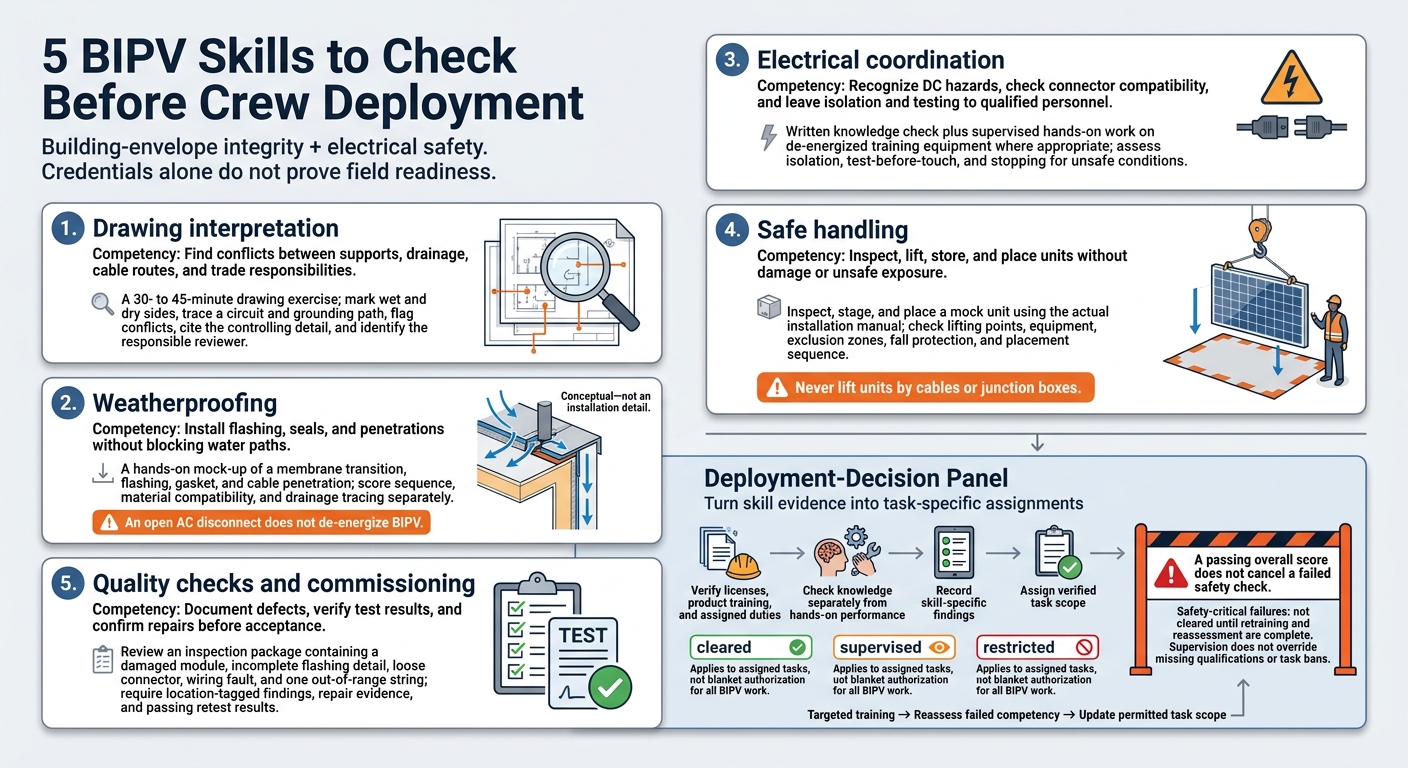
5 BIPV Skills to Check Before Crew Deployment
Installation Video of BIPV Curtain Wall
sbb-itb-aa28329
Define Roles and Check Qualifications
Create a responsibility matrix before site work starts. Use it to close task gaps before training begins. Assign roofers the substrate, flashing, and water-shedding details. Give facade installers responsibility for cladding supports, rainscreen interfaces, alignment, and movement joints. Assign electricians the wiring, grounding and bonding, disconnects, labeling, and testing. Define who can sign off for each trade before work is covered.
Structural engineers should verify loads, substrate capacity, and attachment design. Commissioning personnel should check performance, protection, test records, and handoff to the owner. Supervisors should handle sequencing, permits, inspections, and stop-work decisions. Once responsibilities are clear, confirm that each person is qualified for the assigned tasks.
Check both building-envelope and PV requirements. Record the adopted building, fire, and electrical codes, including applicable National Electrical Code provisions. Confirm local amendments with the authority having jurisdiction. UL notes that the 2021 IBC and IRC editions require BIPV roofing systems to be listed and labeled to UL 7103, so check local adoption before relying on those requirements.
Before dispatch, verify applicable licenses, role-specific safety training, manufacturer instruction for the exact BIPV product, and experience with comparable installations. Record issuing organizations, expiration dates where applicable, task restrictions, and supervisor approval. An OSHA 30 card does not authorize electrical work, qualify someone to engineer an attachment, or qualify someone to commission a BIPV system. Credentials alone do not prove readiness for fieldwork.
Require workers to demonstrate their assigned tasks under observation before working independently. Envelope skills do not establish DC-safety competence, and electrical knowledge does not establish waterproofing competence. Record whether each worker is cleared, needs supervision, or requires training. Withhold assignments when critical qualifications are missing.
1. Reading Drawings and Coordinating Trades
BIPV Installation Risks
A PV layout alone isn’t enough to coordinate BIPV. Check it against architectural plans, roof and facade elevations, wall and roof sections, structural details, roofing or waterproofing details, fire-safety documents, and electrical one-line or three-line diagrams. Missed connections between systems can lead to punctured membranes, blocked drainage, or trapped electrical equipment. Coordinate cable paths through mullions and slab edges before crews close the cavities.
Job-Ready Skills
Workers should know how to locate modules by gridline and elevation, read revisions and dimensions, identify substrates, and match field conditions to the correct detail. They also need to check that supports align with structural framing. Movement joints, access zones around junction boxes, inverters, and disconnects, and maintenance paths must stay clear.
Have workers mark wet-side and dry-side conditions on a section. Ask them to identify the water-shedding plane, drainage path, thermal or air barrier, and exterior-to-interior cable transition. They should explain how each penetration stays sealed, drained, supported, and accessible.
Trade Roles and Qualifications
Once workers can read the drawings, they need to know who should answer each question. Follow the responsibility matrix: the architect or facade designer owns layout and appearance; structural and envelope teams own loads, attachments, movement, drainage, and weather barriers. Roofing and facade crews install supports, membranes, flashings, and modules. Electrical personnel handle DC wiring, grounding, inverters, disconnects, and testing. The general contractor coordinates sequencing and sign-off.
When plans, details, and field conditions don’t match, send the issue to the responsible reviewer. Resolve it before affected work proceeds.
Practical Skills Assessment
Use the drawing set crews will receive on site for a 30- to 45-minute drawing exercise. Include a roof plan, facade elevation, wall section, structural attachment detail, electrical one-line diagram, and a flawed coordination drawing.
Build in conflicts involving supports and membranes, drainage, facade framing and cable routes, movement joints, fire-stopping, and equipment clearances. Require workers to mark wet and dry sides, trace one circuit and the grounding path, flag every conflict, cite the controlling detail, and draft a request for information that names the responsible reviewer.
Save the digital markups and score each skill separately. This lets you target training to the actual skill gap rather than relying on a single pass/fail result.
2. Weatherproofing the Building Envelope
Once crews can read the drawings, they need to keep the building envelope watertight at every penetration and transition.
BIPV Installation Risks
BIPV replaces part of the building envelope. That means every water path must function as part of a roof or facade system while protecting electrical parts. Poor sequencing, failed seals, or blocked drainage can trap water at flashing, membranes, gaskets, frame interfaces, junction boxes, and cable exits. The results can include leaks, corrosion, insulation breakdown, and ground faults. Drainage must work even when the PV system is de-energized. Training should focus on sequence, material compatibility, and continuous drainage.
Job-Ready Skills
Crews should follow the manufacturer’s installation details and identify both the water-shedding surface and the drainage plane. Install flashing, membranes, gaskets, and joints in the specified sequence. Keep sealant bead size, tooling, cure time, and temperature within specification. Maintain continuous gasket compression, keep weep paths open, and size joints to allow movement. Use compatible materials and the specified sealant on prepared, clean, dry surfaces.
Where BIPV meets roofing, masonry, metal, or glass, follow the approved detail – don’t improvise a patch. Keep sealant, debris, and cable loops out of drainage channels. Use factory-sealed cable exits or manufacturer-specified penetration components, and place junction boxes where water won’t collect.
Trade Roles and Qualifications
Roofing crews handle membranes and flashing. Facade crews handle frames, gaskets, and drainage. Electricians handle wiring, junction boxes, grounding, and penetrations. Each crew’s qualifications should match the task, including manufacturer training and experience with the actual assembly. The envelope lead should check these interfaces before they’re concealed.
Practical Skills Assessment
Pair a digital check of material selection and sequencing with a hands-on mock-up.
Ask workers to install a membrane transition, flashing, gasket, and cable penetration using project documents, then block a drain and trace water paths to exposed electrical parts.
Score sequence, material compatibility, and drainage tracing separately. Save photos, then reassess any failed skills after training. Use the results to target retraining before crews move to electrical coordination.
3. Coordinating Electrical Work and DC Safety
BIPV Installation Risks
Once the envelope is sealed, crews still need to control electrical hazards inside the assembly.
An open AC disconnect does not de-energize BIPV. Light-exposed modules built into roofs or facades, batteries, and inverters can still supply DC. Authorized workers must identify every source, apply lockout/tagout, control stored energy, and verify the absence of voltage before contact. Covering modules reduces output, but it does not prove isolation. Do not mate or separate connectors under load unless the equipment and procedure specifically allow it.
Job-Ready Skills
Crews must read string diagrams, confirm polarity, and check the series/parallel layout against the design. Qualified personnel should use approved methods and instruments to check open-circuit voltage, continuity, insulation resistance, and grounding. The electrical lead sets test voltages and pass/fail limits because incorrect testing can damage connected electronics. Record circuit IDs, readings, instrument IDs, and results.
Use connectors listed for the exact application and matched by manufacturer, model, rating, and locking design. Appearance alone is not enough. Check contacts, seals, full insertion, and positive locking. Secure cables against abrasion, strain, wind, and vibration without crushing the insulation.
Knowing how to do the work does not grant approval authority. Only personnel assigned that role may approve isolation and testing.
Trade Roles and Qualifications
Define who may isolate, test, approve energization, and commission. Qualified electrical personnel must control testing, isolation, and commissioning. Before each task, assess shock and DC arc-flash exposure. Assign voltage-rated gloves and arc-rated protection where required. PPE does not replace isolation.
Practical Skills Assessment
For workers assigned to BIPV electrical tasks, start with a written check on string configuration, connector compatibility, DC hazards, and lockout/tagout limits. Follow it with supervised hands-on work on de-energized training equipment where appropriate.
Require isolation and test-before-touch, and score each skill separately. Record whether workers stop when they encounter unexpected voltage, damaged insulation, incompatible components, or a missing protective connection. Document deployment restrictions and reassess failed skills before assigning independent work.
4. Handling and Installing BIPV Safely
Once drawings, envelope details, and electrical coordination are in place, crews still need to move and install BIPV without damaging the units or putting workers at risk.
BIPV Installation Risks
Dropping, bending, or stepping on BIPV units can crack glass, twist units, or damage internal cells. Sharp glass, unstable pallets, suspended loads, and slippery roofs also create hazards. Never lift units by cables or junction boxes, and never carry them up ladders.
Job-Ready Skills
At delivery, inspect packaging, glass, laminates, frames, connectors, junction boxes, and cables. Photograph defects, record serial numbers, and set aside any questionable units.
Store and stack materials in the approved orientation and configuration. Protect edges, and keep surfaces and electrical components free of moisture, mortar, oil, and chemicals that aren’t approved for use.
Before moving units, check that lifting equipment is approved, inspect attachments, and confirm load capacity and lifting points. Barricade exclusion zones and protect roof edges, skylights, and openings. OSHA requires fall protection for construction workers exposed to falls of 6 feet or more.
Brief the crew on the travel route, weather limits, setdown sequence, and hand signals. Stop the move if communication fails.
Trade Roles and Qualifications
Use trained operators and signalpersons for lifting. Put the roofing or envelope crew in charge of staging and substrate protection. Assign one person to oversee fall protection and protect connectors and junction boxes during lifts.
One lift director should control the lift, with one designated signalperson.
Practical Skills Assessment
Use a mock unit and the actual installation manual. Have workers inspect for damage, stage the unit, and place it safely while maintaining exclusion zones and fall protection.
Score their work against weight limits, lifting points, approved equipment, and the placement sequence. Record each failed task, provide corrective practice, and reassess.
Flag any damaged or mishandled unit before final quality checks and commissioning.
5. Checking Quality and Commissioning
After installation, crews must check electrical performance and envelope integrity before concealment and energization. These checks put earlier skills to the test: reading drawings, envelope work, electrical coordination, and safe handling.
BIPV Installation Risks
Acceptable electrical readings can hide poor flashing, blocked drainage, loose fixings, or incompatible connectors. Put affected work on hold until crews correct it. Daylight can keep modules energized, so only qualified personnel should investigate faults under the project’s electrical controls.
Job-Ready Skills
Use documented hold points for delivery inspection, pre-concealment checks, electrical and envelope testing, corrective work, retesting, and acceptance. Carry delivery damage records through each stage.
During installation, check glass and frames, fixing torque, sealant adhesion, flashing laps, open drainage, protected wiring, and compatible, fully locked connectors. Record pass/fail findings with location-tagged photos.
Qualified electrical testing must cover polarity, continuity, insulation resistance, grounding and bonding, string voltage/current, and specified I-V curves. Compare results with approved criteria. Record circuit IDs, irradiance, temperature, and instrument calibration status.
For project-required air and water tests, ASTM E283 measures air leakage, ASTM E331 measures water penetration under static pressure, and ASTM E547 measures water penetration under cyclic pressure. Follow the specified pressures, durations, and acceptance limits – not a generic hose test.
Each trade needs a clearly assigned inspection step.
Trade Roles and Qualifications
The quality manager tracks inspection records and punch lists. The envelope specialist checks weatherproofing and air-water tests. Qualified electrical personnel perform electrical testing and repairs.
Name who accepts repairs, authorizes energization, and signs off. Close out defects only after the required reinspection or retest passes. Final acceptance also requires complete test results, damaged-component reports, weatherproofing records, as-built drawings, and warranties.
Use these results to clear workers, assign supervision, or block deployment until retesting passes.
Practical Skills Assessment
Use the same inspection package crews will see on site.
Give workers a sample inspection package with a damaged module, an incomplete flashing detail, a loose connector, a wiring fault, and test data with one out-of-range string.
Score each worker’s ability to spot defects, inspect against project requirements, check installation details, compare test results with acceptance criteria, and document findings.
Require photos and punch-list entries that identify the location, responsible trade, remedy, and due date. Before closeout, require repair evidence and passing retest results. A digital assessment flags missed safety controls and documentation gaps before crews return to site.
Use Digital Assessments to Find Training Gaps
After scoring each BIPV skill separately, use digital assessments to turn the results into deployment decisions.
Check Knowledge and Hands-On Skills
Map assessment items to the five BIPV skills covered above. Tag each item by skill, product, and severity. Require workers to name the next safe action – not just select an answer.
Keep knowledge scores separate from practical results. Verify hands-on skills through supervised demonstrations on mock-ups or de-energized equipment. Record observed steps, deviations, and supervisor approval in mobile checklists, with time-stamped evidence attached.
Mark safety-critical failures “not cleared” until workers complete retraining and reassessment. Overall scores do not override task bans. Use these results to assign retraining before field deployment.
Train Workers and Reassess Before Deployment
Turn each gap into a training record. Include the worker, specific weakness, required instruction, responsible supervisor, due date, reassessment result, and permitted task scope. Reassess the failed competency rather than repeating general solar training.
Before deployment, check readiness against the actual BIPV product, current drawings, manufacturer requirements, and jobsite procedures. Review clearance whenever the product, design, equipment, or site conditions change. Link these results to staffing records and project assignments.
Pair Assessment Results With Workforce Records
Review findings by worker, crew, project, certification status, and skill. Individual records show who needs coaching. Crew and project views reveal shared gaps that could delay work.
Check credential relevance and expiration separately from demonstrated competence. When assigning crews, weigh verified findings alongside safety training, product experience, availability, and location.
ABLEMKR can bring worker records, status, and compliance data into one view. Employers must still verify BIPV readiness separately. The platform does not replace licensing, manufacturer training, or qualified supervision. Assign workers only to tasks within their verified scope.
Close Training Gaps Before Installation
Use the five skill checks to decide who can work independently and who needs supervision. Record each worker’s status as cleared, supervised, or restricted, and assign only tasks they’ve passed.
Credentials and onboarding are prerequisites – not proof that someone is ready. Keep assignments within each worker’s verified qualifications and demonstrated performance. Don’t schedule workers who still have safety or envelope gaps.
FAQs
How can I prioritize my crew’s BIPV training gaps?
Start with a workforce skill audit. Compare crew skills with project requirements and benchmarks such as the Green Buildings Career Map. Match roles to tasks in each project phase to spot gaps in reading drawings, coordinating electrical work, or weatherproofing.
Review past performance problems and rework, too. Use predictive data and standardized proficiency scales to rank skill gaps by urgency. Then schedule targeted, hands-on training or mentorship before critical project milestones.
How can digital assessments guide hands-on BIPV training?
Digital assessments, such as job knowledge tests and 360-degree feedback, show workers’ current skills and help employers spot gaps in BIPV training, including electrical coordination and weatherproofing. The results guide targeted, hands-on practice and simulations instead of generic instruction.
Digital platforms also track progress toward certification and skill development. This helps employers check whether workers are ready to move from classroom learning to supervised fieldwork.
When should I reassess my crew’s BIPV skills?
Review your crew’s building-integrated photovoltaics (BIPV) skills when equipment changes, building codes are updated, or the project scope grows. Reassessment is required when safety incidents expose performance gaps, recurring defects or failed inspections point to technical skill gaps, or certifications expire.
Regular reviews help your crew stay compliant and work efficiently. Use predictive analytics and performance data, such as quality scores and rework rates, to spot where targeted training is needed.


