
If I wanted to get hired in U.S. renewable energy work, I’d start by matching training to the job – not by picking the longest program. Solar installer jobs are projected to grow 42.1% by 2034, and wind technician jobs 49.9%. That means employers need people who can show up with the right proof: OSHA 10/30, NABCEP-aligned solar training, IREC-accredited programs, wind safety training, or an apprenticeship path.
Here’s the short version:
- If I wanted to enter solar fast, I’d look at a 5.5-day to 16-week boot camp or a short certificate.
- If I wanted solar design or a path toward NABCEP, I’d look for documented training hours and exam prep.
- If I wanted to work in wind, I’d choose a 6-month to 20-month program with climb safety, electrical work, and field repair.
- If I were already in electrical work and wanted to move into storage or microgrids, I’d look for battery and controls training.
- If I wanted paid training while I learn, I’d look at an IBEW apprenticeship.
A few names stand out in this roundup: Solar Energy International, Houston Community College, University of Houston-Downtown, Raritan Valley Community College, NC State, Illinois Solar for All, TSTC, KVCC, UTI, and IBEW training paths.
What matters most is simple: I’d check the total cost, hands-on lab time, safety training, credential path, and whether employers will recognize the program on a jobsite.
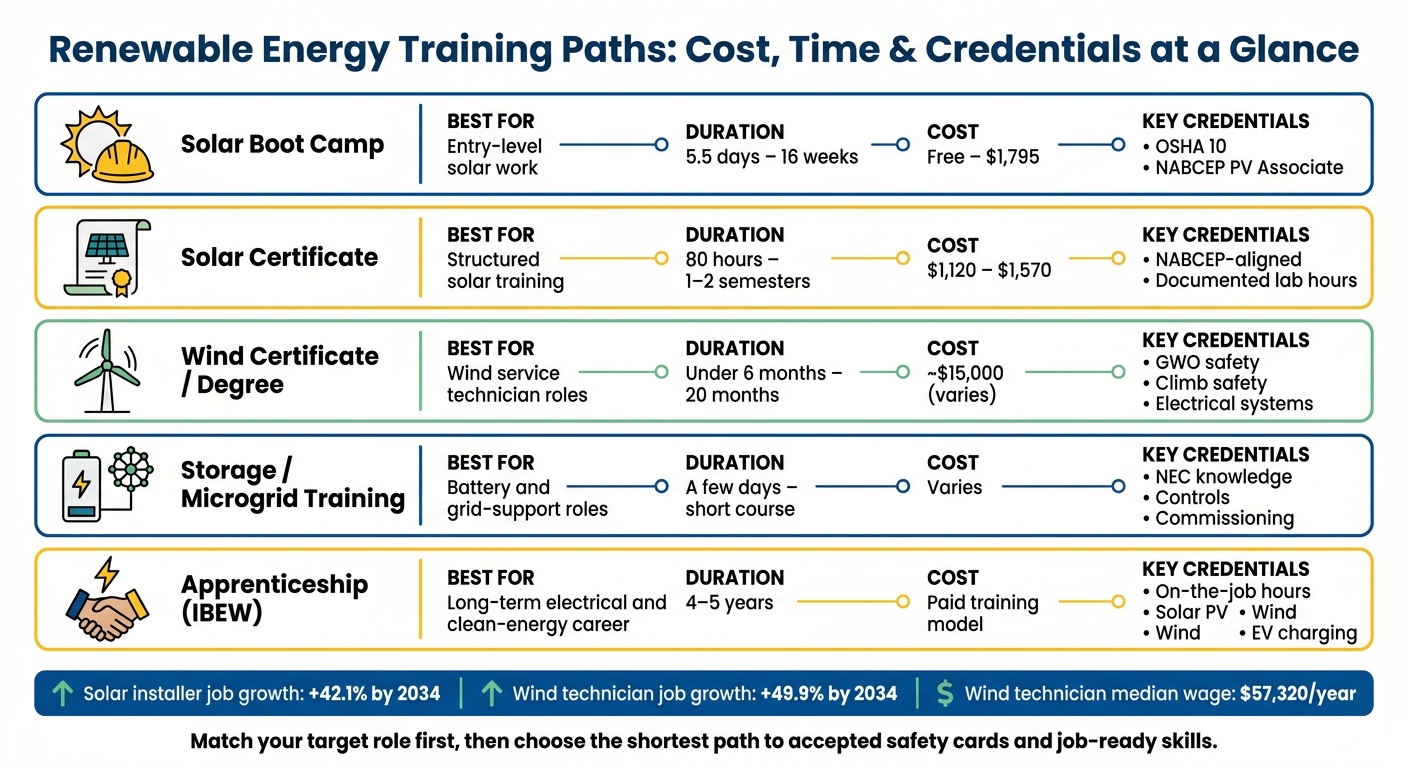
Renewable Energy Training Paths: Cost, Time & Credentials at a Glance
83 Graduates Power Illinois’ Clean Energy Future | Summer Solar 2025
Quick Comparison
| Path | Best for | Time | Typical cost | Main things to look for |
|---|---|---|---|---|
| Solar boot camp | Entry-level solar work | 5.5 days to 16 weeks | Free to about $1,795 | Hands-on install work, OSHA 10, NABCEP prep |
| Solar certificate | Structured solar training | 80 hours to 1–2 semesters | About $1,120–$1,570 | Documented training hours, lab work, exam path |
| Wind certificate / degree | Wind service technician roles | Under 6 months to 20 months | Varies; some around $15,000 | Climb safety, electrical systems, repair training |
| Storage / microgrid training | Battery and grid-support roles | Often a few days to short-course length | Varies | Battery systems, grounding, controls, commissioning |
| Apprenticeship | Long-term electrical and clean-energy work | 4 to 5 years | Paid training model | On-the-job hours, classroom instruction, site experience |
So if I were choosing today, I’d keep it simple: pick the target role first, then choose the shortest training path that leads to accepted safety cards and job-ready skills.
Top Solar Training Programs for Installers and Designers
For solar jobs, most employers want to see NABCEP-aligned training, a community college certificate, or a short boot camp.
Solar Energy International and NABCEP-Aligned Training
Solar Energy International (SEI) offers NABCEP-aligned solar training that blends online coursework, hands-on labs, and continuing education. Its 58-hour online bundle costs about $1,795 and counts toward NABCEP PVIP training-hour requirements.
If you’re planning to sit for the exam, budget for that too. PVIP exam fees come to about $500, and the retest fee is $275.
One thing matters here: before signing up, workers should make sure the program clearly documents training hours in a format NABCEP accepts. That small detail can save a lot of trouble later.
Community College Solar Certificate Programs
Community colleges can be a good fit for people who want a more structured path without committing to a long degree program.
Houston Community College’s Solar Installer certificate includes 80 contact hours and costs $1,149 in total tuition. Books and exam vouchers are separate.
University of Houston-Downtown offers online solar training across seven modules. Its Solar Energy Technician program costs $1,570, while the Solar Panel Installer program costs $1,120.
Many of these programs run in evening or hybrid formats, which can make them easier to fit around work or family schedules. In many cases, the credits are also stackable. So a solar installer certificate may later count as documented training hours toward NABCEP credentials.
Workforce Solar Boot Camps
Boot camps are often the fastest way to get into the field.
Raritan Valley Community College’s eight-day Solar PV Associate Training Bootcamp runs on weekdays from 9 a.m. to 5 p.m. It costs nothing to attend, includes a $500 stipend, and gives participants a chance to meet employers and interview for jobs. The program also prepares learners for the NABCEP PV Associate Exam.
NC State University‘s free 5.5-day solar bootcamp focuses on hands-on installation skills for entry-level jobs.
Some programs go longer and add more support. Illinois Solar for All’s Building Equity in Solar Training (B.E.S.T.) lasts 16 weeks and is open to historically disinvested communities, veterans, returning citizens, and recent high school graduates. CEJA Northern Illinois runs a 12-week free clean energy training program with hands-on work and stipends. Both programs pair job-readiness help with technical training.
Put simply, Raritan Valley and NC State are short entry-level options. Illinois Solar for All and CEJA take more time but add stipend support and extra help for priority groups.
| Program Name | Provider Type | Credential Focus | Duration | Delivery Format | Typical Cost Range |
|---|---|---|---|---|---|
| SEI PV Design & Installation (Grid-Direct) | Private solar training provider | NABCEP PVIP / PV Associate | Varies by course | Online theory with hands-on lab weeks | About $1,795 for the 58-hour bundle |
| Solar Installer Certificate – Houston Community College | Community college | NABCEP-aligned | 80 contact hours | In-person / hybrid | $1,149 tuition |
| University of Houston-Downtown Solar Programs | University program | NABCEP-aligned | Seven modules | Online | $1,120–$1,570 |
| Solar PV Associate Training Bootcamp – Raritan Valley Community College | Community college workforce program | NABCEP PV Associate | 8 days | In-person, weekdays, 9 a.m.–5 p.m. | No cost; $500 stipend |
| NC State Free Solar Bootcamp | University workforce program | Entry-level installer skills | 5.5 days | In-person, hands-on | No cost |
| B.E.S.T. – Illinois Solar for All | State-funded workforce program | Entry-level solar workforce training | 16 weeks | In-person, hands-on | No cost |
Workers who want to move into broader clean-energy jobs often add wind, storage, or electrical training after earning these solar credentials.
sbb-itb-aa28329
Wind and Advanced Electrical Training Programs
Wind turbine technicians are in a fast-growing trade, and the median annual wage is about $57,320. Employers usually want people who know electrical work, can handle climb safety, and can do field repairs.
Wind Technician Certificates and Associate Degrees
For people moving past solar, wind training adds a new layer: electrical systems, mechanical work, and height safety. Most programs teach those skills through either a certificate or an associate degree.
Texas State Technical College (TSTC) offers a 12-month certificate and a 20-month Associate of Applied Science in Wind Energy Technology. The certificate covers core electrical and wind basics. The AAS goes further with advanced troubleshooting and hands-on work such as fiberglass blade repair, gearbox maintenance, and advanced climbing and rescue.
Kalamazoo Valley Community College (KVCC) runs a competency-based Wind Turbine Technician Academy that takes under six months and costs around $15,000. It blends lecture, lab, and field work, with a focus on turbine maintenance and troubleshooting.
Universal Technical Institute (UTI) offers 7- to 8-month programs built on an electrical base, wind systems training, and climb-and-rescue instruction aligned with GWO and ANSI standards. Some colleges also let electrical students add a wind credential and finish with two related credentials, which can help people move between construction and renewable energy jobs.
| Program | Credential | Length | Hands-On Focus | Entry Requirements | Typical Job Titles |
|---|---|---|---|---|---|
| TSTC – Wind Energy Technology | Certificate / AAS | 12 or 20 months | Blade repair, gearbox maintenance, climbing and rescue | High school diploma or GED; ability to work at height and outdoors | Wind Turbine Technician, Wind Energy Technician, Entry-Level Wind Technician |
| KVCC – Wind Turbine Technician Academy | Academy certificate | Under 6 months | Condition monitoring, turbine maintenance, field work | High school diploma; comfort with heights and basic physical fitness | Wind Turbine Technician, Wind Tower Climber, Field Service Technician |
| UTI – Wind Turbine / Electrical & Wind Turbine Technology | Certificate | 7–8 months | AC circuits, wiring, turbine disassembly, climb and rescue | High school diploma or GED | Wind Turbine Technician, Electrical Technician, Construction-Focused Wind Technician |
| Minnesota West Community & Technical College | Certificate / AAS | 1–2 years | Lectures and hands-on practice | High school diploma or GED | Wind Energy Mechanic, Maintenance Technician |
A lot of these programs also expect students to be okay with climbing up to 300 feet and working outside in changing weather.
Energy Storage and Microgrid Credentials
If someone wants to move from installation work into grid support, storage and microgrid credentials can open nearby roles. ESAMTAC certifies safe assembly, commissioning, maintenance, and decommissioning of battery energy storage and microgrid systems. Training covers battery enclosures, DC conductors, grounding and bonding, and system monitoring.
These credentials fit electricians who are already shifting into renewable project work. They can lead to jobs such as:
- Energy Storage Technician
- Battery Systems Technician
- Microgrid Field Technician
- DER Specialist
For engineers and project managers, 3-day microgrid certification courses cover system architectures, control strategies, and how microgrids connect with renewables and storage.
IBEW Apprenticeships and Clean Energy Certificate Paths
Some workers want a longer path with paid training built in. That’s where apprenticeship-based routes come in. They start at helper-level work and build toward licensed clean-energy electrical jobs.
IBEW apprenticeships usually run 4 to 5 years and mix paid on-the-job training with classroom instruction in solar PV, wind systems, EV charging infrastructure, and battery storage. Training sites such as IN-Tech’s Renewable Energy Training Field give apprentices direct time with solar arrays, EV chargers, and interconnected grid systems.
Employer-led options can do the same thing. ReVision Energy‘s in-house apprenticeship is one example, giving workers a straight path into renewable electrical work. The big draw here is simple: wage growth and job-site experience at the same time. These paths matter most when employers know the credential and the worker can step onto a site and work safely.
Safety Standards, Accreditation, and Credentials Employers Check
Finishing a training program is only part of the story. Before someone sets foot on a solar array, climbs a wind tower, or works at a battery storage site, employers want proof that the worker knows the risks and can work safely.
In most cases, hiring teams look at three things: safety cards, training quality, and verified credentials.
OSHA Safety Training for Renewable Energy Work
OSHA 10-Hour and OSHA 30-Hour Outreach cards are the main safety credentials many U.S. energy sites check first. For field work, employers look for Construction (29 CFR 1926). For plant operations, they use General Industry (29 CFR 1910).
OSHA 10 is often required or strongly preferred for entry-level field workers. OSHA 30 is more common for foremen, crew leads, and site supervisors. Federal OSHA does not require these courses in every case, but states like Connecticut, Massachusetts, New York, and Rhode Island require them on public works jobs. On top of that, many contractors make them part of their own hiring rules anyway.
These courses cover the hazards workers run into every day, including:
- fall protection
- electrical safety
- lockout/tagout
- PPE
- hazard recognition
That matters on rooftop solar jobs, in wind towers, and around battery systems.
Online OSHA 10 courses usually cost $60–$100. OSHA 30 courses usually cost $150–$250. After finishing an authorized Outreach program, workers get an OSHA card. Employers often ask for a photo of that card and record the completion date. Many technical training programs build OSHA 10 into the curriculum, which helps graduates show up more prepared for site work.
The safety issues in this field aren’t abstract. A Texas clean energy worker survey found that 48% of solar workers and 60% of onshore wind workers reported heat-related illness on the job. The same survey found that 26% of solar workers reported seeing or experiencing a work-related injury.
OSHA training doesn’t make those risks disappear. What it does do is give workers the terms, habits, and steps to spot trouble and act the right way. In many hiring processes, that OSHA card is the first item checked before work begins.
IREC Accreditation and Program Quality Markers
After safety training, employers usually ask a simple follow-up: Where did you train, and can that training be trusted? That’s where IREC accreditation comes in.
IREC reviews curriculum, instructors, assessments, and alignment with current industry practice. It accredits both the training organization and specific program tracks. It also certifies individual instructors and master trainers. For employers, that can be a strong signal that a program includes hands-on lab work, current NEC knowledge, and built-in safety training. That helps cut down on skill gaps that can slow onboarding.
A few markers tend to stand out:
- IREC-accredited provider status
- IREC-certified instructors
- documented alignment with NABCEP pathways
- performance-based assessments
- use of current industry equipment in labs, such as modern inverters, racking systems, and fall protection harnesses
Programs that publish graduate placement rates give employers one more way to gauge training quality. Once that part checks out, the next issue is speed: how fast can qualified workers get onto a project?
How ABLEMKR Verifies Credentials and Matches Workers to Projects

For employers, credential verification matters most when it helps fill roles faster.
ABLEMKR matches pre-vetted workers to U.S. energy projects based on certification, OSHA status, availability, and location. Workers upload OSHA cards, technical certificates, and training records straight to their profile. Employers can then filter by the exact credentials a job needs, whether that’s OSHA 10 or 30, PV installation training, high-voltage credentials, or wind technician certification. Instead of sorting through everyone, they see workers who already meet the role requirements.
The table below shows how OSHA training, IREC accreditation, and ABLEMKR each handle a different part of staffing a compliant renewable energy site:
| Framework | What It Covers | How Workers Access It | Why It Matters for Employability and Compliance |
|---|---|---|---|
| OSHA 10/30 Outreach | Hazard recognition, fall protection, electrical safety, lockout/tagout, PPE | Authorized online providers, community colleges, employer- or union-sponsored classes ($60–$250) | Baseline site access requirement; required on many public works jobs; reduces incident risk and liability |
| IREC Accreditation | Curriculum rigor, instructor qualifications, assessment standards, alignment with NABCEP and NEC | Enrolling in IREC-accredited programs | Signals job-ready training; reduces onboarding delays; gives hiring teams confidence in skill quality |
| ABLEMKR | Credential verification, worker-project matching, onboarding workflows, compliance tracking, payroll integration | Platform; workers build verified profiles; employers post roles and filter by requirements | Enables fast crew mobilization; embeds worker status, payroll, and compliance tracking across active sites |
For project managers juggling multiple sites or trying to cover last-minute crew needs, ABLEMKR’s built-in compliance tracking and payroll workflows cut down the paper chase. It also gives them a clearer view of who is cleared to work before that person arrives on-site.
Conclusion: Picking the Right Training Program for Your Target Role
The best program is the one that lines up with the job you want most: solar installer, wind technician, or energy storage specialist. Once that target role is clear, compare programs by credential, schedule, and total cost.
Focus on role fit, credential recognition, schedule, and full cost. Put extra weight on OSHA 10, hands-on lab hours, and training that is NABCEP-aligned or IREC-accredited. If you want to get into the field sooner, a focused certificate or boot camp can help you start as a helper or junior installer, then add more credentials over time. Registered apprenticeships make more sense for people planning for the long haul, and they can run from one to five years depending on the occupation.
Those filters matter for a simple reason: employers hire based on proof, not promises. Solar hiring is still tight, so verified credentials carry weight. Workers who show documented OSHA training, accredited coursework, and role-based certifications often get up to speed on the jobsite faster.
The table below gives you a quick way to match training paths to common renewable energy roles:
| Target Role | Recommended Training Path | Key Credentials to Look For |
|---|---|---|
| Solar installer (entry-level) | IREC-accredited certificate or boot camp | OSHA 10, NABCEP PV Associate, hands-on lab hours |
| Solar designer | NABCEP-aligned program with design coursework | Design software, load calculations, NABCEP-aligned credential |
| Wind technician | Wind-specific certificate or associate degree | GWO safety modules, work-at-height, electrical safety |
| Energy storage / microgrid | Electrical systems program with storage focus | NEC knowledge, controls, manufacturer credentials |
| Crew lead / site supervisor | Any of the above + OSHA 30 | OSHA 30 |
Verified training has the most impact when it gets you to the jobsite without delay. After training, connect those credentials to active projects fast – ABLEMKR matches pre-vetted workers to U.S. energy projects based on certifications, safety training, availability, and location so employers can mobilize the right crews faster.
FAQs
Which training path should I pick first?
Choose the path that fits your background and where you want to go. If you’re new to the field, pre-apprenticeships or community college courses are a solid place to start. They can help you build basic safety habits and core electrical knowledge without jumping in too deep on day one.
If you already have trade experience, Registered Apprenticeships may make more sense. They give you a more direct route into hands-on work while helping you build job-ready skills.
If you’re aiming for specialized work or leadership positions, look at certifications like NABCEP or REP. The main thing is to match the option to your goals, whether that’s technical work, research, or management.
Do I need OSHA 10 before I apply?
Often, yes. Most energy trade roles call for OSHA 10 or OSHA 30 because the work can involve risks like electrical shock, falls, and hazardous materials.
The exact requirement depends on the employer and the project, but OSHA 10 is a smart credential to have. It can make you a stronger candidate and help you get cleared for more jobs.
It also helps to keep your certifications up to date on ABLEMKR, so employers can check your qualifications without extra back-and-forth.
How do I know if a program is worth the cost?
Judge a program by how well it lines up with the industry, how much hands-on training it gives you, and what kind of jobs people get after finishing.
Start with credentials that employers already know and ask for. In wind energy, that often means GWO. In solar, look for NABCEP. Those names matter because many hiring managers treat them as must-haves, not nice extras.
Then look at how the program teaches. You want training on actual equipment, not just classroom talk or slide decks. If a school says it prepares students for the job, it should show you the tools, systems, and safety practices people use at work every day.
It also helps to look at the program’s ties to employers. Strong industry partnerships can make a big difference when it’s time to find work. The same goes for job placement rates. If a program has a solid track record of helping students land jobs, that’s a good sign.
One more thing: pay attention to what comes next after the program ends. The best options often include paths to apprenticeships or added certifications. Over time, those can help you move into better-paying roles and build a stronger career.


