
If I had to boil this down to one point, it’s this: the best program depends on the certificate you want, the job you do, and how much time and money you can put in. Some options are built for NABCEP solar paths, some fit AEE exam prep, and some work better for finance, planning, or entry-level project work.
Here’s the short version:
- For hands-on solar work: I’d look first at IREC-accredited programs, including NCCETC CREM, Solairgen PV 203, and MREA PV 312.
- For AEE exam prep: AEE training is the most direct path for REP, SPVP, CEM, EEP, CMVP, and CAP.
- For finance and valuation: Renewable Energy Institute’s RVA is the clearest fit.
- For energy management roles: BCIT SEMAC and some AEE tracks fit better than installer-focused training.
- For low-cost online study: Coursera and the NYSERDA directory are the easiest starting points.
- For U.S. job fit: programs that cover NEC, permitting, safety, and licensing matter more than broad theory alone.
The article compares 9 options using 4 filters:
- Certification alignment
- Delivery format
- Cost
- Fit for U.S. project work
A few numbers stand out:
- AEE courses often run about $1,200 to $2,445
- Coursera can land around $150 to $300 for many course paths
- RVA includes 50+ hours across 350+ lessons
- CREM is a 40-hour / 6-week hybrid program
- University of Toronto’s certificate ends after August 31, 2026
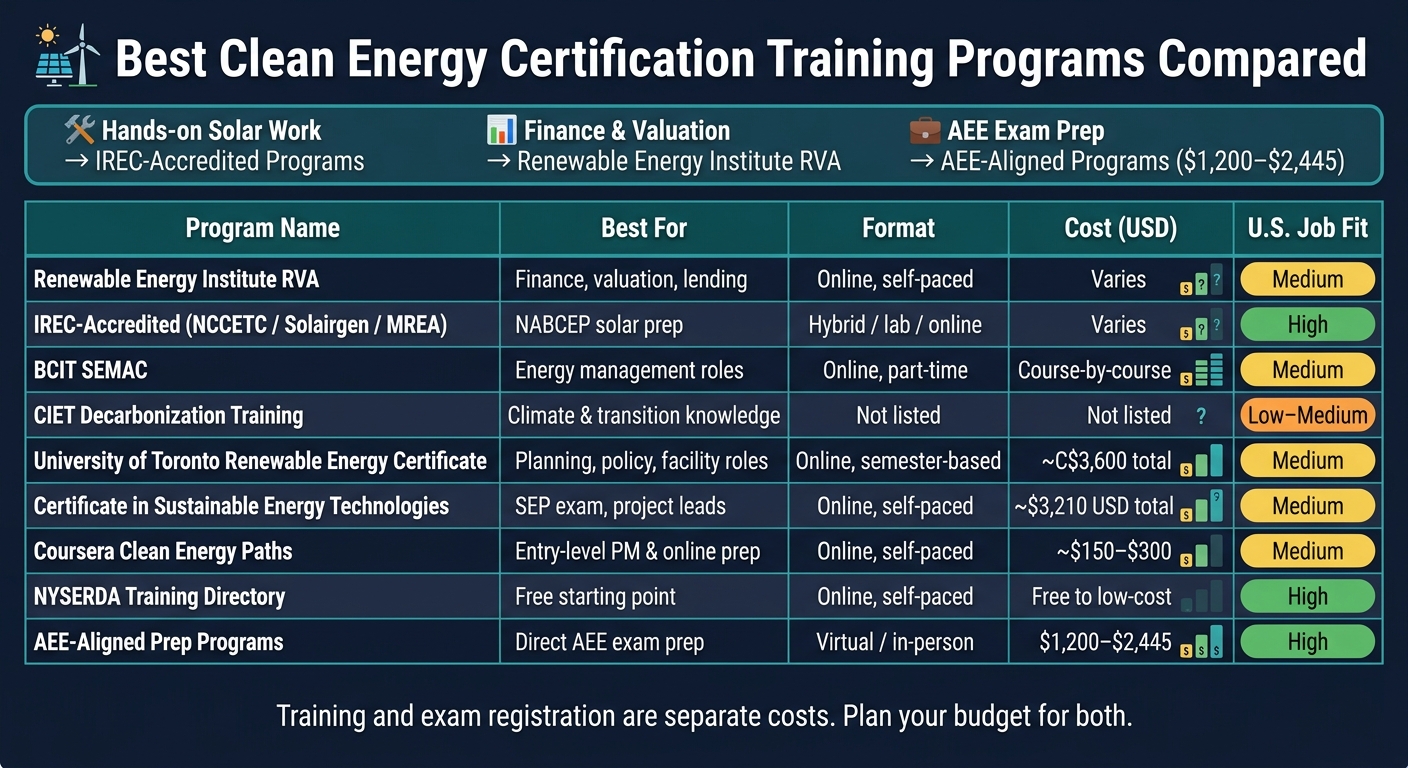
Best Clean Energy Certification Training Programs Compared
Start Your Solar Career: Training & Certification
sbb-itb-aa28329
Quick Comparison
| Program | Best For | Format | Cost Range | U.S. Fit |
|---|---|---|---|---|
| Renewable Energy Institute RVA | Finance, valuation, lending | Online, self-paced | Varies | Medium |
| IREC-accredited programs / NCCETC / Solairgen / MREA | NABCEP-related solar prep | Hybrid / lab / online | Varies | High |
| BCIT SEMAC | Energy management roles | Online, part-time | Course-by-course | Medium |
| CIET decarbonization training | General climate and transition knowledge | Not clearly listed | Not clearly listed | Low to medium |
| University of Toronto Renewable Energy Certificate | Planning, policy, facility-side roles | Online, semester-based | About C$3,600 total | Medium |
| Certificate in Sustainable Energy Technologies | SEP exam path, project leads | Online, self-paced | About $3,210 total | Medium |
| Coursera clean energy paths | Entry-level PM and online prep | Online, self-paced | About $150 to $300 | Medium |
| NYSERDA training directory | Free starting point | Online, self-paced | Free to low cost | High for U.S. basics |
| AEE-aligned prep programs | Direct AEE exam prep | Virtual / in-person | $1,200 to $2,445 | High |
My takeaway: if you need a direct U.S. certification route, I’d stay focused on NABCEP-related or AEE-aligned training. If you’re still early in the process, lower-cost online study can help you build context before you spend $2,000+ on exam prep.
Below, I’d break down which programs fit which path, where they help most, and where they fall short.
1. Renewable Energy Management and Finance – Renewable Energy Institute
The Renewable Energy Institute’s Renewables Valuation Analyst (RVA) program is a finance-first course focused on project modeling and valuation for solar, wind, hydro, and battery storage. If your certification path leans more toward project economics than on-site operations, this is where the program stands out.
Certification Alignment
AEE’s Certified Renewable Energy Professional (REP) credential covers wind, solar, thermal, geothermal, biofuels, and hydro, with a focus on financing and justifying renewable energy projects. That lines up well with RVA. It helps REP candidates build the valuation and finance skills needed to support renewable project justification.
Delivery and Time Commitment
The RVA program is fully online and self-paced, with 50+ hours of video content across more than 350 lessons. For people working full time, that format makes the workload much easier to fit into a normal week.
Best Fit
This program is a strong match for candidates in development, investment, and lending who need asset-structuring skills.
That finance-heavy angle sets it apart from the broader training options covered next.
2. IREC-Accredited Clean Energy Training Programs
These IREC-accredited programs line up closely with NABCEP Board Certifications and AEE credentials. Compared with the finance-first route, this set goes further. It covers management prep and hands-on training for NABCEP exams.
Certification Alignment
The NC Clean Energy Technology Center’s Certificate in Renewable Energy Management (CREM) is a 40-hour hybrid program built around the business side of renewable energy, with prep for project management and PV sales roles. It fits best if you’re aiming for a management-heavy track or the NABCEP PV Technical Sales (PVTS) credential.
On the technical side, Solairgen’s PV 203 course and MREA’s PV 312 lab meet NABCEP JTA and advanced credit-hour needs for exams, including PV Installation Professional (PVIP). That combination is useful if you want exam prep that doesn’t stay stuck in theory. You also get training that can help with field credibility.
Delivery and Time Commitment
The format depends on the program.
CREM runs as a 6-week hybrid course with in-person days, live webinars, and self-paced work. AEE’s Certified Renewable Energy Professional (REP) training is a 3-day program and provides 2.4 CEUs. The Certified Solar PV Professional (SPVP) training is a 4-day virtual live intensive that provides 3.2 CEUs or 32 PDH. MREA’s PV 312 is a focused hands-on lab for roof-mount systems.
If flexibility matters most, CREM stands out here.
Cost and Funding
| Program | Provider | Duration | Cost (Non-Member) |
|---|---|---|---|
| Certificate in Renewable Energy Management (CREM) | NCCETC | 40 Hours (6 Weeks) | Contact provider |
| Certified Renewable Energy Professional (REP) Training | AEE | 3 Days (24 Hours) | $2,000–$2,100 |
| Certified Solar PV Professional (SPVP) Training | AEE | 4 Days (32 Hours) | $2,345–$2,445 |
| PV System Design and Installation (PV 203) | Solairgen | 40 Hours | Contact provider |
| Roof-Mount PV Design & Installation Lab (PV 312) | MREA | 16 Hours | Contact provider |
AEE membership can cut costs by about $100 to $345 per course. One thing to watch: exam fees are usually separate from the training price, so plan for those costs too.
U.S. Job Relevance
These programs also match U.S. code and licensing needs, including the NEC. That’s a big deal if you want training that maps to the work people do on job sites, not just in a classroom.
For example, MREA’s PV 312 is approved for up to 14 credit hours toward Wisconsin Master and Journeyman Electrician licenses. Solairgen’s PV 203 covers PV system design, installation, and NEC compliance.
3. Sustainable Energy Management Advanced Certificate (SEMAC) – BCIT
SEMAC is BCIT’s nine-course online certificate built for working professionals who need hands-on energy management skills across commercial, institutional, industrial, and community facilities. In plain English, it’s a better match for people aiming at energy management work than for those looking for direct solar installation training.
Certification Alignment
BCIT built SEMAC with BC Hydro and FortisBC, which gives the program a clear tie to the kind of knowledge used by people preparing for the AEE CEM credential. That makes it a solid starting point for professionals who want energy management training before moving into that certification path.
Delivery and Time Commitment
SEMAC is offered fully online through part-time studies, so it’s set up for people who are working while they learn. Four of the nine courses also overlap with BCIT’s Building Controls and Energy Management program, which gives learners more room to shape their path.
Cost and Funding
BCIT Flexible Learning programs are priced course by course rather than as one flat program fee. SEMAC also received early funding support from Natural Resources Canada’s Office of Energy Efficiency.
U.S. Job Relevance
For U.S. readers, SEMAC makes the most sense as background training for energy management roles, not as direct prep for field certification. It fits energy managers and facility leaders who need broad training in operations and behavior change, rather than tight exam prep.
It sits much closer to management and facility operations than to the shorter, exam-focused training options that come next.
4. Energy Transition and Decarbonization Training – CIET
While SEMAC leans into energy management, CIET moves in a different direction: decarbonization strategy and climate-focused learning.
The program covers decarbonization, GHG accounting, clean energy transition, and climate change basics. That makes it a solid fit for someone who wants a clearer picture of the energy transition and the ideas shaping it.
That said, the program does not list a certification or exam tie-in. It also doesn’t provide details on delivery format, schedule, or total time required. So if you’re trying to map out a clear training path, those gaps matter.
Compared with the other programs reviewed here, CIET is the least tied to certification prep and the most concept-driven. It adds useful background on decarbonization, but it doesn’t clearly move you toward a specific credential. In plain English: it’s better suited to awareness training than exam prep.
5. Renewable Energy Certificate – University of Toronto School of Continuing Studies
Certification Alignment
If you want management depth more than test prep, this certificate fits that lane well. It sits between hands-on technical training and broad energy strategy.
The program covers energy management best practices, including ISO and ASHRAE references, along with project-planning skills like assessing energy use and comparing options with financial tools. That said, it is not a direct prep route for a specific U.S. certification exam like NABCEP or AEE’s REP.
Delivery and Time Commitment
This is a fully online, semester-based certificate that students can finish over as long as three years. So it gives you more flexibility than classroom-based programs, but it isn’t as tightly focused as exam prep options.
One big detail matters here: the program will no longer be offered after August 31, 2026.
Cost and Funding
Tuition is about C$900 per course, or roughly C$3,600 total for the full certificate.
U.S. Job Relevance
For the U.S. job market, the main draw is its fit for planning and facility-side roles, not certification exam prep. The coursework covers conventional and renewable energy sources, distributed generation, and policy frameworks, which makes it a good match for work in energy planning, policy, and project development.
Its ASHRAE and ISO references also make it especially useful for building and facility roles.
6. Certificate in Sustainable Energy Technologies
Certification Alignment
This program is one of the most direct routes to the Sustainable Energy Professional (SEP) exam from the Foundation Technologies Institute. The setup is pretty straightforward: the three required courses – Energy Fundamentals, Wind Energy Developers, and Solar Energy Developers – start with the basics of power and heat systems, then move into technology economics, project design, and project management.
There’s also a clear performance bar. Students need to earn at least 65% in each course and 75% overall. If you’re aiming for the SEP exam, that close match between the coursework and the exam content is a big plus.
Delivery and Time Commitment
If you’re working full time, the format can make or break a program. This one is fully online and self-paced, with pre-recorded lessons and email support. That means you can work through the material on your own schedule instead of trying to fit live classes into an already packed week.
Each course takes about 42 hours, for a total of 126 hours across all three courses. You get 6 months per course and up to 3 years to finish the full certificate, which gives working professionals a lot more room to pace themselves.
Cost and Funding
Each course costs CAD 1,465.75 – about $1,070 USD. For all three, the total comes to CAD 4,397.25, or about $3,210 USD.
There’s one thing that may lower the total cost: Recognition of Prior Learning can reduce the number of courses you need to take.
U.S. Job Relevance
For U.S. readers, this program lines up well with the kinds of skills used across renewable energy work because it covers wind, solar, geothermal, and smart grids. That gives it a broad base, not just a narrow focus on one technology.
It makes the most sense for project managers and developers who want to move into renewable project leadership. The next options lean more toward lower-cost and more flexible online exam prep.
7. Coursera Clean Energy Specializations and Course Sequences

For readers who want the lowest-cost, fully online path, Coursera is the most flexible next step.
Certification Alignment
Coursera offers flexible, non-credit clean-energy and project-management course sequences that can help with PMI CAPM/PMP prep. The Renewable Energy Specialization from the University of Colorado Boulder covers feasibility studies, project finance, financial modeling, and renewable project finance and lifecycle management.
If your goal is project management, two options stand out. The Google Project Management Professional Certificate includes more than 100 hours of project management education that counts toward PMI’s CAPM. The Microsoft Project Management Professional Certificate is geared toward PMP prep, with mock exams plus coverage of PMP formulas and performance domains.
These courses are non-credit, so they work best as prep rather than stand-alone credentials. In plain English: they’re a better fit for project coordination and development roles than for hands-on technical certification prep.
Delivery and Time Commitment
All of these programs are fully online and available on web or mobile, anytime. That setup is a good match for working professionals who need to study around a job or other responsibilities.
Most self-paced programs take about 3 to 6 months at roughly 10 hours per week.
Cost and Funding
Coursera costs $49 per month after a 7-day free trial, so most 3- to 6-month sequences end up around $150 to $300. Financial aid is available for most specializations and professional certificates.
One thing to watch: PMP or CAPM exam fees are not included in the subscription price.
U.S. Job Relevance
For U.S. readers, the strongest fits are the University at Buffalo solar sequence for NEC and permitting basics, plus the Google certificate for entry-level project coordination.
The Google and Microsoft certificates can also help with clean-energy project coordination, schedule control, and project delivery in construction and energy roles when paired with sector-specific training. Think of them as the project-side layer, not the field-training piece.
The table below compares the main Coursera options for clean-energy project roles:
| Program | Certification Alignment | Time Commitment | Best For |
|---|---|---|---|
| Renewable Energy (CU Boulder) | University Career Certificate | ~4 months (10 hrs/wk) | Utility and energy project coordinators |
| Solar Energy (University at Buffalo) | Non-credit Certificate | ~3 months (10 hrs/wk) | Construction and code inspectors |
| Google Project Management | PMI CAPM (100+ hours) | ~6 months (10 hrs/wk) | Entry-level clean-energy project coordinators |
| Microsoft Project Management | PMI PMP Prep | ~4 months (10 hrs/wk) | PMP candidates in energy and construction |
Readers who need more state-specific or employer-specific training should move next to the program directory that follows.
8. NYSERDA Free Online Clean Energy Training Directory
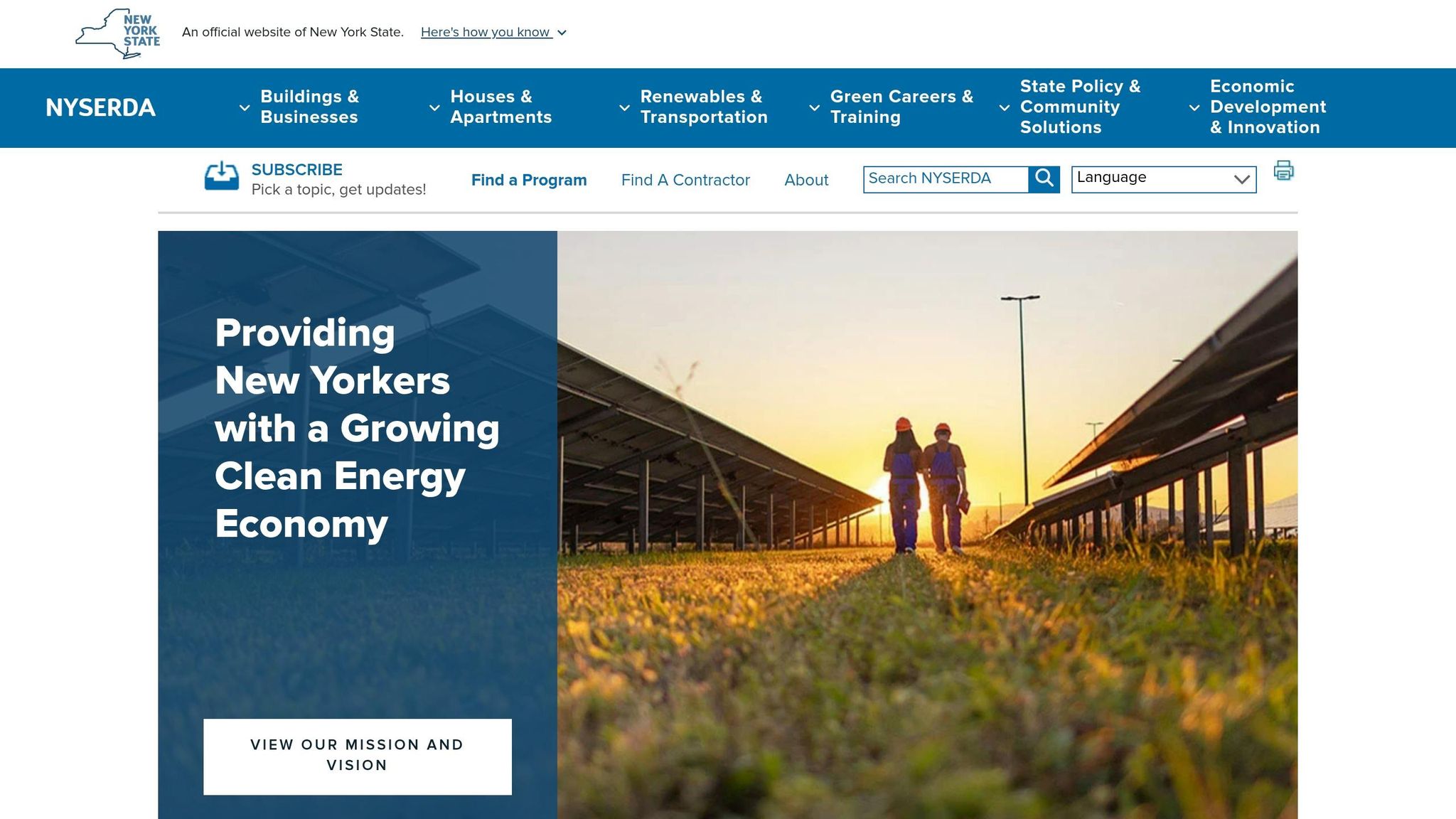
If cost is the main hurdle, the New York State Energy Research and Development Authority (NYSERDA) Free Online Clean Energy Training Directory is the easiest place to start. It gives readers a low-cost way to build background knowledge before jumping into certification prep.
The directory brings together free online courses in Solar, Wind, HVAC, Building Envelope, Electrification/Heat Pumps, Energy Efficiency, and the Business of Clean Energy.
Certification Alignment
This directory is best seen as background training, not straight exam prep. It helps build core knowledge for project and inspection work, including project coordination, auditing, and inspection.
For readers aiming at certification later, the most useful option here is Photovoltaic Solar Energy. That course covers PV project economics and financing. In plain terms, it helps you get your footing before moving into programs that are built more directly around certification exams.
Delivery and Cost
All courses are online, self-paced, and free to audit. If you want a certificate, some providers offer paid options, and pricing depends on the provider.
U.S. Job Relevance
This isn’t just useful in New York. The directory includes courses from Duke, Penn, and the Technical University of Denmark, which makes it useful for readers across the U.S..
NYSERDA’s Clean Energy Career Maps also help tie courses to job paths such as Energy Auditor and Project Coordinator.
Use this directory as baseline training, then move into exam-focused prep if you want a more direct certification path. Next, the article moves to AEE-aligned prep programs for readers who want that route.
9. AEE-Aligned Energy Management and Renewable Energy Prep Programs
For readers ready to move from background training to exam prep, AEE is the most direct next step.
AEE has trained more than 40,000 CEM candidates since 1981. This section looks at the broader AEE portfolio, with a focus on CEM, EEP, CMVP, and CAP, since REP and SPVP were already covered in Section 2. Each program is built around the related Body of Knowledge and includes workbooks and reference materials.
Certification Alignment and Delivery
AEE is the most credential-focused option for energy management and renewable energy exam prep. Each track is short, lined up with the exam, and tied to a clear credential path.
The Certified Energy Manager (CEM) comes in two versions. There’s a 5-day Premier program for a broad mix of professionals, including non-engineers, and a 5-day Accelerated version for licensed professional engineers or people with at least five years of experience.
The Energy Efficiency Practitioner (EEP) is a 2-day starting point that many people use before going after the CEM or Business Energy Professional (BEP). The Certified Measurement & Verification Professional (CMVP) covers industry best practices for checking efficiency project performance and is aimed at measurement and verification professionals and energy engineers. The Carbon Auditing Professional (CAP) is a 2-day program for leaders in charge of greenhouse-gas reporting and reduction.
One detail matters here: signing up for training does not automatically sign you up for the certification exam. You still need a separate application and fee.
| Program | Format | Duration | CEUs |
|---|---|---|---|
| EEP | Virtual | 2 days / 15 hrs | 1.5 |
| CAP | In-Person | 2 days / 16 hrs | 1.6 |
| REP | Virtual | 3 days / ~24 hrs | 2.4 |
| CMVP | Virtual | 3 days / ~24 hrs | 2.4 |
| SPVP | Virtual | 4 days / 32 hrs | 3.2 |
| Premier CEM | Virtual | 5 days / 33 hrs | 3.3 |
Formats, durations, and CEUs come from AEE course listings.
Cost and Funding
The Premier CEM costs $2,100–$2,200 for members and $2,345–$2,445 for non-members. The EEP is the lowest-cost way in, at $1,200–$1,300 for members. If you need to switch your course date or format, AEE charges a $200 transfer fee.
Veterans should also note that the CEM qualifies under the U.S. Department of Veterans Affairs WEAMS Licenses/Certifications program.
U.S. Job Relevance
The CEM has strong recognition with U.S. employers and public agencies. It is recognized by the U.S. Department of Energy for multifamily home energy audits and by the USDA for On-Farm Energy Initiative audits. It is also required by the U.S. Navy for Energy Manager roles and accepted for compliance with building ordinances in cities such as New York City, Seattle, Chicago, Boston, and Atlanta.
There’s also a state-level angle. In Utah, holding a CEM meets eligibility rules for renewable energy investment tax credits tied to solar and geothermal installations.
The next section weighs these options by certification fit, scheduling, cost, and career tradeoffs.
How These Programs Compare: Certification Fit, Scheduling, Cost, and Career Tradeoffs
After looking at each program on its own, it helps to line them up around the factors that usually drive the decision: certification fit, schedule, cost, and how the training maps to actual jobs.
The biggest differences come down to certification target, time commitment, price, and role fit. NABCEP PVIP, PVIS, and PVSI line up best with field and inspection work. AEE REP makes more sense for people working across mixed renewable portfolios, while SPVP is aimed at utility-scale project finance and project work. NYSERDA stands out as the lowest-cost way in for core knowledge.
Schedule matters too, and each option fits a different work style. AEE’s live 3- to 4-day format is a good match if you can set aside most of a work week and want a short path to exam prep. NCCETC’s CREM takes a middle route with a 6-week hybrid setup: 3 full in-person days, then weekly live and self-paced webinars plus assignments.
Here’s the side-by-side view:
| Program | Certification Alignment | Delivery & Time | Cost (USD) | U.S. Job Relevance |
|---|---|---|---|---|
| NCCETC CREM | Advanced credit hours toward NABCEP board exams | Hybrid; 6 weeks / 40 hrs | Varies by provider | Site coordination, solar business management |
| AEE REP | Prepares for AEE REP Exam | Virtual/In-person; 3 days / ~24 hrs | $1,900–$2,100 | Energy management, mixed renewable portfolios |
| AEE SPVP | Prepares for AEE SPVP Exam | Virtual; 4 days / 32 hrs | $2,100–$2,445 | Utility-scale projects, EPC contracts, LCOE |
| NYSERDA Directory | Varies by listed course | Varies by listed course | Free or low-cost | Foundational knowledge; New York-focused |
Once you’ve narrowed the time commitment, cost usually becomes the next screen. That’s especially true if you’re paying out of pocket. NYSERDA is the only option in this group that directly points workers to free or low-cost training. The AEE programs, priced from $1,900 to $2,445, are positioned more like professional development courses, so they often fit employer reimbursement plans or team training budgets better.
Compared with the earlier programs, the NABCEP-aligned routes stay closest to field work. AEE and finance-focused paths fit better for management, planning, and project development roles. For employers, the deciding factor often isn’t just course content. It’s whether someone has the certification record and safety training needed to be sent to a job site.
Pros and Cons of Each Training Program
No single program works for every certification path. The best choice depends on the credential you want, how much time you can set aside, what you can spend, and the kind of job you do. In practice, these programs differ most in three areas: depth, speed, and how closely they line up with a given exam.
| Program | Pros | Cons | Best Use Case |
|---|---|---|---|
| NABCEP Board Certifications | Best fit for technical solar roles; specialized tracks for installation, design, sales, and commissioning | Requires documented field experience and verified training hours | Solar installers, designers, and technical project leads |
| AEE CEM | Broad building-systems view; highly recognized for facility management | Intensive 5-day format; $2,100–$2,445 cost | Facility and energy managers optimizing non-residential buildings |
| AEE REP | Covers a wide range of renewables, including wind, solar, and biofuels | Breadth limits depth on any single technology | Energy consultants managing diverse renewable portfolios |
| AEE SPVP | Focused solar PV training aligned to a clear credential path | Fixed schedule limits flexibility; $2,100–$2,445 cost | Technical specialists and engineers in the solar PV lifecycle |
| NCCETC CREM | Hybrid format that counts toward NABCEP advanced training hours | Requires 3 in-person days in Raleigh, NC; total schedule spans 6 weeks | Managers needing a foundation in solar business and policy before pursuing NABCEP |
A simple way to think about it: NABCEP Board Certifications and AEE SPVP lean more toward hands-on solar work and direct credential alignment, while AEE CEM and AEE REP give you a broader view that fits management or consulting roles. NCCETC CREM sits in the middle, especially for people who want solar business and policy grounding before moving into NABCEP.
The main divide comes down to three paths: broad leadership training, short exam prep, and field-focused solar credentials.
Conclusion
Using the same four filters as above – credential, role, budget, and career stage – the best program comes down to the job you want.
If your day-to-day work is hands-on – installation, design, or commissioning – NABCEP Board Certifications are the strongest match. AEE’s REP and SPVP fit best if you want short, exam-focused prep and work as an energy manager or consultant across a broader mix of renewable projects. If you’re aiming for finance, policy, or development roles, longer academic programs tend to make more sense because they spend more time on project economics and energy strategy.
For everyone else, lower-cost online options are a smart way to get started. They work best as entry points, not as your final credential. They’re also a good pick for background training if you want to build context before spending more time and money.
One practical note: training and exam registration are separate costs, so plan your budget for both.
FAQs
Which certification fits my clean energy career goals?
The right certification comes down to the kind of work you want to do.
If you want to be in the field doing hands-on solar work, NABCEP credentials like PV Installation Professional or Solar PV Professional are strong picks. They fit well for design, installation, and maintenance.
If your path leans more toward project development, policy, finance, or energy management, Yale’s CEED or FDCE certificates and AEE’s REP or CEM certifications may be a better fit. The best choice is the one that lines up with your planned specialty.
Do I need hands-on training, or is online study enough?
It depends on the certification and the skills it covers.
Technical programs often work best with hands-on training. You can read about installation or system design online, sure, but at some point you need to get your hands dirty. That’s often where the learning clicks.
Courses centered on policy, finance, or project management are usually a better fit for online study. Those topics lean more on reading, discussion, and applied planning than physical practice.
In general, online learning may be enough for broad knowledge areas. But for technical skills like installation, maintenance, or system design, practical experience is still the safer bet.
What costs should I expect beyond course tuition?
Beyond tuition, most programs charge a separate certification or exam fee. That fee usually falls between $200 and $2,000, depending on the program.
Some schools also add a $200 transfer fee if you need to make registration changes.


