
Texas refinery contractor work spans craft trades, inspection, and turnaround support. My starting advice: match your skills to the work, then confirm pay, shift hours, travel costs, and site access before accepting.
Here’s how I group the roles covered in this guide:
- Craft trades: Pipefitters, boilermakers, welders, millwrights, industrial mechanics, insulators, scaffold builders, industrial painters, and blasters.
- Electrical and controls: Industrial electricians and instrumentation technicians.
- Inspection and testing: Welding, piping, vessel, corrosion/thickness, and coating inspectors, plus nondestructive testing specialists.
- Planning and field support: Turnaround planners, coordinators, managers, field superintendents, and safety professionals.
I’ll cover assignments around Houston–Galveston Bay, Beaumont–Port Arthur, and Corpus Christi, including maintenance, projects, and shutdowns. For pay context, Texas boilermakers averaged $34.26 per hour in May 2023 – historical data, not a current offer.
<u>A job title or credential alone doesn’t confirm you qualify.</u> I’ll explain what to check, how assignment terms affect total pay, and where ABLEMKR fits into crew dispatch.
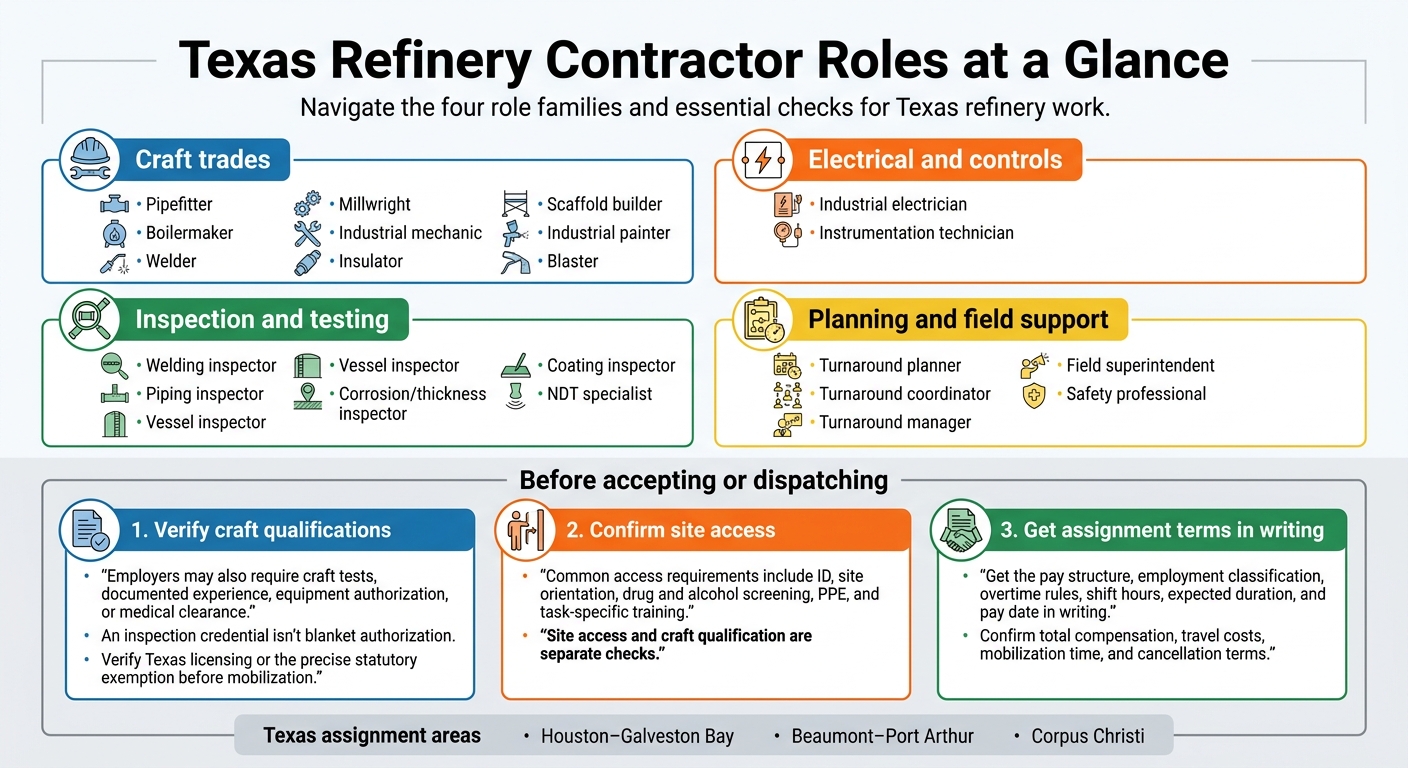
Texas Refinery Contractor Roles at a Glance
Refinery Craft Roles
Texas refineries turn to these core craft crews first for maintenance, repairs, and shutdowns.
Site access and craft qualification are separate checks. Common access requirements include ID, site orientation, drug and alcohol screening, PPE, and task-specific training. That training may cover lockout/tagout, confined-space entry, emergency response, or fall protection.
Employers may also require craft tests, documented experience, equipment authorization, or medical clearance. Confined-space, fall-protection, and respiratory requirements depend on the work – not just the job title.
| Occupation | Experience to verify | Turnaround role | Principal pay drivers |
|---|---|---|---|
| Pipefitter | Process piping, isometrics, fit-up, rigging | Replace piping and valves; align and test systems | Journeyman status, specialty piping systems, overtime |
| Boilermaker | Vessel entry, exchangers, drawings, rigging | Open vessels; repair internals; prepare for inspection | Pressure-vessel and piping work, difficult access, outage length |
| Welder | Current qualifications matching the assigned procedure | Repair piping, structures, and pressure equipment | Specialty alloys, code work, night shifts |
| Millwright | Machinery installation, precision alignment, drawings | Set, level, and align equipment | Precision skills, equipment specialization, overtime |
| Industrial mechanic | Pump, compressor, and turbine troubleshooting | Overhaul equipment and resolve mechanical faults | Equipment expertise, emergency work, shifts |
| Insulator | Insulation, blankets, cladding; removal-specific training | Expose equipment for inspection, then restore insulation | Complex removal, height, overtime |
| Scaffold builder | Task training, load awareness, fall protection | Build and modify access for other trades | Scaffold complexity, height, compressed schedules |
| Industrial painter | Coating application, equipment, specification reading | Apply corrosion protection and vessel linings | Specialty coatings, confined-space work, shifts |
| Blaster | Surface preparation, blast equipment, containment | Remove failed coatings and establish surface profile | Required finish, hazardous-coating controls, overtime |
Pipefitters, Boilermakers, and Welders
Corrosion repairs and equipment replacement drive demand for these trades. During outages, crews may work nights, weekends, and extended shifts. Check drawing skills, fit-up, rigging responsibilities, and inspection hold points before assigning work.
For welders, a certification label alone isn’t enough. Record the process, position, material, thickness range, procedure, and continuity status. Hot work in confined spaces also requires ventilation, an attendant, communication, and rescue planning.
According to BLS, Texas boilermakers earned a mean $34.26 per hour in May 2023. That’s historical wage data, not a current contractor offer. A trade-market source reports $35–$55 per hour for specialized ASME– or AWS-qualified pipe welders in high-demand Gulf Coast markets. Use these figures as reference points, not guaranteed rates.
Millwrights, Industrial Mechanics, and Insulators
Equipment installation drives millwright demand. Breakdowns and overhauls drive mechanic assignments, sometimes outside normal shifts. Employers may combine these job classifications, so confirm the tools, tolerances, drawings, energy-isolation training, and craft test required.
Insulation crews typically arrive before inspection and return after repairs. Work at height and respiratory hazards require task-specific controls. General insulation experience does not qualify someone for hazardous-material removal. That work requires separate training, medical clearance, fit testing, and removal procedures.
Scaffold Builders, Industrial Painters, and Blasters
Check task training, competent-person oversight, load limits, inspection and site-tagging rules, and fall protection. A scaffold card does not authorize a worker to make site-specific scaffold changes.
Staffing follows the work sequence: access, containment, preparation, inspection, coating, and curing. Environmental limits and cure times affect the schedule. Repeated scaffold changes and ventilation needs also determine crew requirements.
These crews often work alongside electricians, inspectors, and planners on the same outage schedule.
sbb-itb-aa28329
Technical and Turnaround Support Roles
Staff these roles by system, inspection scope, and restart responsibility – not job title. These teams handle the inspection, testing, acceptance, and restart checks that follow craft work. In Texas refineries, demand centers on outages, commissioning, and closeout, when restart risk is highest.
| Occupation | Core scope | Qualifications to verify | Typical timing | Pay drivers |
|---|---|---|---|---|
| Industrial electrician | Motor controls, cables, grounding, electrical testing | Texas license or documented exemption; refinery classified-area experience | Isolation, execution, restart | Controls troubleshooting, night coverage, energization duties |
| Instrumentation technician | Transmitters, analyzers, control valves, calibration, loop checks | Testing records; DCS, PLC, and shutdown experience | Execution through commissioning and restart | System expertise, commissioning history, restart deadlines |
| Welding inspector | Weld examination and repair acceptance records | Assignment-specific credentials and code knowledge | Fabrication and repair hold points | Code requirements, acceptance responsibility |
| Piping inspector | Process piping condition and repair records | API 570 where required; relevant experience | Scope development through repair closeout | Piping complexity, reporting responsibility |
| Vessel inspector | Pressure vessels and exchanger inspection | API 510 where required; equipment-specific knowledge | Opening, inspection, repair acceptance | Equipment risk, code requirements |
| Corrosion/thickness inspector | Wall-thickness readings and corrosion records | Ultrasonic qualification and employer authorization | Inspection windows and follow-up | Measurement scope, reporting workload |
| Coating inspector | Surface preparation and coating-thickness checks | Coating-specific qualifications and specification knowledge | Preparation through coating acceptance | Lining complexity, inspection hold points |
| NDT specialist | Ultrasonic, radiographic, magnetic-particle, or penetrant testing | Method-specific certification and employer authorization | Peak execution and repair verification | Advanced methods, interpretation duties |
| Turnaround planner | Scope, estimates, materials, work packages, maintenance-system records | Refinery planning, drawings, and scheduling-system experience | Months before shutdown through closeout | Unit complexity, planning-system expertise |
| Turnaround coordinator | Contractor interfaces, constraints, schedule updates | Field coordination and refinery maintenance experience | Preparation through restart | Interface volume, schedule pressure |
| Turnaround manager | Budget, contractor performance, owner communication | Comparable outage leadership experience | Planning through completion | Budget size, decision authority |
| Field superintendent | Crew deployment, sequencing, field execution | Multi-craft supervision and unit experience | Mobilization through restart | Crew count, critical-path responsibility |
| Safety professional | Hazard assessments, permit support, training, field checks | Relevant process-safety experience; credentials required by scope | Planning through restart | High-risk work, contractor volume, leadership scope |
Industrial Electricians and Instrumentation Technicians
Verify Texas licensing or the precise statutory exemption before mobilization. Refinery work isn’t automatically exempt, and new construction or contractor arrangements can change the requirements. The Texas Journeyman Industrial Electrician license generally requires 8,000 hours of supervised apprenticeship experience under a Texas master electrician, plus an examination.
For instrumentation hires, request calibration records with as-found and as-left readings, loop-check documentation, and commissioning history. Confirm restart duties and shift coverage before setting deadlines.
Inspectors and Nondestructive Testing Specialists
Staff inspection work around hold points and repair signoff, not headcount alone. An inspection credential isn’t blanket authorization. NDT certification must match the method, level, and employer authorization required for the job.
Match qualifications to inspection hold points, reporting workload, and repair-acceptance authority. Equipment deficiencies outside acceptable limits must be corrected before return to service.
Turnaround Planners, Managers, and Safety Professionals
Planning and coordination begin months before shutdown, with schedules tightening as execution starts. Leadership roles are often paid through a salary, day rate, or project-based arrangement.
OSHA 30 is awareness training, not a professional certification. CSP is a separate credential with eligibility and exam requirements. Assign pre-startup safety review and punch-list responsibilities before execution.
Pay, Assignment Terms, and Crew Deployment
Once roles are set, assignment terms determine who can mobilize and how soon. Second-shift work and urgent dispatch affect crew availability during refinery shutdowns and urgent maintenance. In Greater Houston, same-day mobilization can shorten timelines, so crews need to confirm the schedule and site before committing.
What Workers Should Check Before Accepting
Get the pay structure, employment classification, overtime rules, shift hours, expected duration, and pay date in writing. For second-shift assignments, confirm the exact hours – and whether overtime is available, not guaranteed.
Before leaving, confirm that background screening is cleared and who supplies tools and PPE. Verify OSHA 10 or 30 and any required site-specific training before reporting.
What Employers Should Prepare Before Deployment
Create a role-by-role labor plan that connects outage milestones with the skills each crew needs. Before dispatch, verify credentials, safety training, availability, completed onboarding, and site-specific requirements.
Budget beyond base pay. Include overtime, taxes, workers’ compensation, training, and onboarding. Adjust the budget when dates move or urgent repairs change the schedule.
Using ABLEMKR for Workforce Deployment
ABLEMKR supports fast refinery dispatch by matching pre-vetted workers based on certifications, safety training, availability, and geolocation. It also includes onboarding, compliance, and payroll tracking. For Greater Houston mobilizations – including Baytown, Pasadena, and Galveston – confirm role availability and site-specific qualifications before dispatch.
Conclusion: Plan Crews and Confirm Assignment Terms
Match crews to the unit, work package, and outage window. The scope of work – not location alone – determines which roles the crew needs.
Once those roles are set, employers should book critical trades and supervisors months ahead. Keep confirmed, pending, and backup crew rosters updated through mobilization as outage plans change.
Workers should verify qualifications and get assignment terms in writing before accepting. Confirm total compensation, travel costs, mobilization time, and cancellation terms. Headline pay alone doesn’t account for schedule risk.
FAQs
How does refinery contractor demand vary across Texas energy hubs?
Demand depends on where industries cluster and when projects start and finish. Greater Houston, including Baytown and Pasadena, has high demand for turnaround and shutdown crews, including pipefitters, welders, and instrumentation technicians.
In the Permian Basin, an aging workforce and severe labor shortages delay project delivery. Across these regions, employers increasingly turn to local and regional workers as fewer workers are willing or able to relocate.
How can I compare turnaround offers with different travel allowances?
Compare turnaround offers using total costs, not just the day rate:
Total cost = (Headcount × Day Rate × Days) + Overtime + Per Diems + Travel + Insurance
Include base pay and all additional financial incentives so you’re comparing offers on the same basis.
Per diems often run $100–$150 per day in high-cost energy hubs like the Permian Basin. For travel, account for mileage reimbursements at the latest IRS rates or mobilization flight costs, which can vary.
What happens if my refinery shutdown assignment is delayed?
A delayed refinery shutdown assignment typically means more downtime, higher costs, and possible regulatory risks.
Real-time workforce visibility and fast deployment tools help you adjust staffing and address bottlenecks. ABLEMKR helps reduce delays with access to pre-vetted, certified workers, simpler compliance processes, and crew or schedule changes that are easier to communicate and put into action.


