
If you need renewable trade workers fast, don’t rely on one hiring source. In most cases, I’d use union halls for large craft jobs, mobile hiring tools for fast staffing and compliance, referrals for known workers, schools for entry-level pipeline, and subcontractors for specialty scopes.
Clean energy jobs grew 3x faster than the total U.S. workforce in 2024, and construction roles now make up more than 1.6 million clean energy jobs. At the same time, the U.S. is short about 80,000 electricians, with a gap that could hit 107,000 to 224,000 by 2030. So the hiring channel you pick can affect crew start dates, payroll setup, safety checks, and whether work stays on schedule.
Here’s the short version:
- Union halls fit utility-scale, PLA, high-voltage, and crane-heavy jobs
- Staffing platforms and mobile apps fit remote sites, surge hiring, and short lead times
- Referral networks fit trusted repeat hires and fast crew add-ons
- Local schools and apprenticeships fit long-term workforce supply
- Subcontractor partners fit electrical, civil, mechanical, and structural scopes
What I’d look at first:
- Time to fill
- License and cert checks
- Local worker access
- Travel readiness
- Payroll and compliance support
- Union or non-union fit
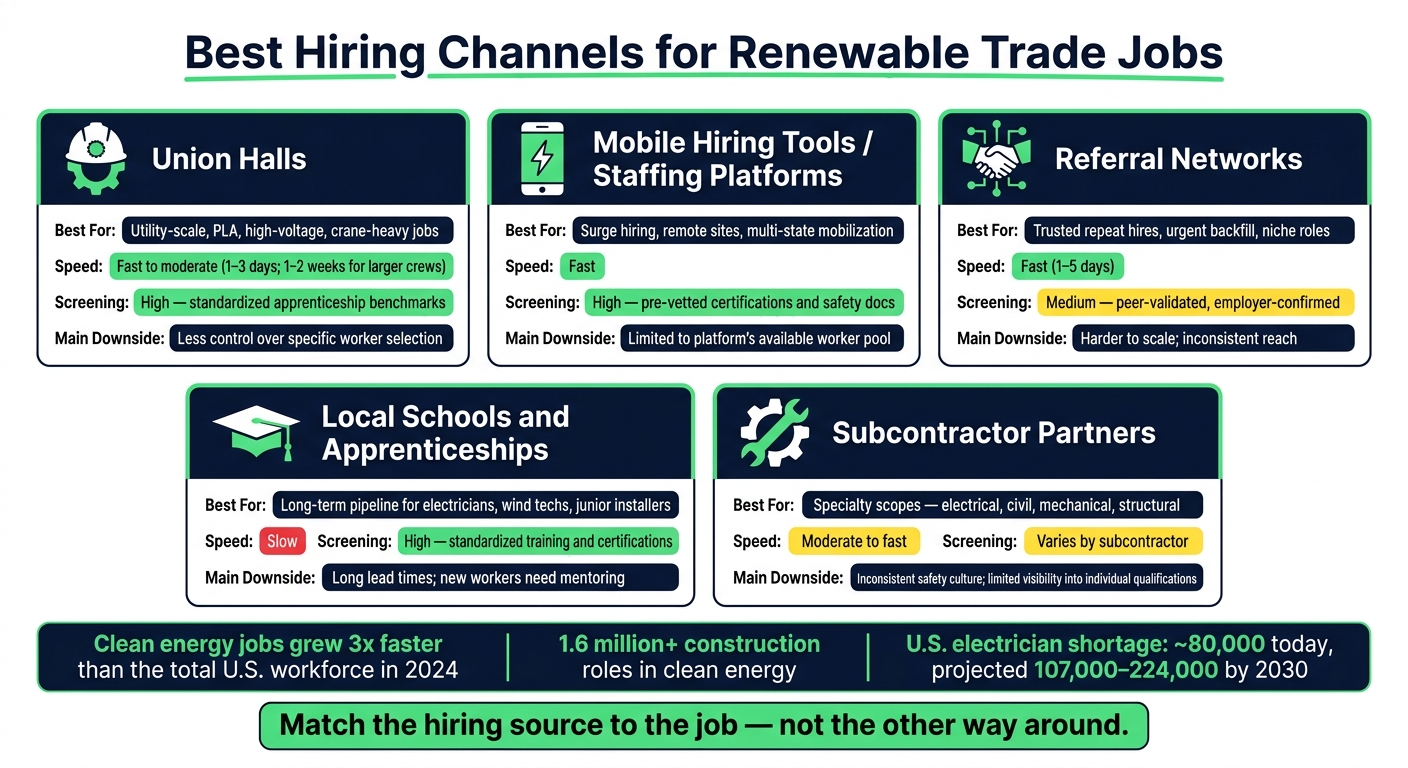
Best Hiring Channels for Renewable Trade Jobs: Quick Comparison Guide
Quick Comparison
| Hiring channel | Best for | Speed | Screening level | Main downside |
|---|---|---|---|---|
| Union halls | Large utility-scale and PLA jobs | Fast to moderate | High | Less say over each worker |
| Mobile hiring tools | Fast staffing across sites | Fast | High | Limited to workers on the platform |
| Referral networks | Known workers and urgent backfill | Fast | Medium | Harder to scale |
| Schools/apprenticeships | Entry-level pipeline | Slow | High | Takes time to develop workers |
| Subcontractors | Specialty work scopes | Moderate to fast | Varies | Oversight can be uneven |
If I had to sum it up in one line, it’s this: match the hiring source to the job, not the other way around.
sbb-itb-aa28329
Union Hiring Halls for Renewable Energy Construction
For jobs where dispatch rules and credential checks matter most, union halls are often the first stop. They give contractors a set path for staffing large renewable and grid projects. The contractor sends in the trade needed, crew size, start date, and required credentials. Then the hall fills that request from its out-of-work list under the collective bargaining agreement (CBA).
How Union Hall Referrals Work on Energy Jobs
When a contractor needs workers for a utility-scale solar or wind project, they send a formal request to the hall. That request covers the trade, headcount, jobsite location, shift details, and needed credentials, such as OSHA training, NCCCO certification, CDL, tower-climbing, or medium-voltage experience. The hall reviews its out-of-work list, finds qualified members, and dispatches them with a referral slip or digital referral. If a referral doesn’t meet the job requirements, the contractor can reject that worker and ask for a replacement.
For renewable work, the trades most often dispatched include:
- IBEW electricians for inverter wiring and substation work
- LIUNA laborers for site prep and trenching
- ironworkers for turbine towers and racking structures
- IUOE operating engineers for crane operation and earthwork
When Union Halls Work Best for Renewable Trades
Union halls tend to work best on utility-scale projects, PLA-governed jobs, and high-voltage or crane-heavy sites where safety paperwork and credential checks are required. Vineyard Wind 1, for example, was built under a PLA with Massachusetts Building Trades.
One big plus is the apprenticeship pipeline. Union apprenticeships mix classroom instruction with thousands of supervised on-the-job hours. For contractors, that means a steadier skill baseline across multi-state projects, even when crews come from different local markets. Standardized union safety training has also been linked to 13% lower accepted workers’ compensation injury claims and about 12% lower workers’ comp costs.
There is a tradeoff, though. Union halls are not always the best fit for contractors that want maximum flexibility or full say over each hire, especially when the hall’s bench is tight during peak construction seasons.
Comparison Table: Union Halls vs. Other Hiring Channels
| Channel | Best Use Case | Verification Level | Union/Non-Union | Typical Lead Time | Main Limitation |
|---|---|---|---|---|---|
| Union Hiring Halls | Utility-scale projects, PLA-driven jobs, high-voltage and crane-intensive work | High – standardized apprenticeship benchmarks | Primarily union-signatory or PLA-driven | 1–3 days; 1–2 weeks for larger crews | Less control over specific worker selection; dispatch rules apply |
| Staffing Platforms / Mobile Apps | Fast-moving renewable projects, crew scaling, non-union or mixed sites | High – cert and safety doc verification built in | Both | Fast – designed for schedule pressure | Limited to the platform’s available worker pool |
| Referral Networks | Trusted repeat hires, niche trade roles, remote or short-notice projects | Moderate – peer-validated, employer-confirmed | Both | 1–5 days depending on network depth | Inconsistent reach; harder to scale quickly |
When halls can’t mobilize crews fast enough, staffing platforms and mobile apps usually step in to cover the gap.
Staffing Platforms, Mobile Apps, and Workforce Deployment Tools
Where Staffing Platforms Fit in Renewable Labor Hiring
Staffing platforms help crews get out the door fast when a project needs non-hall labor, surge support, or coverage for remote sites. They step in where old-school recruiting tends to slow down: outage response, shifting schedules, and short-term craft roles spread across more than one jobsite.
A good platform checks for OSHA 30, NCCER, and site-specific credentials before dispatch. That cuts wasted time and keeps the process tighter when deadlines are close. This is exactly where mobile-first deployment tools do their best work.
ABLEMKR for Mobile-First Energy and Infrastructure Hiring
ABLEMKR fits this setup by putting screening, onboarding, and dispatch into a mobile workflow. It was built for fast field hiring with credential checks in place. The platform matches pre-vetted workers by certification, safety training, availability, and location, so employers don’t have to dig through applicants who can’t do the job when a crew needs to mobilize in a matter of days.
Workers can accept jobs and finish onboarding right from their phones. On the employer side, teams get real-time worker status, payroll workflows, and compliance tracking in one mobile-first platform.
ABLEMKR works well for:
- solar farm construction
- wind turbine maintenance campaigns
- battery storage buildouts
- transmission upgrades
It’s a solid option for any project where mobilization speed and compliance records both matter.
Comparison Table: Staffing Firms, Labor Providers, and Mobile Hiring Tools
| Channel Type | Best Project Types | Geographic Reach | Worker Verification | Speed of Deployment | Compliance Support |
|---|---|---|---|---|---|
| Traditional Staffing Firms | Large-volume renewable construction, local-hire ratio projects | National, with local branch networks | Moderate – varies by firm and role | Moderate | Basic to moderate; depends on firm |
| Crew Suppliers | Short-duration craft needs, outage support, immediate coverage | Regional to national | Variable – depends on the provider | Fast for ready crews; slower for specialized roles | Limited; employer typically handles compliance |
| Mobile Hiring Tools (e.g., ABLEMKR) | Surge hiring, remote site staffing, multi-state mobilization, safety-sensitive roles | National, with geo-location-based matching | High – pre-vetted by certifications, safety docs, and availability | Fast | Integrated – compliance tracking, documentation, and onboarding built in |
For faster local sourcing, referral networks, schools, and subcontractor partners can help expand the labor pool even more.
Referral Networks, Schools, and Subcontractor Partners
When job boards and dispatch systems don’t cover everything, contractors usually fall back on three things that still matter a lot: people they trust, training pipelines, and subcontractor crews.
Referral Networks for Fast, Trusted Renewable Hires
When a project needs installers in a hurry, foremen usually start with people they already know. They call workers they trust for safety, reliability, and pace. That’s the core idea behind referral networks in renewable trades. Supervisors and crew leaders reach out to workers they’ve managed before – people whose work habits and output they’ve seen up close, and who can step onto a site and meet expectations on day one.
A typical referral bonus runs from $250 to $1,000. It’s often paid in two parts: half at 30 days and half at 90 days, with attendance and safety tied to the payout.
That said, a referral isn’t a free pass. Referred workers still need:
- I-9 verification
- Required background or MVR checks
- Drug testing when required
- Proof of OSHA 10/30, fall protection, NCCER, or state licenses
HR still makes the final hiring call.
For longer-term labor needs, schools and apprenticeships add the next layer of supply.
Local Schools and Apprenticeships for Entry-Level Renewable Talent
Community colleges and trade schools now offer renewable-focused training, while registered apprenticeships help build a longer-term flow of solar installers, electricians, and wind techs. Clackamas Community College, for example, offers a six-month renewable energy technology program that prepares students for roles such as solar installer and wind turbine technician.
Registered apprenticeships are listed on Apprenticeship.gov for jobs like solar photovoltaic installers (ONET 47-2231.00). These are paid, multi-year apprenticeship paths that can lead toward journeyman electrician status or more specialized wind technician roles.
This route takes time. It won’t solve next week’s crew shortage. But for contractors with a steady renewable project mix, it can create a dependable stream of workers over time.
When the job calls for a niche scope on an active site, subcontractor partners often fill that gap faster.
Subcontractor Partners as Built-In Craft Labor Networks
Specialty subcontractors – electrical, civil, mechanical, and structural – bring more than tools and know-how to a renewable job. They bring crews with them.
For example, an electrical subcontractor that has already worked on several utility-scale solar farms may show up with a core team that knows tracker installation, medium-voltage terminations, and the site’s safety culture. For the prime contractor, that means access to a ready-made labor network for specialized work without having to recruit each worker one by one.
The catch is oversight. It helps to use preferred subcontractors with strong safety records, clean incident history, and solid schedule performance. Before mobilization, contractors should also require rosters and training documents.
| Channel | Speed | Quality Control | Best Use Case | Main Risk |
|---|---|---|---|---|
| Referral Networks | Fast | High (supervisor-vouched, but needs formal verification) | Immediate crew expansion on familiar scopes | Skipping credential checks; reduced diversity if unchecked |
| Local Schools & Apprenticeships | Slow | High (standardized training and certifications) | Long-term pipeline for electricians, wind techs, and junior installers | Long lead times; new workers need significant mentoring |
| Subcontractor Partners | Moderate to Fast | Depends on subcontractor oversight | Specialized scopes like electrical, civil, structural, and mechanical work | Inconsistent safety culture; limited visibility into individual qualifications |
Conclusion: Choosing the Right Hiring Mix for Renewable Trade Jobs
After looking at the main hiring channels, the next move is simple: match each one to the job in front of you. No single channel does it all. The right mix comes down to project size, hiring speed, location, trade mix, and compliance demands.
A rural wind farm might lean on union travelers and a mobile hiring tool. A rooftop solar project in a major city might depend more on referrals and subcontractors. That mix matters because the labor market still makes key craft roles hard to fill.
Bottlenecks still show up in electrician, pipefitter, and power-line roles. So if you staff a full project through just one channel, things can fall apart fast.
Use each channel where it works best:
- Union halls for structured craft labor
- ABLEMKR for fast mobile deployment and compliance
- Referrals for trusted hires
- Schools and apprenticeships for pipeline growth
- Subcontractors for specialized scopes
That channel mix is the practical answer for renewable trade hiring.
FAQs
Which hiring channel should I use first?
Start with ABLEMKR if you need fast hiring. Its mobile-first matching helps you find pre-vetted workers based on certifications, safety training, location, and availability.
That matters when you’re filling urgent jobs, staffing shutdowns, or sending crews to remote sites. It can help move onboarding, compliance, and payroll along with less friction. You can still build out long-term channels like apprenticeship programs later.
How can I verify licenses and safety certifications faster?
Use automated workforce management platforms to speed up license and safety certification checks. Instead of chasing paper forms and spreadsheets, you get real-time credential tracking that shows certification status and expiration dates at a glance.
These systems can also send renewal alerts, cross-check credentials against industry databases, and give teams immediate visibility into a worker’s status before they arrive on-site.
What hiring mix works best for remote renewable projects?
For remote renewable energy projects, a hybrid approach usually works best. Leaning on just one channel is rarely enough, especially when you’re dealing with remote-site logistics, certifications, and tight timing.
A better move is to combine digital hiring platforms like ABLEMKR with local partnerships, including community colleges, technical schools, and apprenticeship programs. Then layer in flexible contract staffing and regional workforce mapping to fill gaps and scale crews as each project phase shifts.


