
If you’re aiming for a career in renewable energy, certifications can be your ticket to better opportunities, higher pay, and job readiness. Here’s a quick rundown of the five key certifications that can help you stand out:
- Certified Renewable Energy Professional (REP): A broad certification covering solar, wind, biomass, geothermal, and energy storage. Ideal for leadership roles in renewable energy projects.
- NABCEP PV Installation Professional (PVIP): Known as the gold standard for solar professionals, this certification focuses on the entire lifecycle of solar projects.
- Certified Energy Manager (CEM): Geared toward optimizing energy use in facilities and integrating renewable solutions, often required for energy-related roles.
- Global Wind Organisation (GWO) Basic Safety Training: A must-have for wind turbine technicians, ensuring safety in high-risk environments.
- Certified Sustainable Development Professional (CSDP): Focused on sustainability, energy efficiency, and waste management, perfect for project planning and environmental roles.
Quick Comparison:
| Certification | Focus Area | Career Roles | Cost Range | Time to Complete |
|---|---|---|---|---|
| REP | Renewable energy systems | Leadership in energy projects | Varies | 1–6 months |
| NABCEP PVIP | Solar energy | Solar installer, consultant | Varies | Training + exam |
| CEM | Energy optimization | Energy manager, consultant | $435–$595 | ~2 months |
| GWO Basic Safety Training | Wind energy safety | Wind turbine technician | Varies | Short courses |
| CSDP | Sustainability | Project manager, environmental analyst | Varies | Training + exam |
These certifications not only validate your expertise but also align with industry and regulatory standards, making you a strong candidate in the renewable energy market. Let’s dive deeper into each certification.
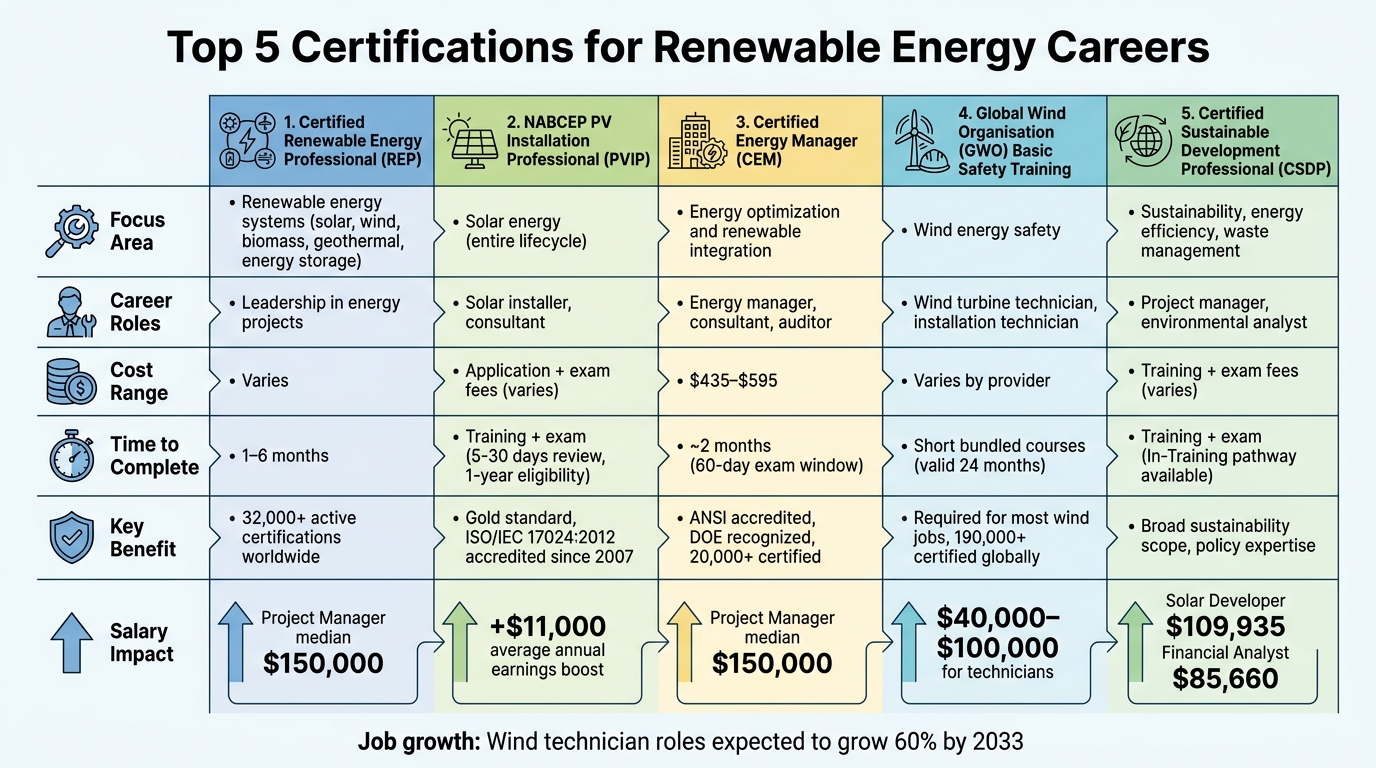
Top 5 Renewable Energy Certifications Comparison Chart
Start Your Solar Career: Training & Certification
sbb-itb-aa28329
1. Certified Renewable Energy Professional (REP)
The Certified Renewable Energy Professional (REP) certification is designed to meet the growing demand for expertise in the renewable energy field. This credential stands out because it covers a wide range of renewable systems, including solar, wind, biomass, geothermal, and energy storage. Unlike certifications that focus on just one area, the REP provides a broader perspective, which is especially valuable as energy companies increasingly shift toward sustainable solutions. It’s a robust way to validate skills across multiple renewable energy disciplines.
Recognition in the U.S. Renewable Energy Market
Since 1977, the Association of Energy Engineers (AEE) has issued the REP certification, which has gained substantial recognition with over 32,000 active certifications worldwide. Employers, government agencies, and academic institutions hold AEE credentials in high regard. As Tom Swallow from Energy Magazine points out:
"energy certifications set professionals apart from the rest and help develop renewable-focused careers".
This certification prepares professionals for leadership roles in sustainability and renewable energy projects, making it a valuable asset in the industry.
Cost of Certification
The cost of obtaining the REP certification depends on factors like membership status and location. For detailed pricing, it’s best to consult the AEE website. If you don’t yet meet all the qualifications, you can apply for the "In-Training" designation while you work on fulfilling the requirements.
Time Required to Complete
Earning the REP certification involves three key steps: meeting eligibility requirements, completing an approved training program through AEE or an authorized partner, and passing a comprehensive exam. Exams are available both online and in person after training. The time it takes to complete the process depends on your prior experience and how quickly you finish the training.
Career Impact and Job Opportunities
This certification can significantly enhance your career prospects. The REP credential demonstrates your readiness to take on strategic roles in renewable energy initiatives, making you more attractive to employers looking for leaders in the transition to sustainable energy systems. It also highlights your expertise and credibility, helping you stand out in a competitive job market where renewable energy expertise is increasingly in demand.
2. NABCEP PV Installation Professional
The NABCEP PV Installation Professional (PVIP) certification is a highly respected credential in the solar industry. It demonstrates a professional’s expertise across the entire solar project lifecycle, from initial design to ongoing maintenance. What makes this certification stand out is its basis in rigorous standards and a Job Task Analysis (JTA) that aligns with the practical needs of utility companies, government agencies, and businesses.
Recognition in the U.S. Renewable Energy Market
NABCEP has been a leader in certification for over a decade and has held ISO/IEC 17024:2012 accreditation since 2007. This recognition highlights NABCEP’s commitment to excellence. Employers value this credential because it goes beyond basic registration – it signifies peer recognition. As NABCEP puts it:
"Certification is a mark of excellence and offers the public a high degree of protection because practitioners have to voluntarily meet standards and qualifications and pass an exam."
The certification’s foundation in ongoing research and industry feedback ensures it remains a reliable indicator of success for professionals in the renewable energy sector.
Cost of Certification
The PVIP certification requires two separate payments: an application fee and an exam fee, both of which are non-refundable and non-transferable. Additional expenses include OSHA 10-hour or 30-hour Construction Safety training, advanced training from approved providers, and a copy of the National Electrical Code (NEC) codebook, which is the only reference allowed during the exam. There are also optional fees, such as $50 for rescheduling the exam and $25 for ordering duplicate physical certificates.
Time Required to Complete
Once you submit all the necessary documentation, the review process typically takes between 5 and 30 days. After approval, you’ll have a one-year eligibility period to pass the exam, with up to four attempts allowed during that time. If you don’t pass on the first try, you’ll need to wait at least two weeks before rescheduling. The certification is valid for three years from the date it’s issued, providing a clear timeline for professional growth.
Career Impact and Job Opportunities
Holding a NABCEP certification can boost your annual earnings by more than $11,000 on average and unlock opportunities in specialized roles with utility companies, government agencies, and private solar firms. The PVIP credential confirms your skills in PV system design, installation, operations, and maintenance. It also lends credibility if you’re looking to start your own solar installation or consulting business. Additionally, NABCEP offers a Career Center where you can post your resume and receive job alerts tailored to certified professionals in the renewable energy field.
3. Certified Energy Manager (CEM)
The demand for proven expertise in renewable energy careers has made the Certified Energy Manager (CEM) certification a standout credential. Offered by the Association of Energy Engineers (AEE) since 1981, this certification is designed for professionals focused on optimizing energy use in facilities, buildings, and industrial plants. The CEM covers a wide range of topics, including energy audits, efficiency strategies, and integrating renewable energy solutions into existing systems. With over 20,000 certified professionals worldwide, it’s a widely respected qualification. Companies like Johnson Controls, Honeywell Building Technologies, Ameresco, Schneider Electric, Siemens Building Technologies, ENGIE North America, and Trane Technologies often list the CEM as a key requirement for energy-related roles.
Recognition in the U.S. Renewable Energy Market
The CEM certification holds strong recognition in the U.S., accredited by the ANSI National Accreditation Board (ANAB) and acknowledged by the U.S. Department of Energy (DOE) under the Better Buildings Workforce Guidelines. Many state and federal energy incentive programs mandate certified professionals for project eligibility, frequently specifying AEE credentials like the CEM. Additionally, utility demand response and incentive programs often require a CEM-certified individual to validate energy calculations and savings projections, giving certified professionals a clear edge in the job market.
Cost of Certification
The certification exam costs $435 for AEE members and $595 for non-members. Membership in AEE, which ranges from $165 to $195 annually, can help reduce these fees. Candidates are also required to complete a mandatory training program approved by AEE or an authorized partner, which comes with additional costs separate from the exam fee.
Time Required to Complete
The certification process begins with an application review, which typically takes 2–4 weeks. Once approved, candidates have a 60-day window to take the exam. The test includes 180 multiple-choice questions and has a 4-hour time limit, with a passing score set at approximately 70% (126 correct answers). The certification remains valid for three years, after which renewal requires earning 30 Professional Development Hours (PDHs) through activities like conferences, courses, or webinars.
Career Impact and Job Opportunities
The CEM certification is often used as a key benchmark by recruiters in the renewable energy sector. It’s essential for roles such as Energy Manager, Energy Auditor, Facility Manager, Energy Consultant, and Project Manager for energy service companies (ESCOs) working on clean energy transitions. It’s also referenced in federal energy management procurement guidelines and GSA contracts, making it valuable for government-related positions. For example, Renewable Energy Project Managers with a CEM certification can expect a median annual salary of around $150,000, while Solar Project Developers typically earn between $100,000 and $160,000 per year.
4. Global Wind Organisation (GWO) Basic Safety Training
The Global Wind Organisation (GWO) Basic Safety Training (BST) is widely regarded as the standard safety qualification for wind turbine technicians, often facilitated through specialized construction staffing solutions. Created by major industry players like Vestas, Siemens Gamesa, and Ørsted, this certification ensures that technicians possess the essential safety knowledge and practical skills needed to handle the unique risks of working in remote, high-altitude turbine environments. It reflects the industry’s dedication to consistent safety protocols across wind energy projects. GWO BST focuses on practical, hands-on safety training for high-risk tasks. As Maersk Training explains:
"GWO training is more than a qualification. It’s a requirement for most wind jobs – and often the first step for those entering the sector".
Recognition in the U.S. Renewable Energy Market
In the U.S., the GWO BST certification is not just about safety – it’s also a key credential for meeting industry standards. Many wind plants across the country require this certification for employee access. GWO standards align with OSHA regulations through regional committees, making the certification both a safety measure and a legal requirement. Employers can verify a technician’s credentials instantly through the Wind Industry Database (WINDA), a global registry. Over time, the certification has shifted from being a recommendation to what the Global Wind Organisation calls:
"a contractual expectation up and down the supply chain".
With wind technician jobs expected to grow by 60% between 2023 and 2033, the GWO BST has become a critical starting point for anyone entering this growing field.
Cost of Certification
The price of GWO Basic Safety Training depends on the provider and location. Public institutions like Nunez Community College offer discounted rates, while private centers like Tech Safety Lines charge standard market prices. Many training providers bundle all five modules – Working at Height, Manual Handling, First Aid, Fire Awareness, and Sea Survival – into a single course, reducing both the time and overall cost. Some programs, such as those at Universal Technical Institute (UTI), include the GWO BST as part of a broader 7-month curriculum designed to prepare students for immediate employment.
Time Required to Complete
GWO BST courses are typically offered as bundled packages to streamline the process. Certification is valid for 24 months, after which technicians need to complete refresher training to maintain their credentials and site access. To track and verify certification, candidates must register for a WINDA ID at winda.globalwindsafety.org. As of 2024, over 190,000 technicians worldwide hold valid GWO certifications, with more than 530,000 training records uploaded to the WINDA database that same year. This efficient system highlights GWO’s role in ensuring a well-prepared workforce.
Career Impact and Job Opportunities
Earning the GWO BST certification opens doors to roles like Wind Turbine Technician, Installation Technician, and Field Service Technician. The UTI Editorial Team emphasizes:
"Safety is the top priority for wind employers today, making GWO certification an important one to have as a wind technician".
Certified Wind Turbine Technicians can earn between $40,000 and $100,000 annually, while Wind Farm Site Managers earn between $90,000 and $130,000. One notable benefit of GWO training is that certified technicians are available for up to six additional workdays per year compared to those trained outside the GWO framework, thanks to standardized training efficiencies. The certification also provides career flexibility, allowing technicians to move easily between projects and regions.
5. Certified Sustainable Development Professional (CSDP)
The Certified Sustainable Development Professional (CSDP), offered by the Association of Energy Engineers (AEE), is designed for professionals working in renewable energy, energy efficiency, waste management, and environmental conservation. This certification validates expertise in areas like policy, technical requirements, program analysis, and financial assessments tied to sustainability. It serves as a key credential for those dedicated to advancing a future powered by sustainable energy sources.
Recognition in the U.S. Renewable Energy Market
In the U.S. renewable energy sector, the CSDP is highly regarded, supported by AEE’s global network of over 32,000 active certifications across more than 100 countries. The credential showcases a professional’s ability to reduce operational costs and cut carbon emissions, helping them stand out in a competitive field. Its broad scope, from green construction goals to involvement in governmental policy initiatives, makes it particularly appealing for those working with organizations focused on sustainability.
Cost of Certification
Certification fees and training costs must be paid upfront through AEE or an authorized partner. To make the process more accessible, AEE offers remote exam options, cutting down on travel-related expenses. Before applying, ensure you meet the required combination of education and professional experience. If you don’t yet qualify, you can pursue an "In-Training" designation, allowing you to gain the necessary experience while working toward full certification.
Time Required to Complete
To earn the CSDP, candidates must complete an approved training program to gain the core knowledge needed for the exam. Depending on your qualifications, you can take the exam live after in-person training or schedule it remotely online. For those pursuing the "In-Training" pathway, additional experience may be required before completing the certification. This streamlined process makes it easier for professionals to transition into impactful roles within the sustainable development field.
Career Impact and Job Opportunities
The CSDP certification opens up a range of career opportunities, including roles in sustainable project planning, green construction, government institutions, and environmental management. Certified professionals can pursue positions such as:
- Renewable Energy Project Manager: Median salary of $150,000
- Wind Farm Project Manager: Annual salary of $194,978
- Solar Project Developer: Annual salary of $109,935
- Financial Analyst for Renewables: Annual salary of $85,660
This certification equips professionals with a mix of technical energy expertise, financial analysis, and policy knowledge – skills that are increasingly in demand as more companies prioritize renewable energy solutions.
Certification Comparison Table
Choosing the right certification depends on your career stage and professional focus. To help simplify the decision-making process, the table below outlines the key features of each certification for easy comparison.
| Certification | Fee Structure | Time to Complete | Prerequisites | Primary Career Impact |
|---|---|---|---|---|
| Certified Renewable Energy Professional (REP) | Application fees, exam fees, recertification fees | 1–6 months depending on experience | Prior field experience and formal education | Recognized widely across renewable energy sectors |
| NABCEP PV Installation Professional (PVIP) | Application fees, exam fees, recertification fees | Training and field experience | Specific training hours, field experience, and exam | Known as the gold standard for solar professionals; boosts marketability and global recognition |
| Certified Energy Manager (CEM) | Application fees, exam fees, recertification fees | Typically pursued by mid-career professionals | Requires mid-career professional status | Recognized worldwide in public and private sectors, particularly for engineers and consultants |
| Global Wind Organisation (GWO) Basic Safety Training | Training program fees, certification fees | Varies based on program requirements | Often linked to apprenticeship programs | Essential for wind turbine technicians and field crew roles |
| Certified Sustainable Development Professional (CSDP) | Training and exam fees (via AEE or authorized partners) | Training program plus exam; "In-Training" pathway available | Combination of education and professional experience | Leads to roles in sustainable project planning, green construction, and government institutions |
Each certification comes with its own set of fees, training timelines, and prerequisites. Notably, the NABCEP PV Installation Professional credential has been accredited under the ISO/IEC 17024:2012 standard since 2007, underscoring its rigor and prestige. This comparison offers a clear view of the options to help you select the certification that aligns best with your career goals in renewable energy.
Conclusion
Earning a recognized certification in renewable energy can significantly improve career opportunities and demonstrate job readiness. Credentials like NABCEP, CEM, and GWO showcase your technical skills, boost your appeal to employers, and open doors to higher-paying roles across the industry. As EditorsDesk at TheWorkTimes aptly put it:
"Credentials in 2025 are not just resume fillers. They signal immediate job-readiness and bridge experience gaps for career changers".
With billions of dollars being invested in de-carbonization, grid upgrades, and climate-resilient infrastructure, certifications have become a critical factor for recruiters when evaluating candidates.
These certifications also play a key role in meeting regulatory and federal funding requirements, ensuring companies stay compliant while qualifying for incentives.
On top of advancing individual careers, certifications help streamline workforce deployment. ABLEMKR, for example, connects certified renewable energy professionals with major U.S. projects. Using mobile-first technology, the platform matches pre-vetted workers to job sites based on their certifications, safety training, availability, and location. Whether it’s utility-scale solar installations, wind farm maintenance, or grid upgrades, ABLEMKR enables employers to quickly deploy certified crews, even for last-minute shutdowns or remote projects. Real-time visibility into worker credentials ensures efficiency and compliance.
For workers, ABLEMKR offers flexible opportunities, competitive pay, and reliable payments. As the energy transition accelerates, combining the right certifications with verified job opportunities positions professionals at the forefront of one of the fastest-growing sectors in the U.S. economy.
FAQs
Which certification should I get first for my renewable energy career goal?
The NABCEP PV Associate (PVA) certification is a solid starting point for anyone looking to break into the renewable energy field. Recognized throughout North America, it focuses on essential topics like solar system design, safety protocols, and installation practices. This certification not only helps establish your credibility but also showcases your understanding of the fundamentals, setting you up for future opportunities in the renewable energy industry.
Do these certifications require prior experience or can beginners qualify?
Many beginner-friendly renewable energy certifications are available. However, others, like NABCEP certifications, typically require some level of prior training, experience, or education in the field. It’s important to carefully check the specific requirements for each certification to see if you qualify.
How do I keep these certifications active after I pass the exam?
To keep your renewable energy certifications valid, you’ll typically need to complete continuing education or periodic recertification steps. For instance, NABCEP mandates 30 hours of advanced Continuing Education Units (CEUs). Similarly, certifications from organizations like AEE or ISO require approved training and regular renewals. Be sure to review the specific guidelines for each certification to stay compliant and maintain your credentials.


