
Energy infrastructure projects demand technical skills, regulatory compliance, and efficiency. Certifications validate your expertise, boost career prospects, and ensure adherence to industry standards. Here are some of the best certifications for professionals in this field:
- Certified Energy Manager (CEM®): Focuses on energy auditing, efficiency, and cost reduction. Requires 3+ years of experience (with a degree) and costs $500 for the exam.
- Project Management Professional (PMP®): Recognized globally for managing large-scale projects. Requires 3–5 years of project leadership and costs vary by region.
- Certified Measurement and Verification Professional (CMVP®): Specializes in verifying energy performance. Requires 3 years of experience (or 1 year with CEM/CEA) and costs $400 for the exam.
- Certified Building Commissioning Professional (CBCP®): Centers on commissioning building systems for efficiency. Requirements and costs vary.
Quick Comparison:
| Certification | Experience Needed (with Degree) | Cost | Focus Area |
|---|---|---|---|
| CEM® | 3+ years | $500 | Energy auditing and efficiency |
| PMP® | 3–5 years | Varies | Project management |
| CMVP® | 3 years (or 1 with CEM/CEA) | $400 | Verifying energy savings |
| CBCP® | Varies | Varies | Building system commissioning |
Certifications are key for career growth and compliance in energy projects. They also help platforms like ABLEMKR match qualified workers with critical tasks, ensuring safety and efficiency.
Becoming an Energy Manager, with Cathy Zheng
Best Certifications for Energy Infrastructure Professionals
The certifications listed below are some of the most respected credentials for individuals working in energy infrastructure. Each one highlights specific skills that are essential for successfully managing energy projects. These certifications signal to employers in utilities, oil & gas, and renewable energy sectors that you possess the expertise they value.
Certified Energy Manager (CEM®)
The CEM® certification, offered by the Association of Energy Engineers (AEE), is designed for professionals who specialize in energy auditing, sustainability, and overall energy management. It’s particularly suited for those who assess energy systems, pinpoint inefficiencies, and implement strategies to reduce costs.
To qualify, your education and experience play a key role. If you hold a four-year degree in engineering, architecture, or have professional registration, you’ll need at least three years of relevant experience. Without a degree, ten years of experience in energy engineering or management is required. The certification process includes an application and exam fee of $500, with a $300 renewal fee every three years.
For those who pass the exam but don’t yet meet the experience criteria, there’s an option to apply for the Energy Manager in Training (EMIT) designation. This allows candidates up to six years to gain the necessary experience.
Project Management Professional (PMP®)
The PMP® certification from the Project Management Institute (PMI) is a globally recognized credential for managing large-scale projects, including those in the energy sector. The exam evaluates a candidate’s ability to manage people (42%), processes (50%), and business environments (8%) across predictive, agile, and hybrid project methodologies.
PMP-certified professionals enjoy clear career benefits. For instance, they earn 17% higher median salaries compared to their non-certified peers in 21 countries. Additionally, 66% of PMP holders reported an increase in total compensation over the past year.
"When people see PMP behind my name, they understand that I’m speaking with authority on project management." – Wayne Kremling, Boeing
To apply, candidates need 3–5 years of project leadership experience and 35 hours of formal project management training. The certification must be renewed every three years by earning 60 Professional Development Units (PDUs). Notably, updates to the PMP exam in July 2026 will incorporate topics like AI, sustainability, and value delivery.
Certified Measurement and Verification Professional (CMVP®)
The CMVP® certification is tailored for professionals who specialize in verifying energy performance and savings, particularly in facilities and infrastructure projects. This credential is especially relevant in environments where measurement and verification (M&V) protocols are critical.
Eligibility depends on your educational background. If you have a degree in fields like science, engineering, architecture, business, law, or finance, you’ll need three years of M&V experience. However, for those already holding CEM or CEA certifications, the requirement drops to one year. The application and exam cost $400, with a $300 renewal fee every three years.
For candidates who meet the educational requirements but lack experience, the CMVP-IT (In-Training) designation is available.
Certified Building Commissioning Professional (CBCP®)
The CBCP® certification focuses on commissioning management for both new and existing buildings. Commissioning ensures that critical building systems – like HVAC, lighting, and controls – function as intended and meet performance benchmarks.
This certification demonstrates expertise in auditing and maintaining system performance, which directly impacts energy efficiency and operational costs. By ensuring that building systems run efficiently, CBCP-certified professionals play a key role in the success of energy projects.
Certification Comparison
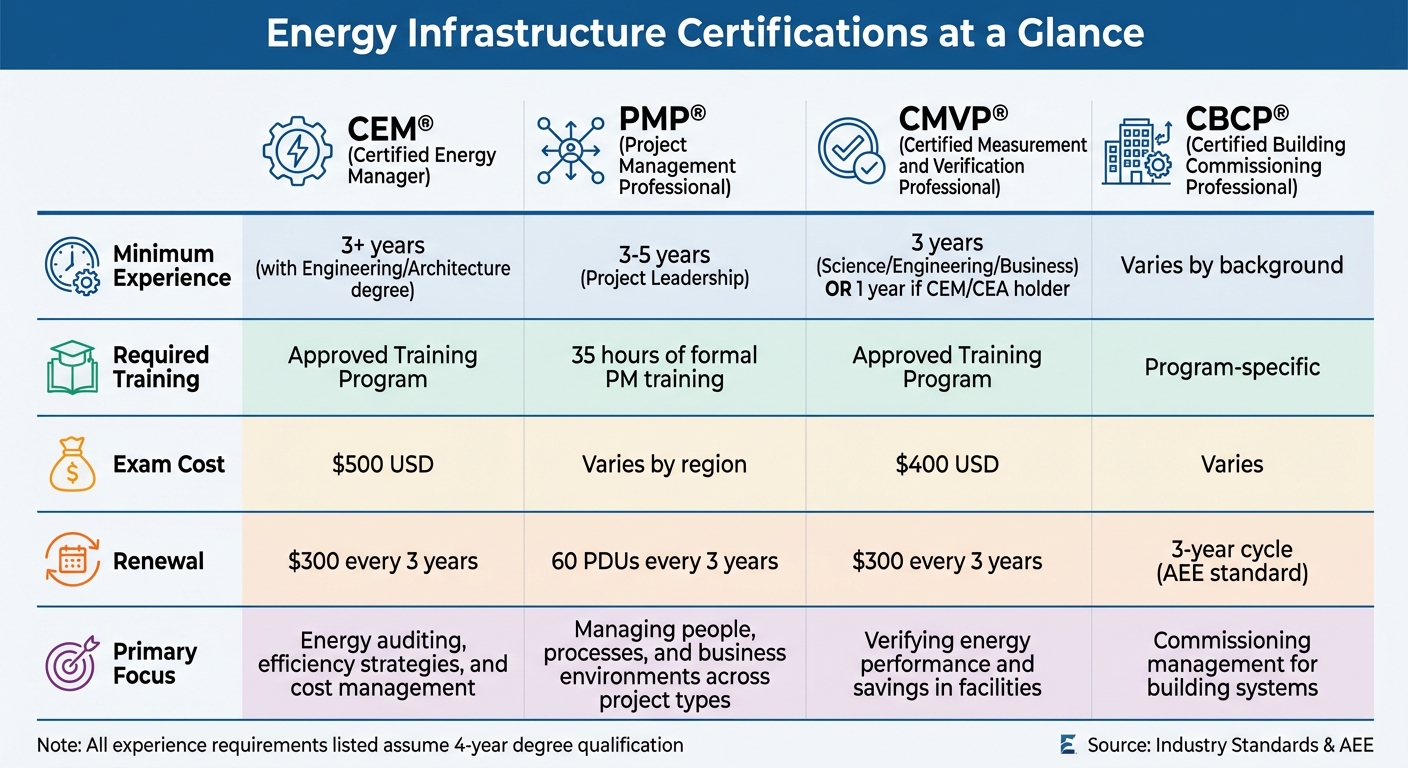
Energy Infrastructure Certifications Comparison: Requirements, Costs, and Focus Areas
Comparison Table
Certifications in energy infrastructure cater to different career stages and project focuses, each with its own entry requirements and maintenance expectations. The table below highlights key aspects of four certifications, helping you align your career goals with the right credential. A notable feature of AEE certifications is their flexible prerequisites – higher educational qualifications can reduce the required professional experience.
| Certification | Minimum Experience (with 4-Year Degree) | Required Training | Exam Cost (U.S.) | Renewal Requirement | Primary Focus Area |
|---|---|---|---|---|---|
| CEM® | 3+ years (Engineering/Architecture) | Approved Training Program | $500 | $300 every 3 years | Energy auditing, efficiency strategies, and cost management |
| PMP® | 3–5 years (Project Leadership) | 35 hours of formal PM training | Varies by region | 60 PDUs every 3 years | Managing people, processes, and business environments across project types |
| CMVP® | 3 years (Science/Engineering/Business); 1 year if CEM/CEA holder | Approved Training Program | $400 | $300 every 3 years | Verifying energy performance and savings in facilities |
| CBCP® | Varies by background | Program-specific | Varies | 3-year cycle (AEE standard) | Commissioning management for building systems |
This side-by-side comparison simplifies the selection process, ensuring you can pinpoint the certification that best matches your expertise and career aspirations.
sbb-itb-aa28329
How ABLEMKR Uses Certifications for Workforce Matching

Certifications act as solid proof that a professional meets specific safety, technical, or regulatory standards. ABLEMKR taps into this by connecting pre-vetted workers with energy infrastructure job sites based on their verified credentials. This approach ensures operators can quickly assemble teams for critical tasks, like emergency pipeline repairs or scheduled utility maintenance. A key part of this process is recognizing the difference between verified certifications and basic course completion certificates.
On ABLEMKR’s platform, certifications – which demonstrate proven competency and are issued by third-party organizations accredited by ANSI under ISO/IEC-17024 standards – are clearly distinguished from certificates, which merely confirm course attendance. This distinction is crucial in the energy sector, where certain certifications are non-negotiable. Workers often cannot legally or contractually start roles in offshore oil, gas, or wind projects without specific credentials like BOSIET or GWO.
ABLEMKR takes this a step further by integrating with secure databases to automate credential verification. For example, in pipeline projects, the platform accesses NCCER transcripts and digital credentials, which are validated by ISNetworld to ensure workers meet the qualifications for designated "Covered Tasks." Andrea Chamblin, Operator Qualification Manager at Colonial Pipeline, highlights the value of this system:
"I like that NCCER talks to not just operators for my industry in pipeline. They talk to the contractors. They talk to the up and coming folks and I think that’s the complete circle of engagement".
Beyond pipelines, ABLEMKR also verifies credentials through resources like NERC‘s System Operator Certification and Credential Maintenance Database (SOCCED). This database ensures system operators maintain the necessary qualifications to work in control centers across North America. By providing real-time updates on worker status, the platform helps employers reduce risks and stay compliant with industry regulations.
Additionally, ABLEMKR monitors certification renewal requirements, such as the 30 professional development units (PDUs) needed every three years for PMI-CP holders. This built-in tracking simplifies workforce management and ensures that employees remain qualified over time. These strategies emphasize ABLEMKR’s focus on deploying only properly credentialed workers for energy infrastructure projects.
Conclusion
Certifications serve as a powerful testament to expertise and can directly enhance the success of energy projects. They confirm a professional’s knowledge in energy management, ensure adherence to stringent industry standards, and create pathways to opportunities in sectors like utilities, oil and gas, and heavy infrastructure. As Robin Lopez, Jr., Project Manager at Booz Allen Hamilton, shared:
"I was able to advance my Project Management career with the help of the PMI-CP certification. I felt more confident in myself after passing the exam and receiving my certification."
Earning certifications is an investment that yields long-term benefits. These credentials often require periodic renewal, which keeps professionals up-to-date with new technologies and evolving industry trends. This renewal process ensures they remain equipped with the latest skills and knowledge.
Through verified credentials, ABLEMKR connects pre-qualified workers to mission-critical projects across the U.S., allowing operators to quickly deploy skilled teams while maintaining strict compliance standards.
FAQs
What are the benefits of earning certifications for energy infrastructure projects?
Certifications in energy infrastructure projects can be a game-changer for your career and the success of the projects you work on. They serve as proof of expertise in key areas like renewable energy systems, utility operations, and safety protocols, helping professionals stand out in a crowded job market. With these credentials, individuals often find themselves in stronger positions for leadership roles, higher pay, and compliance with industry regulations.
Beyond personal career growth, certifications also play a crucial role in improving project outcomes. They ensure adherence to safety and reliability standards, which can simplify permitting processes, meet insurance requirements, and even attract potential investors. For example, certifications in energy storage systems or HVAC&R solutions demonstrate compliance with rigorous standards, providing confidence to stakeholders. Moreover, these certifications help address the industry’s growing skills gap, enabling teams to quickly and efficiently tackle critical tasks like system repairs, shutdowns, or renewable energy installations.
In essence, certifications not only make you more employable but also enhance project safety and help meet the fast-moving demands of the energy sector.
What are the experience requirements for certifications like CEM®, PMP®, CMVP®, and CBCP®?
The Certified Energy Manager (CEM®) certification has experience requirements that vary based on your educational background. For instance, if you hold a 4-year engineering degree, you’ll need 3 years of energy-related experience. However, if you don’t have a degree, you may need up to 10 years of relevant experience.
The Certified Measurement and Verification Professional (CMVP®) certification requires 3 years of documented experience in energy management projects, specifically in measurement and verification.
For the Project Management Professional (PMP®) and Certified Building Commissioning Professional (CBCP®) certifications, the sources do not specify experience requirements.
Why is it important for energy professionals to renew their certifications?
Renewing certifications in the energy sector isn’t just a formality – it’s a necessity. With technologies, safety protocols, and regulations constantly shifting, staying certified ensures professionals are up to date on the latest developments. This knowledge is key to maintaining credibility and delivering solutions that are both safe and efficient.
Take certifications like Renewable Energy Professional (REP) or UL 9540 for energy storage systems as examples. These often require renewal to align with updated safety and regulatory standards. Keeping these credentials current isn’t just about compliance – it can also be critical for securing permits, insurance, and project approvals. For employers, a workforce with up-to-date certifications means fewer compliance risks, improved safety, and smoother project execution overall.
To make the renewal process easier, tools like ABLEMKR are invaluable. They help track certification deadlines, automate compliance checks, and ensure workers remain qualified for essential energy infrastructure projects. This not only keeps companies competitive but also upholds the highest standards of safety and performance in a demanding industry.


