
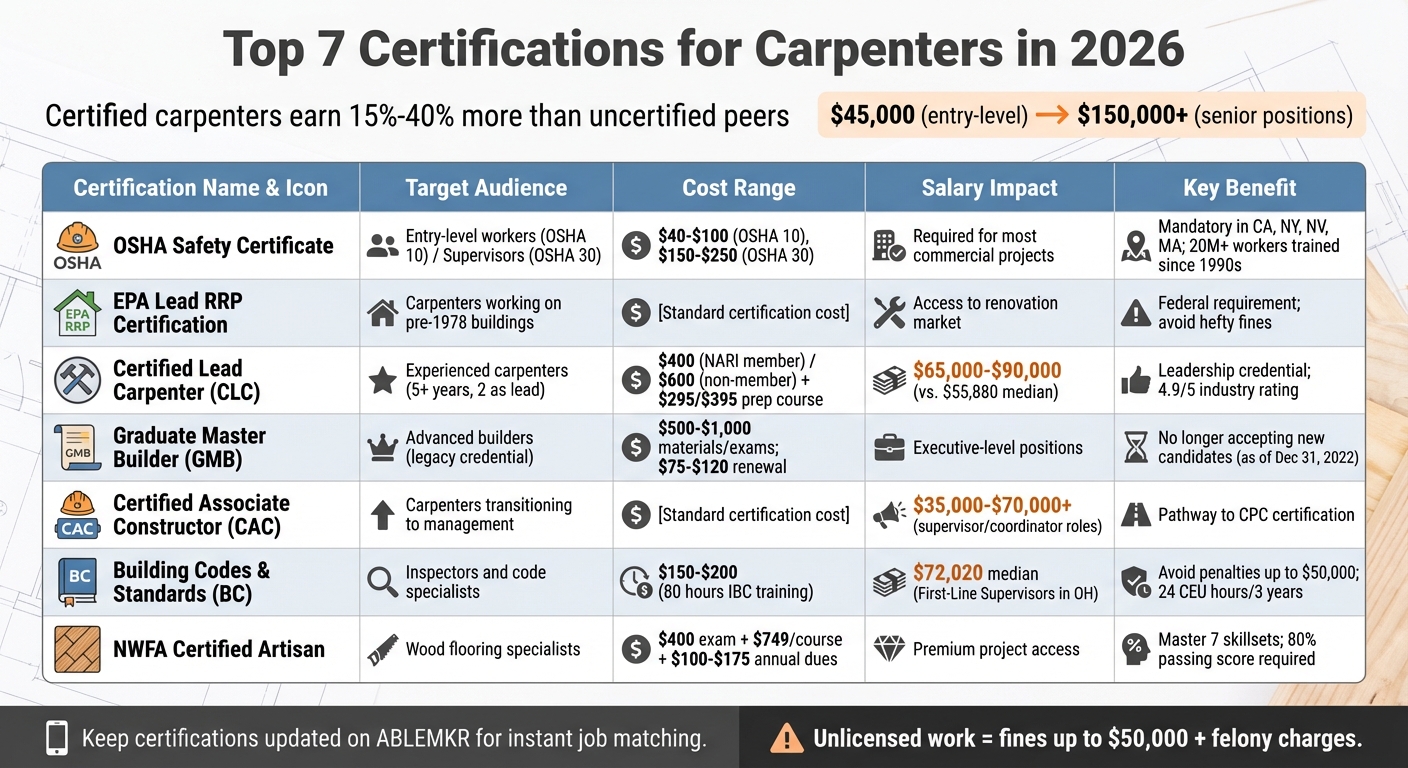
Certifications are now the backbone of career growth in carpentry. In 2026, certified carpenters earn 15%-40% more than their uncertified peers, with salaries ranging from $45,000 for entry-level roles to over $150,000 for senior positions. Beyond higher pay, certifications ensure compliance with safety standards, reduce employer costs, and open doors to specialized projects. Here are the top certifications every carpenter should consider this year:
- OSHA Safety Certificate: Mandatory for jobsite safety; OSHA 10 for workers, OSHA 30 for supervisors.
- EPA Lead RRP Certification: Required for handling lead-based paint in pre-1978 buildings.
- Certified Lead Carpenter (CLC): For experienced carpenters transitioning to leadership roles.
- Graduate Master Builder (GMB): Legacy credential for advanced technical and managerial expertise.
- Certified Associate Constructor (CAC): Ideal for transitioning from trade work to management.
- Building Codes and Standards (BC): Focused on regulatory expertise and compliance.
- NWFA Certified Artisan: Specialization in advanced wood flooring techniques.
These credentials not only boost earning potential but also make you a preferred choice for contractors. Whether you’re starting out or aiming for leadership, certifications are your best investment in 2026.
Top 7 Carpentry Certifications: Requirements, Costs, and Salary Impact 2026
1. OSHA Safety Certificate
Industry Relevance
The OSHA Safety Certificate has become the go-to credential for carpenters in 2026. For entry-level workers, OSHA 10 is the starting point, while OSHA 30 is tailored for supervisors and foremen [8, 9]. In states like California, this certification is a must-have for nearly all commercial construction projects.
Since the 1990s, the OSHA outreach program has trained over 20 million workers in safety awareness. The training zeroes in on the "Focus Four" hazards: falls, electrocution, struck-by incidents, and caught-in/between scenarios – these are the leading causes of fatalities in construction. Brad Fishbein, Founder of TradeCareerPath.com, emphasizes its importance:
Whether you’re sweeping floors or wiring panels, OSHA 10 tells employers: ‘I understand the basics of jobsite safety, and I take it seriously’
- Brad Fishbein, Founder of TradeCareerPath.com.
This certification not only helps meet safety regulations but also lays the groundwork for career advancement.
Career Advancement Potential
Holding an OSHA card immediately boosts your employability and appeal to hiring managers [8, 9]. Many employers require it for job applications, and apprenticeship programs often list it as a prerequisite [8, 9]. For carpenters looking to work on lucrative projects like public works or government contracts, OSHA 10 is typically mandatory just to bid on the site [1, 8].
For those aspiring to leadership roles, OSHA 30 is the benchmark. It’s often required for foremen and lead carpenters, signaling readiness for supervisory responsibilities while also helping employers save on insurance costs [1, 8]. This certification is a critical step in climbing the professional ladder.
Compliance with Safety and Legal Standards
In states like New York, Nevada, and Massachusetts, OSHA certification is legally required for certain jobs. For example, in New York City, carpenters need an OSHA card as part of Site Safety Training (SST) to work on most construction sites. The training follows OSHA’s Construction Standards (29 CFR 1926), focusing on hazard recognition and prevention.
The cost of OSHA 10 training ranges from $40 to $100, while OSHA 30 training typically costs between $150 and $250. To avoid scams, make sure you’re enrolling with an OSHA-authorized provider – this can be verified on OSHA.gov. Training is capped at 7.5 hours per day, and you’ll need to score at least 70% to pass. After completing the course, keep your printable certificate handy, as the physical DOL card can take several weeks to arrive by mail.
sbb-itb-aa28329
2. EPA Lead Renovation, Repair and Painting (RRP) Certification

Industry Relevance
The EPA Lead Renovation, Repair and Painting (RRP) certification is a must-have for carpenters working on residential or commercial properties built before 1978. Federal regulations mandate that all renovation, repair, and painting firms – including smaller businesses – must hold this certification when working on housing or facilities occupied by children that were constructed prior to this year. Since a large portion of U.S. homes fall into this category, this certification is crucial for carpenters aiming to stay competitive in 2026.
Certified firms are responsible for ensuring that any worker disturbing painted surfaces is either a certified renovator or has received proper training from one. Without this certification, carpenters risk losing access to a significant share of renovation work, especially in older neighborhoods and historic areas. Beyond opening doors to more projects, this certification also ensures adherence to federal lead-safety regulations, which are explored further below.
Compliance with Safety and Legal Standards
The RRP Rule, enforced by the EPA, is more than just a guideline – it’s a legal requirement. Certification guarantees that carpenters follow lead-safe work practices, safeguarding both workers and building occupants from the dangers of lead exposure. Non-compliance can lead to hefty fines and legal troubles, making this certification an essential step in reducing liability. By mastering these safety standards, carpenters not only protect themselves and others but also position themselves for higher-quality projects that demand strict compliance.
Specialized Skill Development
Earning EPA RRP certification enhances career opportunities by providing carpenters with sought-after skills in lead-safe renovation. The training goes beyond surface-level knowledge, teaching carpenters how to identify and assess lead-based paint hazards, conduct inspections, and carry out post-abatement dust-lead testing. It also includes practical skills like creating occupant protection plans and preparing detailed abatement reports. These capabilities ensure compliance with regulations while boosting credibility for sensitive and high-stakes renovation projects.
3. Certified Lead Carpenter (CLC)
Industry Relevance
The Certified Lead Carpenter (CLC) certification, offered by the National Association of the Remodeling Industry (NARI), is designed for seasoned professionals ready to take on leadership roles in remodeling projects. It’s particularly suited for those managing on-site operations, where balancing client communication, subcontractor coordination, and technical execution is key. To qualify, candidates need at least five years of remodeling experience, with two of those years spent as a lead carpenter.
The certification process involves a 180-question, multiple-choice exam conducted online with live proctoring. Candidates have three hours to complete it. To help with preparation, NARI offers an eight-week Zoom course, featuring two-hour sessions each week. If you don’t pass on the first try, you’re allowed up to three attempts, with a $50 fee for each retest after the initial one.
This credential not only validates technical skills but also positions professionals for roles with greater responsibility and earning potential.
Career Advancement Potential
Achieving the CLC certification can significantly boost both your career and your paycheck. By 2026, certified lead carpenters are projected to earn between $65,000 and $90,000, compared to the $55,880 median salary for carpenters. In metropolitan areas, salaries often fall between $65,000 and $85,000, with specialists in custom homes or restoration sometimes exceeding $90,000.
"NARI Certified Lead Carpenters (CLC®) are recognized as skilled field professionals who oversee all on-site aspects of a remodeling project – including personnel coordination, subcontractor management, scheduling, safety, and client relations – all while remaining actively engaged in hands-on work." – NARI
The certification signifies a transition from primarily hands-on tasks to a leadership role. It demonstrates the expertise required to manage project timelines, budgets, and team dynamics. This distinction can make a professional stand out in a competitive job market, with the credential earning a high 4.9 out of 5 rating for its relevance to industry standards in 2026.
Compliance with Safety and Legal Standards
Beyond career advancement, the CLC certification equips carpenters to take charge of jobsite safety and ensure regulatory compliance. Certified professionals gain a solid understanding of building codes and develop the communication skills needed to work effectively with code officials. Training also covers OSHA safety standards and EPA regulations for hazardous materials, helping contractors avoid fines or project delays.
"A Certified Lead Carpenter (CLC) is responsible for overall jobsite safety conditions, should be aware of possible hazardous conditions and materials that may be encountered on a job, and should be able to instruct others in proper procedures to minimize hazards." – Kacey Larsen, Qualified Remodeler
With falls accounting for 20% of all occupational injuries in the field, safety management is a critical component of the CLC role. Practical measures, like driving in or bending exposed nails on scrap lumber and keeping work areas free of debris, not only reduce hazards but also prevent citations for poor housekeeping, which is a common violation.
| Fee Type | NARI Member | Non-Member |
|---|---|---|
| Certification Fee | $400 | $600 |
| Online Prep Course | $295 | $395 |
| Annual Renewal | $69 | $138 |
To maintain certification, professionals must complete five hours of continuing education (5 CEUs) annually, ensuring they stay up to date with industry changes.
4. Graduate Master Builder (GMB)
Industry Relevance
The Graduate Master Builder (GMB) designation from NAHB recognized builders with extensive technical and managerial expertise. However, the program stopped accepting new candidates as of December 31, 2022, making it a legacy credential. For those who earned it before this deadline, the GMB remains a respected mark of achievement, showcasing mastery in areas like advanced construction technology, multifamily housing development, and business management.
Career Advancement Potential
Professionals with a GMB designation often move into leadership roles such as site superintendents, project managers, or even business owners. The program placed strong emphasis on financial management, customer service, and navigating complex building codes. While no longer available to new participants, the credential continues to highlight a builder’s long-term dedication to their craft – something employers value. Maintaining the GMB requires ongoing education and periodic renewals.
Specialized Skill Development
Unlike entry-level certifications, the GMB program focused on advanced topics aimed at preparing carpenters for executive-level responsibilities. Continuing education under the GMB covered areas like business management, advanced construction practices, and emerging technologies – skills that help professionals make informed decisions about budgets, timelines, and resource allocation. For those seeking master-level credentials in 2026, alternative options include the Certified Graduate Builder (CGB) or Certified Professional Constructor (CPC). These programs typically cost between $500 and $1,000 for materials and exams, with renewal fees ranging from $75 to $120 every two years.
Next, we’ll examine other certifications that expand on these advanced capabilities.
5. Associate Constructor (AC)
Industry Relevance
The Certified Associate Constructor (CAC) – previously known as the Associate Constructor (AC) – is the entry-level credential in the AIC‘s Constructor Certification Program. For carpenters moving from hands-on trade work into management or supervisory roles, this certification validates not only their technical carpentry expertise but also their ability to interpret specifications and navigate building codes effectively [20, 22].
Career Advancement Potential
The CAC sets professionals apart and creates opportunities for leadership roles. Dr. Lana Cobel explains:
A certification differentiates the competency of the individual members on the team. And if I am building a project, I want the best people on my team. It limits my risk – my risk of accidents and failure. It also accelerates the probability of success with both time and money.
- Dr. Lana Cobel, University of Houston.
This credential can lead to roles such as site supervisor or project coordinator, with salaries ranging from $35,000 to over $70,000 annually, depending on experience and location. Additionally, the CAC can serve as a stepping stone toward the Certified Professional Constructor (CPC), the highest certification level for senior construction managers.
Compliance with Safety and Legal Standards
The CAC program places a strong focus on safety leadership and jobsite safety protocols, which are essential for adhering to local and national regulations. Training also includes understanding building codes and interpreting architectural and structural drawings to ensure legal compliance at every project stage. Earning this certification demonstrates the ability to avoid issues like insurance disputes, stop-work orders, or bid delays, offering peace of mind to employers and clients alike.
Specialized Skill Development
Before sitting for the exam – held twice a year in April and November – candidates must meet specific education or experience requirements. Unlike general trade certifications, the CAC emphasizes construction management skills, including communication, problem-solving, and leadership techniques [16, 22]. To maintain the certification, professionals must complete ongoing Continuing Professional Development (CPD) credits, ensuring their skills stay aligned with current industry practices. This makes the CAC an essential step for those looking to transition from trade work to construction management, aligning with the broader theme of advancing career opportunities in the field.
6. Building Codes and Standards (BC)
Expanding your certification portfolio with training in building codes and standards adds a crucial layer of regulatory expertise to your technical skills.
Industry Relevance
Building codes certification equips carpenters with the knowledge to navigate regional code handbooks effectively. This includes tackling issues like air barriers and moisture control, which are vital for maintaining structural integrity. For instance, certified professionals can inspect critical systems such as the thermal envelope to ensure seamless air, water, and thermal barriers. Modern certifications also emphasize a holistic approach, integrating energy efficiency, durability, and indoor air quality across the entire building process.
Career Advancement Potential
Earning an ICC Residential Combination Inspector certification opens doors to inspector roles for single-family homes, duplexes, and townhouses. This certification requires 80 hours of IBC training, typically costing between $150 and $200. In Ohio, for example, First-Line Supervisors of Construction Trades – positions that often require advanced knowledge of building codes – earn a median annual salary of $72,020. To maintain ICC certification, professionals must complete at least 24 hours of continuing education every three years. These credentials ensure adherence to legal and safety standards, which is critical for career growth.
Compliance with Safety and Legal Standards
Falling short of compliance can result in severe consequences. In Nevada, unlicensed contracting is classified as a Category E felony, carrying fines between $10,000 and $20,000, up to four years in prison, and additional administrative fines of up to $50,000. Similarly, a 2005 court ruling in Illinois highlighted that unlicensed contractors cannot enforce mechanics liens, emphasizing the financial risks of working without proper certification. In California, a CSLB license is mandatory for construction projects where labor and materials exceed $500.
Working uncertified can trigger CSLB penalties, stop-work orders, insurance denials, or disqualification from future bids – especially on bonded projects.
- ABLEMKR
Specialized Skill Development
BC certification training goes beyond basic carpentry, teaching essential techniques like "pen tests" to verify the continuity of thermal, air, and water barriers. It also covers a range of systems, including electrical, plumbing, mechanical, and fire protection, ensuring carpenters are prepared for complex projects. This training includes expertise in firestops, wall bracing, floor load/span data, and moisture control systems. Notably, about 27% of First-Line Supervisors in construction hold a post-secondary certificate as their highest level of education, showcasing the value of these credentials in advancing within the industry.
7. National Wood Flooring Association (NWFA) Certified Artisan
For carpenters aiming to specialize in advanced wood flooring, the NWFA Certified Artisan designation is a mark of high-level expertise. Building on the NWFA Craftsman and Master Craftsman tracks, this certification showcases skills in intricate and specialized wood flooring techniques that go far beyond basic installation.
Industry Relevance
This certification strengthens your technical credentials by focusing on advanced, industry-specific skills. The NWFA program is widely recognized as the gold standard for wood flooring professionals in the U.S. Many flooring manufacturers recommend hiring NWFA Certified Professionals to ensure proper installation of their products. The program emphasizes seven "Master Skillsets" essential for high-end flooring projects: Circular/Curved Application, Color & Finish, Marquetry/Inlay, Medallions, Parquetry, Textured Wood, and Wood Bending. Mastery of these skills is critical for handling intricate and precision-driven assignments.
Career Advancement Potential
Earning the Artisan-level certification is a significant commitment but opens up premium career opportunities. To achieve Certified Craftsman status, professionals must hold both the Certified Installer and Certified Sand & Finisher credentials for at least a year each and master four of the seven Master Skillsets. The Master Craftsman level requires completing all seven skillsets and a specialized project.
The financial investment includes a $400 Certified Installer exam fee, $749 for each Intermediate Installation and Sand & Finish course, and annual certification dues of $100 (or $175 for dual certifications). These credentials provide independent contractors with a strong endorsement of their expertise, making them highly sought after in the industry.
Compliance with Safety and Legal Standards
NWFA-certified professionals are required to sign a Code of Conduct and earn 10 Continuing Certification Units (CCUs) annually by June 30, ensuring they stay informed about ethical practices and the latest industry standards. Additionally, passing the NWFA Certified Inspector exam requires a score of at least 80%, further demonstrating a commitment to excellence and compliance.
Specialized Skill Development
To qualify, candidates typically need three years of hands-on experience or a combination of one year of experience and attendance at approved classes. The advanced techniques taught – ranging from detailed marquetry and medallion designs to complex wood bending – prepare artisans to tackle projects that require exceptional skill. This expertise leads to higher earning potential, better job security, and access to top-tier roles in construction and flooring. By mastering these advanced techniques, professionals not only enhance their craftsmanship but also boost their overall appeal in a competitive job market.
How Certifications Improve Carpenter Careers on ABLEMKR

On ABLEMKR, your certifications are more than just formalities – they’re your ticket to better job opportunities. The platform revolves around verified credentials, directly connecting you to projects that match your qualifications. For instance, whether you hold an OSHA 30 card for commercial construction, an EPA Lead RRP certification for pre-1978 renovations, or a CSLB C-5 license for carpentry in California, the app uses these credentials to pair you with the right job. Contractors rely on these filters to find workers, making it essential to keep your certifications updated on your profile. Once verified, these credentials immediately enhance your professional standing.
What’s even better? ABLEMKR takes care of the verification process upfront, cutting out hiring delays. Contractors can see your verified certifications, ratings from previous projects, and even live location data, presenting you as a pre-qualified candidate ready to hit the ground running. For time-sensitive projects, certified carpenters naturally become the top choice.
"Working with a construction recruiting agency, like ABLEMKR makes it easy [to verify documentation]." – ABLEMKR
Another major benefit is compliance matching. The app ensures you meet all legal and regulatory requirements for each job. For example, if a project in Illinois involves lead paint removal, which could trigger an EPA fine of $44,539 per day for violations, only carpenters with the proper credentials will show up in contractor searches. This helps protect contractors from costly penalties and delays, while also increasing demand for carpenters with up-to-date certifications.
To make the most of ABLEMKR, upload all your current certifications, including OSHA 10/30 cards, trade-specific licenses, CPR/First Aid certifications, and specialty credentials like NWFA or EPA Lead RRP. Don’t forget to set up free job alerts to stay on top of new opportunities. Regularly updating your profile with refresher courses – like the EPA Lead RRP’s required 4-hour refresher every five years – can turn profile views into job offers in no time.
Conclusion
Certifications not only enhance earning potential but also establish professional credibility in the increasingly competitive construction industry. By 2026, certifications have become a must-have career differentiator. Certified carpenters earn significantly higher wages, with entry-level salaries ranging from $45,000 to $55,000 and senior managers earning anywhere from $100,000 to $150,000 or more annually. Credentials such as OSHA 30, EPA Lead Renovation, Repair and Painting certification, and NWFA Certified Artisan highlight expertise in safety protocols, building codes, and modern construction practices – qualities that contractors actively seek.
"Certification is now one of the strongest ways to stand out in the U.S. construction workforce." – NewBalanceJobs
For those aiming for leadership positions, certifications like Certified Lead Carpenter (CLC) or Graduate Master Builder pave the way to supervisory roles, project management, and hybrid positions that blend on-site responsibilities with tasks like remote compliance monitoring. As the industry embraces green building initiatives and advanced tools like BIM, specialized certifications help professionals stay competitive for large-scale, high-budget projects.
Start with foundational credentials like OSHA 10/30 and core trade certifications, then build on them with specialized credentials tailored to your career aspirations. Whether you’re diving into flooring expertise through NWFA or focusing on sustainability with LEED, every certification you earn strengthens your position in the job market. Staying current by renewing credentials every three years is equally important.
The construction industry rewards those who continuously invest in their professional growth. With the right certifications, you can unlock higher pay, take on greater responsibilities, and access top-tier projects across the country. Keeping your credentials up to date ensures you’re always prepared for the most in-demand opportunities, solidifying your reputation as a top-tier construction professional.
FAQs
What certification should I get first as a carpenter?
The OSHA Safety Certificate serves as a solid starting point for anyone in carpentry. It delivers critical safety information and is widely acknowledged across the industry. In fact, many employers see it as a basic requirement for maintaining workplace safety.
Do I need EPA Lead RRP if I never work on pre-1978 buildings?
No, you don’t need an EPA Lead RRP certification if you never work on buildings constructed before 1978. This certification is specifically required for projects that disturb painted surfaces in homes built prior to 1978, as these may contain lead-based paint.
How can I verify if a certification provider is legitimate?
To confirm if a certification provider is legitimate, start by checking whether they are recognized by established industry standards, accredited bodies, or well-known organizations. Look into whether their certifications are widely respected and accepted within the construction field. Additionally, take the time to research their reputation and how well their offerings align with the needs of the industry – this can provide further assurance of their credibility.


