
Battery Energy Storage Systems (BESS) are becoming essential for renewable energy storage, but they come with serious safety risks. Workers face hazards like high-voltage DC shock, arc flash, and thermal runaway, which can lead to fires or explosions. Proper safety training is critical to prevent incidents and protect both workers and assets. Employers must create tailored training programs that address these risks, comply with regulatory standards, and ensure workers are qualified to handle BESS-specific challenges.
Key Points:
- Top Hazards: Thermal runaway, toxic gas release, DC shock, and arc flash.
- Regulations: NEC Article 706, NFPA 70E, UL 9540, and more.
- Worker Training: Focus on Electrical Safety Programs (ESP), PPE use, and emergency response.
- Certifications: NABCEP Energy Storage Installation Professional (ESIP) and Qualified Electrical Worker (QEW).
- Emergency Protocols: Evacuation plans, alarm response, and proper shutdown procedures.
Employers can also use tools like ABLEMKR to track certifications and ensure compliance. Regular refresher training is essential as safety standards and technology evolve.
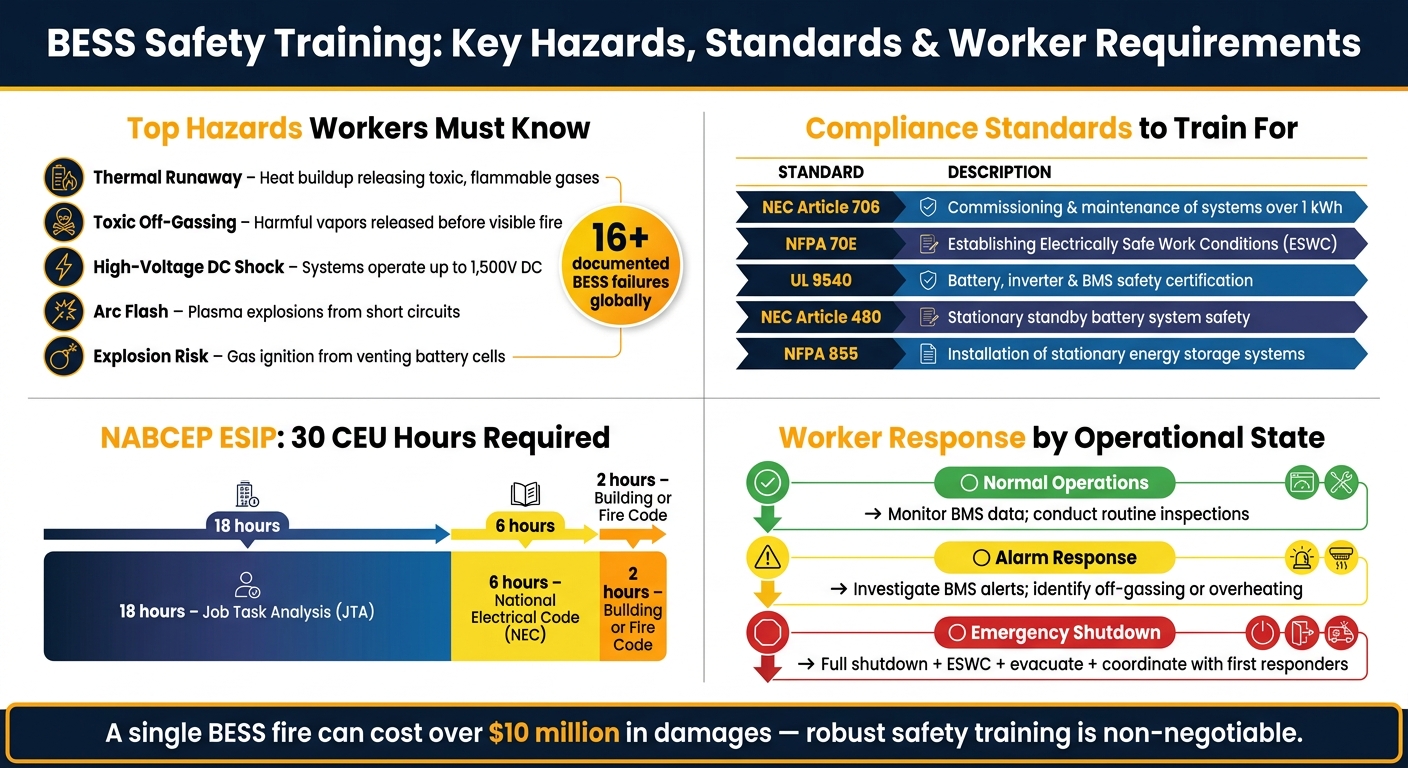
BESS Safety Training: Key Hazards, Standards & Worker Requirements
Power Up Safety: Mastering Arc Flash Hazards in Battery Energy Storage Systems
sbb-itb-aa28329
Employer Responsibilities for BESS Safety Training
When it comes to safety training for Battery Energy Storage Systems (BESS), the responsibility starts with employers. They need to establish documented programs tailored to the unique hazards associated with BESS.
Matching Training to BESS Hazards and Risks
The foundation of safety training is creating a formal Electrical Safety Program (ESP) – a written plan that highlights key risks like DC shock, arc flash, chemical exposure, and thermal runaway. This plan must be customized to account for the specific battery chemistry, voltage levels, and scale of each installation.
A critical concept in BESS safety is understanding "stranded energy." Even when disconnected from the grid, BESS units can retain energy within their cells, posing serious risks. Unlike traditional AC systems, these systems don’t lose all energy immediately, which means hazards can persist. Additionally, DC arcs are particularly dangerous because they lack a zero-crossing point, causing them to last longer and release more energy.
"The most critical aspect is implementing a comprehensive electrical safety program that prioritizes establishing an electrically safe work condition (ESWC) before any work begins." – ExpertCE
Employers should conduct a formal risk assessment before installation or maintenance. This identifies specific site hazards like arc flash and shock risks, guiding decisions on appropriate personal protective equipment (PPE) and safe work practices.
Effective hazard-based training must also align with regulatory standards to ensure full compliance.
Meeting Regulatory Standards and Certifications
In addition to hazard-specific training, employers need to design programs that comply with U.S. regulatory standards. The table below outlines key frameworks to integrate into training:
| Standard | What It Covers |
|---|---|
| NEC Article 706 | Guidelines for commissioning and maintaining energy storage systems over 1 kWh |
| NFPA 70E | Rules for establishing an Electrically Safe Work Condition (ESWC) |
| UL 9540 | Certification ensuring batteries, inverters, and Battery Management Systems (BMS) function safely together |
| NEC Article 480 | Safety requirements for stationary standby battery systems |
Employers should also leverage resources like the North American Board of Certified Energy Practitioners (NABCEP) for certification guidance. For example, workers in roles such as Energy Storage Installation Professional (ESIP) must complete 30 hours of continuing education for recertification, including at least 6 hours focused on the NEC and 2 hours on building or fire codes. Aligning internal training with these requirements ensures workers stay qualified and the company remains compliant.
To simplify compliance tracking, platforms like ABLEMKR can help monitor worker certifications and flag upcoming renewal deadlines. This eliminates the need for manual record-keeping while providing real-time visibility into compliance.
Identifying Hazards in Battery Energy Storage Systems
Understanding the risks associated with Battery Energy Storage Systems (BESS) is essential for worker safety. Unlike conventional electrical systems, BESS installations come with a distinct set of hazards, which means training must go beyond standard electrical safety practices.
Key Hazards to Cover in Training
One of the most critical risks in lithium-ion BESS is thermal runaway – a dangerous heat buildup that releases toxic and flammable gases. ExpertCE describes it as: "The process [thermal runaway] can cause the battery to vent hot, toxic, and flammable gases, potentially leading to fires or explosions." Early warning signs, such as off-gassing and unusual temperature readings, often occur before visible smoke, leaving workers with limited time to respond.
The table below highlights the main hazard categories that workers should be trained to identify:
| Hazard Category | Specific Risk | Why It Matters |
|---|---|---|
| Thermal | Thermal runaway | Unchecked heat rise can spread through the entire system |
| Chemical | Toxic off-gassing | Release of flammable and harmful vapors before visible fire |
| Electrical | High-voltage DC shock | Continuous current (DC) is harder to interrupt |
| Electrical | Arc flash | Plasma explosions caused by short circuits |
| Chemical/Thermal | Explosion | Ignition of gases from venting cells |
Utility-scale systems often operate at voltages as high as 1,500 V DC, making specialized safety protocols essential for worker protection in these high-voltage environments. Over the past few years, there have been at least 16 documented BESS failures globally that resulted in fires and property damage. Recognizing early indicators, such as off-gassing or abnormal temperature changes, is crucial for mitigating these risks. By identifying hazards early, workers can take proactive steps to prevent incidents.
Why Hazard Awareness Helps Prevent Incidents
Training workers to identify hazards is only the first step – cultivating a strong sense of awareness is equally important for incident prevention. With proper awareness, workers can detect early warning signs and take action before a situation escalates. For instance, noticing the smell of off-gassing or spotting an unusual temperature spike on the Battery Management System (BMS) can allow for timely intervention. This real-time vigilance enables workers to assess the situation and respond effectively to avoid emergencies.
"Battery Energy Storage Systems (BESS) are unique in that they cannot typically be fully de-energized and there are so many tasks to be performed by so few technicians." – American Clean Power (ACP)
Incorporating UL 9540A standards into training ensures that workers are prepared for the specific thermal runaway characteristics of the batteries they handle. Tailored protocols based on these standards can significantly improve safety outcomes.
Worker Qualifications and Certification Requirements
Not every worker handling electrical systems is equipped to work on a Battery Energy Storage System (BESS). These systems present distinct risks, requiring specialized training and certifications. Employers must understand the qualifications necessary to ensure safety and competence.
What Makes a Qualified Electrical Worker for BESS
The cornerstone credential for this field is the Qualified Electrical Worker (QEW) designation. A QEW for BESS must undergo training specifically focused on battery systems, which can remain energized even when disconnected from the grid.
The American Clean Power (ACP) Association has established guidelines for BESS Operations Qualified Electrical Workers, helping companies create tailored QEW programs for their sites. It’s important to distinguish between construction-phase workers and operations and maintenance (O&M) personnel. Construction crews typically finish their work before systems are fully energized, whereas O&M staff regularly handle live equipment. This makes advanced certifications essential for O&M teams. Additionally, smaller team sizes at BESS sites mean workers often need to be adaptable and skilled across various tasks.
"Building, operating, and maintaining any power generation project requires an elevated level of electrical safety awareness, training, technical skills, knowledge, and the personal discipline to always act in a safe manner." – American Clean Power (ACP)
To maintain expertise, qualified workers are encouraged to pursue the NABCEP Energy Storage Installation Professional (ESIP) credential. This certification requires ongoing education, with 30 hours of continuing education units (CEUs) needed for recertification. Key training areas include:
| Training Category | Recertification Hours Required | Purpose |
|---|---|---|
| Job Task Analysis (JTA) | 18 hours | Procedures for working with energized equipment |
| National Electrical Code (NEC) | 6 hours | Safe installation practices and PPE standards |
| Building or Fire Code | 2 hours | Emergency access and containment protocols |
In addition to formal qualifications, hands-on training in safety procedures, including personal protective equipment (PPE) and energized work practices, is critical.
Training on PPE and Energized Work Controls
Once workers are certified, they must develop expertise in safety protocols for live systems. Since BESS units remain energized at all times, workers must treat them as live equipment. This mindset is essential and should be reinforced through comprehensive PPE and practical training.
PPE requirements for BESS environments go beyond standard electrical gear. Workers need to understand arc flash boundaries, use voltage-rated gloves and face shields, and know when flame-resistant clothing is necessary. Training should also include establishing and maintaining approach boundaries around energized equipment, as outlined in NEC standards.
For employers managing O&M teams across multiple sites, tools like ABLEMKR offer a streamlined way to verify worker certifications. ABLEMKR provides verified worker profiles and compliance tracking, ensuring technicians have the necessary credentials – such as QEW status and CEUs – before arriving on-site.
Safe Work Procedures for Routine BESS Operations
Having clear, repeatable procedures is critical for the everyday tasks workers perform on-site. Without them, consistency and safety can quickly fall apart.
Step-by-Step Procedures for Inspections and Maintenance
One key lesson for workers from day one: a BESS (Battery Energy Storage System) is never completely off. Unlike traditional electrical systems, the DC sections of battery strings stay energized even when disconnected from the grid. Lockout/Tagout (LOTO) procedures need to account for this. Make sure this point is crystal clear during training – don’t assume workers will figure it out on their own.
Routine inspections revolve around three key checklists: Product Safety, Personnel Safety, and Site Safety. These checklists aim to:
- Ensure equipment is functioning properly.
- Confirm workers have the right protective gear.
- Verify that access routes are safe and unobstructed.
In addition, workers should perform a Battery Hazard Analysis or Failure Modes and Effects Analysis (FMEA) to identify potential failure points early. During walkthroughs, tools like gas detection devices or thermal imaging cameras can be lifesavers. They help spot issues like off-gassing or heat buildup before they escalate into a thermal runaway event.
Finally, always adapt these protocols to follow the exact manufacturer and site-specific guidelines.
Following Manufacturer and Site-Specific Guidelines
Manufacturer manuals are your go-to resource for tailoring procedures to the specific battery chemistry and configuration at your site. For example, a lithium-ion system has completely different risks compared to a redox flow battery. Procedures designed for one won’t necessarily work for the other.
Site-specific details are just as crucial. Hands-on training, including facility walkthroughs, helps workers connect the procedures they’ve learned to the actual layout of the site. Simulations and role-playing based on real-life scenarios and manufacturer recommendations can further reinforce proper practices.
As battery technology evolves and safety standards like NFPA 855 are updated, make sure safety documentation is revised regularly to stay up-to-date.
Emergency Response and Incident Escalation Training
Ensuring safety on Battery Energy Storage System (BESS) sites goes beyond routine operations – it requires a well-practiced approach to emergency readiness. Even with thorough inspections and established safety protocols, emergencies like gas releases, equipment failures, or fires can escalate in mere minutes. Workers must be equipped to act swiftly and decisively in such situations.
Building Emergency Response Protocols
The cornerstone of effective emergency response is knowing the triggers that demand immediate action. For instance, workers should treat any sign of off-gassing as a clear evacuation signal. Lithium-ion thermal runaway events release hot, toxic, and flammable gases, which can rapidly lead to fires or explosions. In these cases, the focus must be on evacuation and isolating the area – not troubleshooting.
Comprehensive training should also prepare workers to collaborate with local first responders and Authorities Having Jurisdiction (AHJ). Since fire departments may not be familiar with BESS-specific risks, such as stranded energy or unique DC arc behavior, pre-incident planning and hands-on simulations are crucial. Realistic drills using regional mockups or shared training facilities can help ensure everyone is ready for a coordinated response.
"Battery Energy Storage System (BESS) safety must be built into operations, not just bolted on during emergencies." – Kevin Hernandez and Luke Martin, Partners, ScottMadden
The financial stakes are high: a single BESS fire or explosion can cost over $10 million in damages, downtime, and reputational harm. Many utilities are now investing less than $1 million to develop robust BESS safety programs, which include these emergency protocols. These efforts clearly separate routine monitoring from critical incident responses, providing a strong foundation for operational state guidelines.
Normal Operations vs. Alarm Response vs. Emergency Shutdown
One common challenge is helping workers distinguish between routine alerts and actual emergencies. Training should clearly outline the three operational states:
| Operational State | Primary Objective | Key Worker Actions |
|---|---|---|
| Normal Operations | System health monitoring | Monitor Battery Management System (BMS) data; conduct routine inspections |
| Alarm Response | Hazard mitigation | Investigate BMS alerts; identify off-gassing or overheating; prevent escalation |
| Emergency Shutdown | Personnel safety and isolation | Perform a full shutdown; establish an Electrically Safe Work Condition (ESWC); evacuate; coordinate with first responders |
This structure allows workers to transition seamlessly from routine monitoring to emergency actions.
During normal operations, the BMS continuously tracks cell temperature, voltage, and current, leaving workers in a primarily observational role. However, when an alarm is triggered, they must investigate immediately. Ignoring BMS malfunctions is not an option.
Emergency shutdowns require a different approach than standard lockout/tagout procedures. Workers need to disconnect all power sources – AC, DC, and PV – and operate breakers in the high-voltage box. After the shutdown, the lingering energy in battery cells must be addressed by confirming voltage absence with a properly rated tester. This includes checking both phase-to-phase and phase-to-ground voltage without exception.
Understanding the unique risks of DC arcs is also critical. Unlike AC arcs, DC arcs sustain energy longer because they lack a zero-crossing point, causing more extensive damage. Workers trained to recognize and respond to DC faults are better prepared to minimize harm and address these hazards effectively.
Verifying Training and Scheduling Refreshers
Testing Worker Knowledge Through Drills and Demonstrations
Maintaining a strong safety culture requires more than just completing a training course. Employers need to ensure workers can actually apply what they’ve learned, especially when dealing with the constant challenges of energized conditions in BESS environments. Practical drills and demonstrations are essential to confirm that theoretical knowledge translates into safe, effective practices in the field.
Hands-on drills and facility walkthroughs are excellent tools for assessing readiness. These exercises test workers’ ability to identify hazards and properly execute an ESWC. A critical step during these drills is performing the "live-dead-live" voltage verification. This involves using a voltage tester on a known live source before and after testing the BESS equipment, ensuring workers fully understand and can execute this key safety procedure.
Role-playing adds another layer to this evaluation. By simulating real-world scenarios – such as responding to a thermal runaway event or managing a BMS alarm – workers demonstrate their ability to make sound decisions under pressure. BakerRisk, a firm specializing in process safety, underscores the value of tailored training:
"The most effective courses incorporate your company’s specific hazards, incidents, and lessons learned." – BakerRisk
To keep track of training progress and simplify audits, platforms like ABLEMKR can document completed courses and manage PDHs and CEUs. These tools also help ensure refresher training is scheduled on time.
Setting Up a Refresher Training Schedule
Regular testing highlights the importance of refresher training, especially as BESS technology and safety standards continue to evolve. Refresher schedules should align with key milestones, such as certification renewals or updates to safety codes.
For example, the North American Board of Certified Energy Practitioners (NABCEP) requires professionals like the Energy Storage Installation Professional (ESIP) to complete 30 hours of advanced CEUs for recertification. This includes at least 6 hours on the NEC, 18 hours covering Job Task Analysis (JTA), and 2 hours focused on fire or building codes.
Regulatory changes also demand timely updates to training materials. For instance, revisions to NEC Article 706 and NFPA 70E (which introduced new battery safety requirements in its 2024 edition) require immediate attention. Similarly, updates to UL 9540 or UL 9540A standards necessitate revising training modules to address system certification and thermal runaway prevention. As ExpertCE puts it:
"Continuous education is the best tool for ensuring both your safety and your professional competency." – ExpertCE
A hybrid training model works best for refreshers. Self-paced online modules can cover theoretical updates, such as changes to the NEC, while in-person, instructor-led sessions can focus on hands-on skills. This approach ensures retraining is both thorough and efficient, keeping workers prepared for the challenges ahead.
Conclusion: Building a Safety-First Culture in BESS Workplaces
Creating a safety-first culture in Battery Energy Storage System (BESS) workplaces demands a consistent, organization-wide commitment. The American Clean Power Association emphasizes this by stating:
"Building, operating, and maintaining any power generation project requires an elevated level of electrical safety awareness, training, technical skills, knowledge, and the personal discipline to always act in a safe manner." – American Clean Power (ACP)
This discipline starts with employers who take the lead by implementing structured systems like a documented Electrical Safety Program (ESP), Qualified Electrical Worker (QEW) programs, and hazard-specific training. These aren’t just optional measures – they’re the backbone of a safe workplace. In BESS environments, where the risks are significant and the margin for error is minimal, these precautions are non-negotiable.
Safety guidelines must remain dynamic, evolving alongside updated standards like NEC Article 706, NFPA 70E, and UL 9540. Additionally, they should adapt to changes in equipment and site conditions that may introduce new risks. With the rapid expansion of BESS installations across the U.S., staying ahead of these developments is more important than ever.
As operations grow, managing certifications, monitoring compliance, and ensuring worker qualifications can become overwhelming if done manually. Tools such as ABLEMKR can simplify this process, enabling employers to track certifications, identify compliance gaps, and ensure only qualified personnel are deployed to high-risk BESS sites. This real-time oversight strengthens safety initiatives and ensures accountability.
Ultimately, every BESS worker must be equipped with the knowledge of potential hazards, adhere to established protocols, and maintain up-to-date credentials to ensure a safe and efficient workplace.
FAQs
What’s the safest first action if you smell battery off-gassing?
If you detect the smell of battery off-gassing, get to fresh air immediately. This odor indicates thermal runaway, which releases toxic, flammable, and potentially explosive gases. Staying in the area without the right respiratory protection is dangerous, especially if smoke is present. These situations can worsen rapidly, so focus on your safety by evacuating the area and adhering to your workplace’s emergency response procedures.
How is BESS lockout/tagout different since batteries stay energized?
Traditional lockout/tagout (LOTO) procedures are designed to isolate equipment from energy sources, ensuring worker safety during maintenance or servicing. However, when it comes to Battery Energy Storage Systems (BESS), things get a bit more complex. These systems usually can’t be fully de-energized, so standard LOTO practices need to be adjusted.
For BESS, this means performing thorough battery risk assessments to understand potential hazards. It also involves setting up administrative work controls tailored to these systems and equipping workers with the right personal protective equipment (PPE) to handle energized tasks safely. These steps are crucial for managing the unique risks associated with BESS effectively.
What certifications should BESS O&M technicians have to work safely?
To ensure safety when working with Battery Energy Storage Systems (BESS), technicians must have a solid foundation in safety practices and obtain specific certifications. Some of the key requirements include:
- OSHA Training: Completion of the OSHA 10-hour or 30-hour safety training programs.
- Hazardous Material Training: Training under 49 CFR Part 172 to handle hazardous materials safely.
- NABCEP Certification: The NABCEP Energy Storage Installation Professional (ESIP) certification is highly recommended for expertise in energy storage systems.
Additionally, technicians should be well-versed in standards like NFPA 855, UL 9540, and the National Electrical Code (NEC). Many employers may also mandate participation in internal Qualified Electrical Worker (QEW) programs to develop specific technical skills required for the job.


