
If I want to pass an AWS welding test, I need to train for the exact test – not just weld more.
AWS Certified Welder testing is narrow by design. My pass or fail result depends on matching the process, position, base metal, thickness, joint, and backing listed for that test. A weld that looks good can still fail if I miss the WPS, use the wrong settings, or leave defects like undercut, porosity, or slag inclusions. And since AWS maintenance is due every 6 months, passing the test is only part of the job.
Before I practice, I want to lock down:
- The code path: AWS D1.1, ASME Section IX, API 1104, or another code
- The WPS details: amperage, voltage, polarity, filler, preheat, interpass limits, bead type
- The coupon setup: bevel, root opening, backing, thickness, fit-up
- The weld sequence: root, fill, cap
- The inspection method: visual, bend test, or radiography
- The common fail points: incomplete fusion, poor penetration, undercut, porosity, high cap, slag inclusions
Here’s the short version:
- I get the WPS first
- I practice on the same coupon and position
- I spend extra time on the root pass
- I clean and inspect every pass
- I check machine settings and fit-up before test time
- I keep my cert active with the 6-month maintenance requirement
A lot of weld test failures come from small setup mistakes, not lack of skill. So if I want a better shot at passing, I need to weld to the code, weld to the WPS, and treat practice like test day.
That’s what this guide covers.
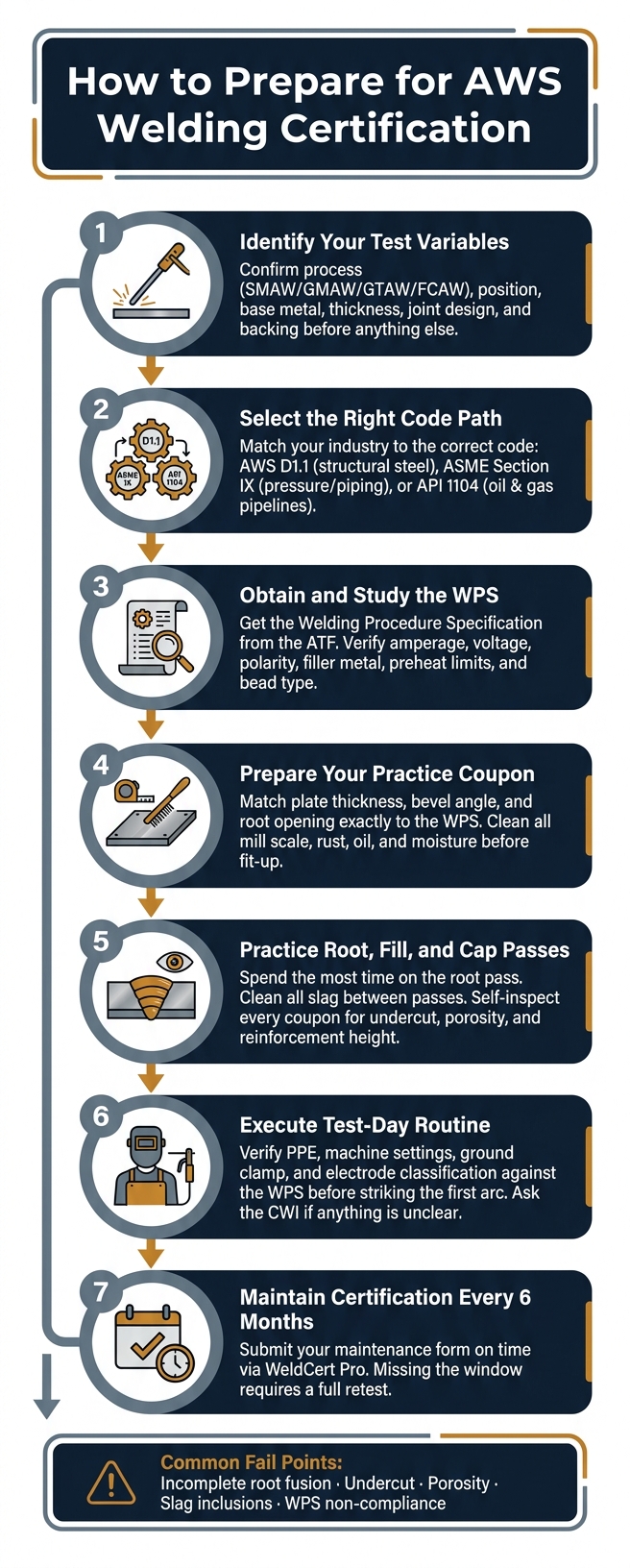
AWS Welding Certification: Step-by-Step Prep Process
AWS D1.1 SMAW 3G Qualification Test
sbb-itb-aa28329
Understand the Certification Requirements Before You Practice
Before you strike even one arc, get clear on exactly what the test covers.
Each AWS Certified Welder credential is tied to a specific mix of variables:
- the welding process: SMAW, GMAW, GTAW, or FCAW
- the test position
- the base metal type and thickness
- the joint design
- whether backing is required
If even one of those changes, you may need a separate qualification. That’s why it’s smart to confirm the exact process, position, metal, thickness, joint design, and backing before you start practicing. Those details determine the coupon you need to train on next.
Know What the Test Coupon and Weld Sequence Will Look Like
Once the test variables are set, your practice coupon should match the same joint geometry. Expect a plate or pipe coupon with the bevel, root opening, and backing listed in the WPS.
The WPS lays out the exact joint you must reproduce. So you shouldn’t be guessing when it comes to dimensions. You’ll know them before you ever step into the test facility.
The weld sequence also follows a fixed order: root pass, fill passes, and cap pass. Inspectors look closely at each stage.
The root pass is where many candidates get tripped up. Incomplete penetration or lack of fusion at the root often leads to bend test failures. Fill passes need to stay steady from bead to bead. Then the cap pass is checked for profile, reinforcement height, and visible surface defects such as undercut or porosity.
How AWS Tests Are Evaluated
Your practice should line up with the same inspection standard used on test day.
A Certified Welding Inspector (CWI) supervises the test and checks your weld using one or more methods, depending on the code in play. That may include visual inspection (VT), which looks at surface shape and profile. It may also include guided bend tests, which open the coupon to show internal defects, or radiographic examination (X-ray), which can spot hidden voids and inclusions.
The most common failure points are undercut depth, porosity, incomplete fusion, excessive reinforcement, or a cap that is too high. When you know what the inspector is checking for, your practice gets a lot more focused.
Study the Code, WPS, and Inspection Rules That Apply to Your Test
Once you know the test variables, line them up with the code and WPS that control the test. The code depends on the kind of work you want to do, so start with the industry and work backward from there. Then pull the right code and WPS before you practice.
AWS D1.1 (Structural Welding Code – Steel) covers structural plate tests. ASME Section IX covers pressure vessels and piping. API 1104 covers oil and gas transmission pipelines.
How to Read a Welding Procedure Specification the Way an Inspector Does
Treat the WPS like your test-day setup sheet, not like light reading. The WPS controls the test. Get the WPS from the ATF before practice starts, then check every setup item against it: base metal (P-Number), filler metal (F-Number and AWS classification), amperage and voltage ranges, polarity, travel speed, preheat and interpass temperature limits, and whether stringer or weave beads are allowed.
This part matters more than many welders think. A test can fail for WPS non-compliance even if the weld looks good on the surface. Your machine setup has to match the WPS exactly before you strike the first arc.
Visual Acceptance Criteria That Determine Pass or Fail
Once the WPS is clear, learn the exact limits that decide pass or fail. Most test failures come from visual or cosmetic defects, not from a total lack of welding ability. Go straight to the acceptance table in your code. For D1.1, that means Table 6.1, and you need the exact number, not just a general idea.
That kind of detail gives you a target you can practice against. If undercut has a set depth limit, for example, you can measure for it instead of guessing. Surface cleanliness, starts and stops, and weld size also get checked during inspection, and they often catch people who spent all their time chasing a nice-looking bead profile.
Comparison Table: Common AWS Code Paths for Welder Testing
Use this table to match your test to the right code path.
| AWS Code | Scope | Typical Material | Common Test Type | Where It’s Used |
|---|---|---|---|---|
| D1.1 | Structural Steel | Carbon Steel (>1/8") | 3G/4G Plate (Stick/Flux-Core) | Buildings, bridges, heavy equipment |
| D1.2 | Structural Aluminum | Aluminum Alloys | – | Aerospace, marine, transportation |
| D1.3 | Sheet Metal | Steel (up to 3/16") | Lap, fillet, or groove welds | HVAC, light manufacturing |
| D1.5 | Bridge Welding | Structural Steel | Plate groove welds | DOT bridge construction and repair |
| D1.6 | Structural Stainless | Stainless Steel | – | Food processing, chemical plants |
| B2.1 | General Piping | Various | 6G Pipe (non-pressure) | Commercial HVAC, food and beverage |
| ASME Section IX | Pressure Vessels/Piping | Various | 6G Pipe (Stick/TIG) | Refineries, boilers, power plants |
| API 1104 | Pipelines | Carbon Steel | Cross-country pipe | Oil and gas transmission lines |
| D17.1 | Aerospace Fusion | Titanium, Inconel, Stainless | Precision TIG on thin alloys | Aircraft and spacecraft components |
With the code rules in front of you, the next step is practice that matches the required position and pass sequence.
Build Test-Ready Skills With Deliberate Practice
Knowing the code and WPS is only half the battle. The other half is building muscle memory that still works when the test starts and the pressure kicks in. Once you know the WPS, practice the exact setup it calls for. Use the exact coupon and the exact position listed on the WPS.
How to Prepare Plates Before Striking an Arc
Bad fit-up can sink a test before you even strike an arc. Match the plate thickness, bevel angle, and root face to the WPS. Clean mill scale, rust, oil, and moisture from the joint and backing with a grinder or wire brush. If that junk stays in the joint, it can lead to porosity.
After cleaning, use a spacer to set the root opening exactly as the WPS says. Tack the coupon at both ends to hold the gap. Then check alignment again after tacking so the plates didn’t move as they cooled.
How to Practice Root, Fill, and Cap Passes for 3G and 4G Positions
Once the coupon is fit correctly, shift your attention to pass control. The root pass is the most critical part of the weld, and it’s also where people fail most often. Spend most of your practice time there. Control your rod angle, hold a steady arc length, and move at a consistent pace. After the root, bend-test a practice coupon to check internal penetration instead of judging the weld by surface appearance alone.
Practice to the WPS, not to your habits.
In 3G (vertical-up) and 4G (overhead), heat control matters a lot during fill passes. If the plate gets too hot, the puddle can sag in vertical-up or drip in overhead. Watch your interpass temperature. If needed, slow your travel speed or pause. After every pass – root, fill, and cap – chip and brush away all slag before you run the next bead. That step helps stop slag inclusions, which are a common reason coupons fail bend tests.
For the cap pass, aim for a steady weave or stringer width that overlaps the groove edges slightly. Watch for undercut at the toes of the cap. That often happens when you move too fast or hold the rod angle too steep at the edges.
Practice Drills Table: Skills Gained and Defects Prevented
Use these drills to work on the defects most likely to fail a test.
| Drill Name | Skill Gained | Defect Prevented |
|---|---|---|
| Root Pass Repetition | Penetration and fusion control | Incomplete penetration, burn-through |
| Heat Control Runs | Amperage and travel speed synchronization | Undercut, excessive distortion |
| 3G Vertical-Up Control | Puddle manipulation against gravity | Cold lap, sagging, overlap |
| Interpass Cleaning Drill | Slag and oxidation removal discipline | Slag inclusions |
| Cap Profile Drill | Consistent bead width and reinforcement | Excessive reinforcement, surface irregularities |
Run each drill in the exact position and with the exact electrode your WPS requires. After each coupon, inspect it yourself before asking anyone else to look at it. Check the toes for undercut, the surface for porosity, and the profile for excessive reinforcement. Catch the defects early, fix them, and use that self-check to build your test-day routine.
Get Ready for Test Day and Use Certification to Access Better Jobs
Practice gets you ready. Test day is about control. You want the same setup, the same checks, and no shortcuts.
A Simple Test-Day Routine That Cuts Avoidable Mistakes
Before any welding starts, check PPE, ventilation, and fire control in the work area. Then set amperage and polarity for SMAW, or wire feed speed and voltage for GMAW/FCAW, exactly as listed in the WPS. After that, check the leads, ground clamp, electrode classification, and shielding gas before you strike an arc. One loose ground or one wrong setting can ruin the coupon before the first pass even settles.
If anything about the setup isn’t clear, ask the CWI before you begin. Also confirm the required position – 3G, 4G, or 6G. Once the coupon is in place, you can’t move or rotate it. That makes alignment a big deal, especially before the root pass. A lot of test-day failures come from rushed fit-up, and that’s the kind of mistake that stings because it didn’t have to happen.
These habits often mark the line between a clean coupon and a failed one.
Good Habits vs. Failure Risks
| Prepared Behavior | Risk Behavior | Why It Matters |
|---|---|---|
| Verifying machine settings against the WPS | Using settings not matched to the WPS | Prevents out-of-spec defects |
| Grinding coupons to remove all mill scale | Skipping metal prep or leaving residue | Mill scale causes porosity and fusion failures |
| Checking root gap and bevel angle tolerances | Poor root gap and bevel alignment | Poor fit-up leads to root-pass failure |
| Cleaning each pass to remove slag pockets | Ignoring slag pockets before the next bead | Prevents inclusions in bend tests |
| Planning bead sequence and interpass cooling | Overheating the metal or rushing the cap | Helps prevent cracking and defects |
Conclusion: Certification Prep, Recordkeeping, and Finding Qualified Work
Once the test is done, the next job is keeping that certification active and making sure it helps you land better work.
You need to submit a maintenance form every six months to keep the certification active. Miss that window, and you’ll need a full retest. In late 2025, AWS moved Certified Welder maintenance and credentialing to a digital-first system called WeldCert Pro.
AWS certification is portable, which means it stays with the welder, not the employer or the job site.
That matters when you’re looking for work across projects or companies. ABLEMKR matches AWS-certified welders to construction and energy projects based on certifications, safety training, availability, and location.
FAQs
How do I know which AWS code applies to my test?
Match the code to your job’s industry, material, and process needs. For example, AWS D1.1 covers structural steel, D1.2 covers aluminum, and D17.1 applies to aerospace.
Your certification is tied to the specific WPS used during testing. So before you test, check the standards for the projects you want to work on and confirm them with your employer or an AWS Accredited Test Facility.
What should I do if I don’t have the WPS yet?
If you don’t have a Welding Procedure Specification (WPS), contact an AWS Accredited Testing Facility (ATF). They can walk you through the requirements for the specific test you’re taking.
This certification is performance-based. That means you’ll need to show that you can follow the applicable WPS the testing center gives you during the exam.
How can I tell if my root pass is test-ready?
Check it the way a Certified Welding Inspector would: look for a consistent bead, proper placement, and clean joint fit-up.
Also, inspect your own work for common defects like undercut and porosity. Make sure your travel speed, amperage, and electrode choice match your Welding Procedure Specification. If you can, ask an experienced welder for feedback.


