
If I had to boil this down to one point, it’s this: workers’ comp fines usually happen when coverage, worker status, and state rules don’t match the job before work starts.
In this article, I walk through the main checks that help stop that from happening: confirm whether coverage is required, make sure the policy fits each state and each job, verify worker and subcontractor status, and keep records ready for audits and injury reports. That matters because the cost of getting it wrong can be steep – Florida issued 2,323 enforcement actions and assessed $14.7 million in penalties in 2024, and some states can issue $1,000 per day fines or even criminal charges.
Here’s the short version:
- Check state rules first: coverage rules change by state, industry, and worker count.
- Match the policy to the work: names, dates, class codes, payroll, and job states all need to line up.
- Watch multi-state jobs closely: some states require coverage through the state fund.
- Verify subcontractors before site access: no current proof of coverage, no entry.
- Keep records in one place: payroll, COIs, injury reports, and exemption forms should be easy to pull.
- Review during the policy year: waiting until audit time is where extra premium and fines start.
A few points stand out. In most states, employers must carry workers’ comp, while Texas is the main exception for private employers. In monopolistic states like Ohio and Washington, private coverage alone is not enough. And if payroll, class codes, or subcontractor records are wrong, employers can face added premium, uninsured claims, stop-work orders, and back charges.
So instead of treating workers’ comp as a year-end paperwork job, I’d treat it like a pre-job and every-job checklist. That’s the core idea behind the article.
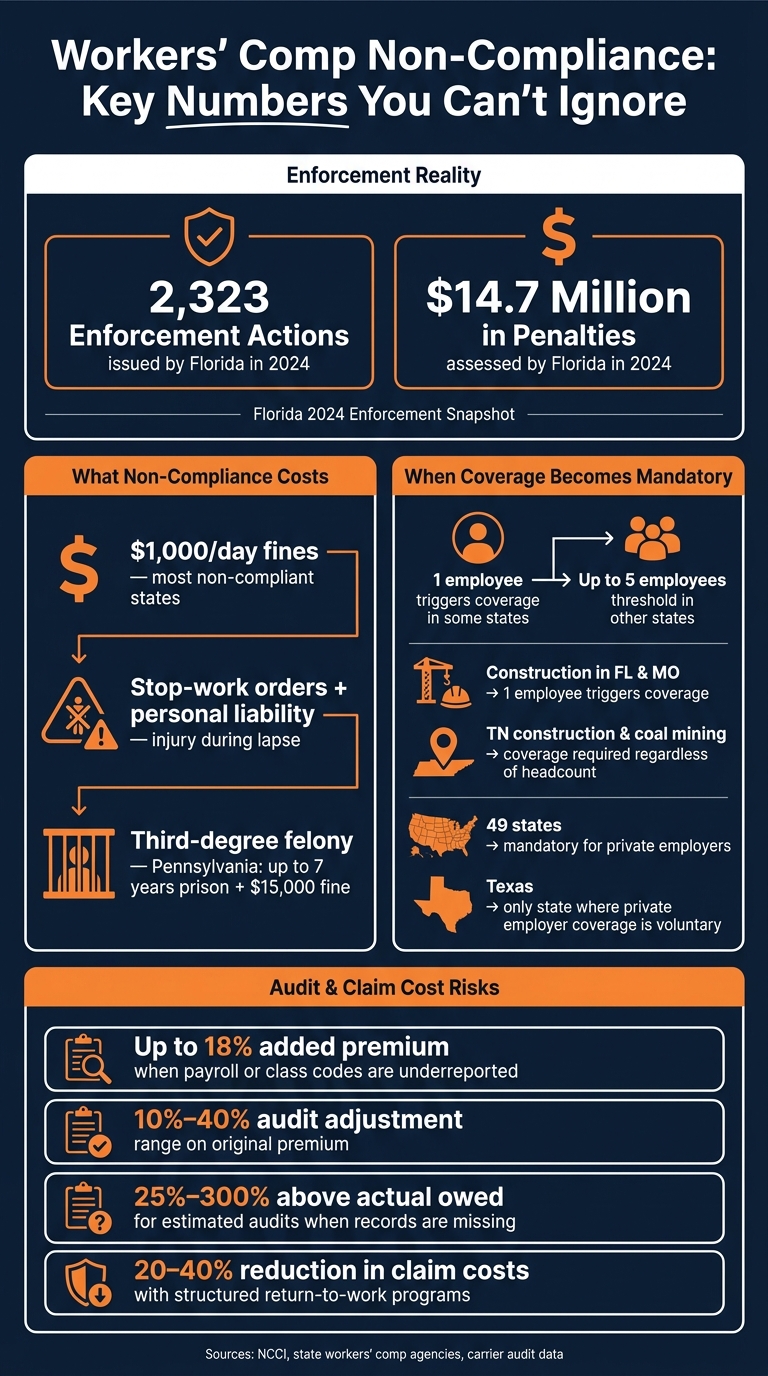
Workers’ Comp Non-Compliance: Key Penalties, Thresholds & Audit Risks
OSHA Fines vs Workers’ Comp
sbb-itb-aa28329
Confirm coverage requirements before work starts
Before you send a crew to any jobsite, confirm where workers’ comp coverage is legally required. In 49 states, private employers must carry it. Texas is the only state where it’s voluntary for private employers. But there’s a catch: if a Texas employer chooses not to subscribe, they can lose common-law defenses if a worker gets hurt.
The main thing to sort out upfront is when coverage becomes mandatory.
Check state thresholds, worker counts, and exemptions
The employee count that triggers workers’ comp can change a lot from state to state. In some places, coverage starts at 1 worker. In others, the threshold runs up to 5 workers.
Construction often faces tighter rules than other industries. In Florida and Missouri, a construction employer must carry coverage as soon as they hire one employee, even though the general thresholds in those states are 4 and 5 workers. Tennessee is even stricter: construction and coal mining employers must carry coverage no matter how many workers they have.
When you count workers, don’t just look at full-time staff. You also need to include:
- Part-time workers
- Seasonal workers
- Temporary workers
Those groups can all count toward the threshold. And there’s another risk that catches people off guard: uninsured subcontractors may be treated as your employees. If that happens, their injuries can become your liability.
Owner and officer exemptions can also trip people up. Many states allow them, and they’re valid when handled the right way. But they don’t always last forever. In Florida, for example, exemptions have to be renewed every two years.
Once you know the threshold, make sure the policy lines up with every state where work will take place.
Review multi-state exposures and state-specific penalties
Crossing state lines can change the coverage picture fast. Workers’ comp is tied to the worksite, not your company headquarters. That means every state where your crews work must be plainly listed on the policy.
A few states add one more layer. North Dakota, Ohio, Washington, and Wyoming are monopolistic states. Private insurance doesn’t work there for base coverage. Employers have to register and buy coverage straight from the state fund.
Mess this up, and the cost can be steep. Non-compliance may lead to $1,000 per day in fines, stop-work orders, and personal liability for medical bills and lost wages if someone gets injured. In Pennsylvania, operating without coverage can be charged as a third-degree felony, with penalties of up to 7 years in prison and a $15,000 fine.
Document your legal coverage decision
Before work begins, put together a one-page compliance memo for each state where the job will happen. It should note the employee count, the state threshold, any exemptions, and proof of active coverage in that state.
Update the memo at least once a year, or any time your company starts work in a new state. Keep it with your policy papers, broker emails, and exemption forms. If an investigator shows up or an audit starts, having that file ready can help back up your coverage decision.
ABLEMKR adds real-time visibility into worker status and built-in compliance tracking, which can help keep coverage records in order as crews move from one job to the next.
Verify the policy, classifications, and job-site fit
After you document the coverage requirement, check the policy itself before crews head to the site. Then make sure the policy lines up with the employer, the work being done, and each state where the job happens.
Confirm the policy is active and issued correctly
Start with the declarations page. Check the effective date, expiration date, legal entity name, FEIN, and any DBA names. If the named entity, dates, or tax ID details are off, coverage can be challenged. Even a one-day lapse can lead to stop-work orders and steep penalties. Also make sure the insurer is allowed to write coverage in each state where you operate.
Once you know the policy is active, look at whether the rating details fit the job.
Match class codes, payroll, and work locations to actual operations
Class codes should match the work people do and the payroll tied to that work. Clerical Code 8810 applies only to employees doing 100% office work. If someone regularly goes to a job site or warehouse, they may need a higher-risk classification.
This part matters more than a lot of employers think. Premium audits can uncover up to 18% in added premiums when payroll or class codes are underreported.
Also check that every active job state appears under Other States Insurance. If codes don’t match or a state is missing, the employer can end up facing uninsured claims and audit penalties.
After class codes and payroll, turn to the contract protections connected to the policy.
Review endorsements and employer’s liability details
Part A pays state benefits. Part B covers employer’s liability claims, and many contracts call for at least $1 million.
If the employer works in monopolistic states – North Dakota, Ohio, Washington, and Wyoming – pay close attention here. State fund policies in those states often do not include employer’s liability coverage. In that case, you need a separate stop-gap endorsement from a private carrier to cover that gap.
Last, review Part 3, Other States Insurance, for every active job state. If a state is missing from Part 1 or Part 3, crews can be left without coverage, and the employer can face fines and uninsured claims.
Control worker status, subcontractors, and site records
After you confirm coverage, tighten up worker status and site records before anyone steps on site. Start with your own team. Then check each subcontractor before mobilization.
Set a clear process for W-2 onboarding and classification decisions
Put every W-2 worker into payroll through construction staffing, and classify any nonemployee under the state test that applies. Do that before you label anyone a contractor. If you get classification wrong, you could face fines and stop-work orders.
Corporate officers, LLC members, and partners are often included in coverage by default. That said, some states let them opt out by filing state-specific exemption forms. If you use those forms, keep signed copies on file and track renewal dates. In Florida, for example, exemptions may need renewal every two years.
Once worker status is locked in, shift to subcontractor coverage and site-entry records.
Collect and track subcontractor insurance documents
Require a current COI before site access. Before any subcontractor starts, collect a full packet: a current Certificate of Insurance (COI), a W-9, and a signed written agreement. Don’t rely on the paper certificate alone. Check the COI through your state’s proof of coverage database.
Also make sure the policy clearly covers the state where the work will happen. Set alerts 90, 60, and 30 days before each policy expires, and suspend site access right away if coverage lapses during the project.
Require labor and materials to be listed separately on every invoice.
“Carriers often include subcontractor or contract labor in a premium audit unless you can prove the subcontractor had their own workers’ comp coverage during the time they worked for you.” – Tina Meyer, Reliable Premium Management
With coverage checked, post notices and keep each site file organized in one place.
Post required notices and centralize workforce records
Most states require employers to post a workers’ compensation notice in a visible workplace spot at each job site. These notices usually explain employee rights, coverage details, and how to report injuries.
Keep one central record set for every active site, including:
- Payroll journals
- Job classification worksheets
- IRS Form 941 filings
- Subcontractor COIs
- Officer exclusion forms
- Injury reports
- A master list of subcontractors with names, trades, dates worked, and job sites
Most states audit payroll history going back three to five years, so keep the supporting records for at least that long.
Run regular reviews, incident reporting, and audit prep
Once your records live in one place, don’t let them just sit there. Put them to work.
Regular check-ins help you spot payroll drift, missing COIs, and late injury filings before audit season shows up. The goal is simple: keep payroll, claims, and subcontractor records up to date all year, not in a last-minute scramble.
Reconcile payroll and coverage throughout the policy year
Add four recurring checks to your operations calendar:
- Weekly: Reconcile payroll to the policy.
- Quarterly: Run an internal audit that breaks down wages by employee, class code, and the state where work was physically performed.
- Semiannually: Conduct site interviews with supervisors and crew leads to confirm NCCI class codes still match day-to-day duties.
- Pre-expiration: Ninety days before expiration, forecast total payroll by class code and flag any spikes greater than 10% compared with your original estimates.
If your premium is more than $25,000, run a pre-audit ten months into the policy term. That gives you time to fix payroll allocations and collect any missing subcontractor COIs before the carrier’s auditor arrives.
If payroll is off from estimates by 20% or more in the middle of the term, request a mid-term policy endorsement right away. That can help reduce the cash-flow hit when the audit lands.
Also, track overtime premium as its own line item. Auditors tax only the premium portion of overtime pay, not the full overtime wage. If your records don’t separate that out, auditors will charge the full overtime amount at the regular rate.
This matters because audit changes can get expensive fast. Premium audits can uncover up to 18% in added premium when payroll or class codes are under-reported. Audit adjustments often land between 10% and 40% of the original premium. And estimated audits, when records are missing, can come in 25% to 300% above what was actually owed.
These recurring checks help keep class codes, payroll, and work-state allocations in line before audit time.
Standardize injury reporting and keep audit-ready files
When someone gets hurt, complete the file that same day. Speed matters here.
OSHA requires fatalities to be reported within 8 hours. Hospitalizations, amputations, or loss of an eye must be reported within 24 hours. State First Report of Injury (FROI) deadlines are different by state. California requires filing within 5 days of learning about an injury, Florida within 7 days, and Illinois within 30 days. A late report can turn a small claim into a penalty issue, and it’s one of the most common compliance failures.
Train supervisors to document the scene right away, including the date, time, location, witnesses, and the nature of the injury. Notify your carrier within 24 hours and file the FROI before the state deadline. After that, start a return-to-work plan. Employers with structured return-to-work programs reduce claim costs by an average of 20–40%.
For audit-ready files, keep these records organized and easy to pull:
- Tax filings: Form 941, W-2/W-3 summaries, SUTA reports
- Payroll detail: General ledger, overtime premium breakdown, bonus/commission logs
- Subcontractor proofs: COIs, 1099-NEC, W-9s
- Incident and compliance files: Injury reports, FROIs, OSHA logs, return-to-work notes, officer exclusion forms, posting notices, training logs
“Employers with good audit trail practices (maintain accurate payroll journals and classification worksheets) have fewer audit adjustments.” – Bowthorpe Insurance
If your crews work across state lines, use GPS or detailed timecards to log hours by the state where work was physically performed. Without that backup, auditors may assign all payroll to the highest-rated state.
Conclusion
Confirm state coverage rules before work starts. Make sure policy structure and class codes match what your team actually does. Keep worker status and subcontractor records tight. Then review everything on a set schedule through the year.
For rotating crews and multi-state projects, ABLEMKR keeps worker status, payroll workflows, and compliance tracking in one place.
FAQs
Do I need workers’ comp in every state where my crew works?
Yes. Workers’ compensation is regulated at the state level, so you need to meet the rules in each state where your crew works.
That matters because the rules can change from one state to the next. Coverage thresholds differ. Exemptions differ too. Even the way you buy insurance isn’t always the same.
And there’s one big wrinkle: North Dakota, Ohio, Washington, and Wyoming require workers’ comp coverage through a state-run fund.
Can uninsured subcontractors become my liability?
Yes. In many states, if a subcontractor doesn’t have the required workers’ compensation coverage, the general contractor or hiring company can end up on the hook for injuries to that subcontractor’s workers.
That means you could be liable for medical bills, lost wages, and disability benefits. It can also push up your future insurance premiums. And because this risk can stretch across multiple subcontractor tiers, checking coverage before any work starts is critical.
What records should I keep for a workers’ comp audit?
Keep records that verify payroll, employee classifications, and subcontractor coverage.
Include:
- Payroll summaries and tax filings
- Employee rosters, job duties, and separated overtime records
- Subcontractor certificates of insurance
- Financial statements, officer/owner exclusion forms, and your current experience modification worksheet


