
If I want to avoid workers’ comp penalties in Ohio, I need to do four things: get BWC coverage before work starts, report payroll correctly, classify workers by what they actually do, and pay every bill on time.
Ohio is strict here. If I have 1 or more employees, I usually need coverage through the Ohio Bureau of Workers’ Compensation (BWC). If I miss payroll reporting, the BWC can use estimated payroll plus 10%. If I let a bill over $1,000 sit unpaid for 60 days, I can end up marked non-complying. And if I receive an assessment notice, I may have only 20 days to act.
Here’s the short version:
- Get BWC coverage before the first employee starts work
- Use Ohio BWC coverage, not general liability insurance
- Report payroll from actual wages and work performed
- Match class codes to job duties, not job titles
- Track due dates for premiums, true-up reports, and BWC notices
- Keep records for payroll, subcontractors, claims, and payments
- Fix errors fast if the BWC sends a notice or assessment
If I run construction crews, use subcontractors, or move workers between job sites, I need to watch this even more closely. Small reporting mistakes can turn into back premiums, interest, lapse problems, and collection action.
The article below walks through the rules, the common penalty triggers, and the recordkeeping steps I can use to stay in good standing.
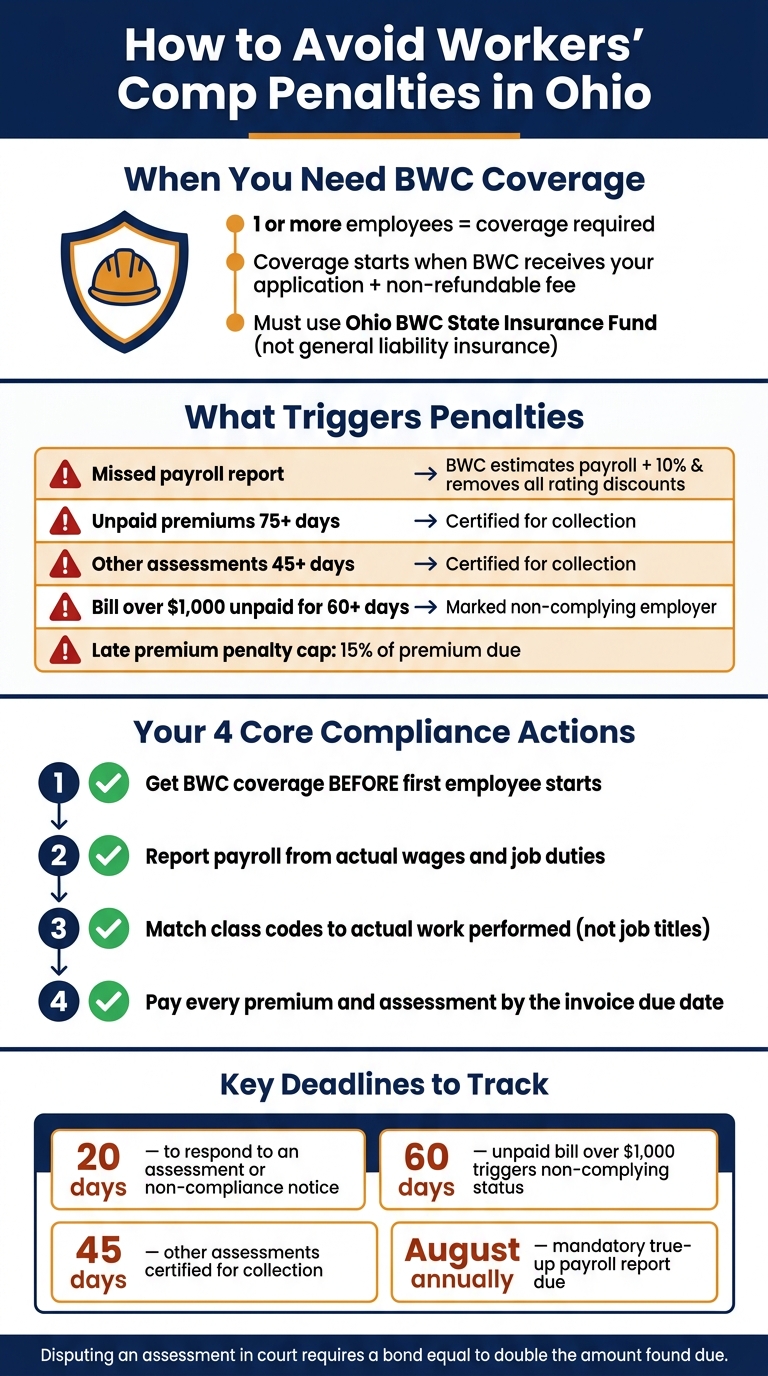
How to Avoid Workers’ Comp Penalties in Ohio: Key Rules & Deadlines
Columbus MBAC Lunch & Learn: Workers’ Comp & Risk Management Essentials with the Ohio BWC.
Know When Your Business Must Carry Ohio Workers’ Comp Coverage
Under Ohio law, an amenable employer is any private employer with one or more employees. In plain English, if you hire even one worker, Ohio will usually expect you to carry workers’ comp coverage.
For most amenable employers, that means getting coverage through the Ohio Bureau of Workers’ Compensation (BWC) State Insurance Fund unless the business has been approved as self-insured under section 4123.35 of the Revised Code.
A business becomes a non-complying employer if it doesn’t keep coverage active, doesn’t pay required premiums, or doesn’t meet self-insurance rules. The same thing can happen if a bill or assessment of more than $1,000 stays unpaid for 60 days after the invoice date.
That label can hit hard. It may leave the employer on the hook for claim costs paid by the BWC, let the BWC place a lien on the employer’s real and personal property, and, in cases the BWC sees as justifiable, lead the agency to ask the attorney general to stop the employer from operating. Once coverage is required, the next piece is understanding how Ohio handles state-fund coverage, self-insurance, and lapsed accounts.
State Fund Coverage, Self-Insurance, and Who Falls Under Ohio BWC Rules
For employers in the state fund, new coverage begins when the BWC receives the application and the non-refundable fee. That timing matters. It’s not based on when you meant to apply or when you planned to deal with it.
Self-insurance is only open to employers approved under section 4123.35. Those employers still answer to separate BWC oversight and compliance rules.
If coverage lapses, reinstatement starts only after the overdue amount is paid in full. Partial payment doesn’t do the job.
Understand the Penalties Ohio Employers Face for Non-Compliance
Once you have coverage, the main risk isn’t getting the policy itself. It’s what happens after that: reporting on time, paying premiums, and using the right payroll and class code data.
In Ohio, the trouble usually starts with late filings, unpaid premiums, or payroll mistakes.
Late Reporting, Unpaid Premiums, and Lapsed Coverage Penalties
Miss your annual payroll report deadline, and the cost can hit right away. The BWC can base your premium on estimated payroll plus 10%, and you’ll also be removed from all rating plans and discount programs for the next policy year.
Late premium payments can snowball too. Unpaid premiums and assessments accrue interest at the state-set rate. If premiums stay past due for 75 days, they’re certified for collection. For other assessments, that happens after 45 days.
And if a premium isn’t paid within the grace period, the BWC applies a lapse that is backdated to the first day of the month nearest the due date.
Payroll Misreporting, Worker Misclassification, and Fraud Investigation Risk
Payroll errors can be expensive. If wages are underreported, or workers are placed under the wrong classification code, the BWC can recalculate premiums and assessments for the affected period on a retroactive basis.
Misclassification can also lead to back premiums and penalties for the full lapse period. Late premium penalties are capped at 15% of the premium due, but that can still be a big number if your payroll is large. And if the misclassification looks intentional, it can draw fraud investigation risk.
The good news? These problems are usually preventable. Tighter payroll processes, renewal tracking, and audit checks can help you avoid them. The next section walks through the payroll, renewal, and review checkpoints that help stop these penalties before they start.
sbb-itb-aa28329
Set Up Payroll, Classification, and Coverage Controls to Prevent Penalties
Report Payroll Accurately and Classify Workers by Actual Job Duties
Once coverage is active, the next place things can go off track is payroll and class code drift.
Payroll reports should match actual wages, job duties, and work locations. If your records don’t line up with the work people are doing, premiums can be recalculated.
Classification codes need to match the work itself, not the title on the org chart. A person called a “technician” might spend part of the week doing clerical work, part in the shop, and part in the field. Those hours should be reported under the right codes. The same goes for any new job type or new work site. As soon as that changes, review classification right away.
A simple way to keep this clean is to build a "First Day File" for each new hire. Before that person starts, include:
- Policy number
- Payroll setup
- Start date
- Specific job duties
- Primary work location
- Supervisor
- Initial wage record
That file gives you a clean starting point. It also makes it much easier to explain payroll setup later if questions come up.
Use Payment, Renewal, and Review Checkpoints to Prevent Coverage Lapses
Controls break down fast when deadlines and notices aren’t managed.
Missed due dates and unread notices can lead to lapses that were easy to avoid. A fixed review schedule helps keep small issues from turning into expensive ones.
| Frequency | Action | Why It Matters |
|---|---|---|
| Weekly | Reconcile payroll to the BWC policy | Catch classification errors before they compound |
| Monthly | Review new hires, duty changes, new subcontractors, and work location changes | Identify operational changes that affect classification |
| Quarterly | Audit 10% of payroll records for classification accuracy | Reduce misclassification risk and retroactive adjustments |
| Annually | Submit the mandatory August true-up report | Maintain policy standing and keep discounts active |
It also helps to assign one person to own BWC deadlines, watch notices, and track subcontractor Certificates of Insurance (COIs) and expiration dates. When that work is spread across three people – or worse, nobody – things slip. And in Ohio, an unpaid obligation or assessment over $1,000 that is 60 days past due can trigger a coverage lapse.
There’s another risk here too. If the annual payroll report isn’t filed, the result can be a 10% estimated payroll increase and removal from rating plans and discount programs for the following policy year.
Keep one dedicated BWC file for payroll records, class codes, and BWC notices. One folder, one system, one place to look. That alone can save a lot of scrambling later.
How ABLEMKR Can Support Compliant Workforce Deployment and Payroll Visibility

For rotating crews and multi-site work, visibility matters just as much as recordkeeping.
ABLEMKR supports compliant workforce deployment with verified worker profiles, integrated payroll workflows, real-time job-site visibility, and embedded compliance tracking.
Build Documentation and Audit Practices That Keep You in Good Standing
Once your payroll and coverage controls are set, the next job is simple: keep the proof.
Your audit file should make it easy to show who worked, what they did, which policy covered them, and how any injury was handled. For construction crews and traveling teams, that also means keeping the job site, work date, and worker assignment on file.
Records Ohio BWC Audits Are Likely to Request
Ohio BWC audits usually look back at the last one to two years of records. Auditors tend to focus on payroll accuracy, class codes, and whether wages were reported the right way for each type of work.
In practice, they usually ask for records across a handful of categories:
| Record Category | Specific Documents to Retain |
|---|---|
| Payroll & Tax | Payroll reports and tax filings |
| Business Operations | Business contracts, job descriptions, employee duty logs, and business-entity records |
| Subcontractors | Certificates of workers’ compensation coverage, invoices, and written scopes of work |
| Injury Claims | Injury reports, medical notes, work restrictions, and claims correspondence |
| BWC Policy | Policy/account number, classification notes, billing statements, and payment confirmations |
Run Internal Audits and Fix Errors Before They Become Penalties
Use that file as a working tool, not just a storage folder. A monthly review can help you spot mistakes before the BWC does. Update the file with new hires, duty changes, new subcontractors, and any new BWC correspondence.
It also helps to run a yearly class-code review against current job descriptions and duty logs. That extra check can save a lot of trouble later.
Clerical classifications need special care. If someone is listed under a clerical code, make sure they are actually spending at least 90% of their time in a physically separated work area and have no operational duties. Auditors pay close attention to that rule.
"Errors [in classification] can cause significant expense to your business." – Deb Weber, Kirsch CPA Firm
Respond Quickly to Assessments, Lapse Notices, and Stop-Work Issues
When the BWC sends a notice, time matters more than a long explanation. Under Ohio law, employers have 20 days from receiving an assessment or non-compliance notice to either pay or file a sworn written petition. Miss that window, and the assessment becomes final.
If you want to push the dispute into the court of common pleas, you must post a bond equal to double the amount found due .
For payment defaults that are less than 60 days old, contact the BWC and ask for a waiver of default for good cause . If the waiver is approved, coverage can be reinstated retroactively once payment is received, as long as no appeal is pending.
When you do reach out, document every step:
- Date of the call
- Name of the BWC contact
- What outcome was discussed
- Payment confirmation
That kind of paper trail can make a messy situation much easier to sort out later.
Conclusion: Key Steps to Avoid Workers’ Comp Penalties in Ohio
The last safeguard is simple: be consistent.
Get BWC coverage before your first employee starts. Report payroll the right way each year. Pay premiums by the invoice due date.
If job duties shift or crews move to new sites, review class codes right away. When class codes are up to date, your records become the last layer of protection.
Keep subcontractor certificates, payroll records, and injury files organized so you can answer any BWC notice before the deadline slips by.
For teams working across multiple sites, ABLEMKR gives you real-time visibility into worker status and compliance records with embedded compliance tracking and integrated payroll workflows.
Cover workers early, report accurately, keep records current, and respond fast.
FAQs
Do independent contractors count as employees in Ohio?
No. For Ohio workers’ compensation purposes, independent contractors are not treated as employees.
But a 1099 form or an independent contractor agreement, by itself, doesn’t settle the issue. The Ohio Bureau of Workers’ Compensation looks at each work relationship case by case. If a worker has been mislabeled, the result can be retroactive premiums, audits, and penalties.
What happens if I disagree with a BWC assessment?
If you disagree with a BWC assessment, you need to file a written petition with the bureau within 20 days after you receive the notice.
That petition must be verified under oath by you or an authorized agent. It also needs to spell out which items you dispute and why you dispute them. After that, the BWC will schedule a hearing.
Miss the 20-day deadline, and the assessment becomes final and legally binding.
How often should I review class codes and payroll records?
Review your class codes and payroll records at least once a month to help stay compliant and cut the risk of penalties.
You should also check them whenever your business changes. That includes hiring staff, changing job duties, adding subcontractors, opening or closing locations, or shifting operations.
Keep your records accurate and up to date, and hold on to them for at least five years.


