
Hiring is slowing because many applicants can’t handle automated production on day one. In solar, battery, and wind plants, the main gaps are robot fault recovery, PLC/HMI basics, digital quality checks, and LOTO/electrical safety. The article’s main point is simple: if I want to fill these jobs faster, I need to screen for exact automation skills early and back that up with tight onboarding in the first 30 days.
Here’s the short version:
- The problem isn’t resume volume. It’s a skills mismatch.
- More than 80% of battery-sector stakeholders reported shortages of skilled local candidates.
- U.S. manufacturers are short about 600,000 robotics workers.
- 16% of manufacturing workers have no digital skills, and 19% have only very limited skills.
- Skilled trades roles often take 67 days to fill, and many searches stretch past 90 days.
- LOTO remains a major issue, with 2,443–2,655 OSHA citations in FY 2024.
If I were fixing this, I’d focus on four moves right away:
- Write job posts around day-one automation tasks
- Test skills before manager interviews
- Source workers from markets that already have automation talent
- Use a fixed 30-day onboarding track with hands-on sign-offs
That’s the whole story in plain terms: renewable factories don’t just need more people; they need people who can work safely and solve basic automation problems without slowing the line.
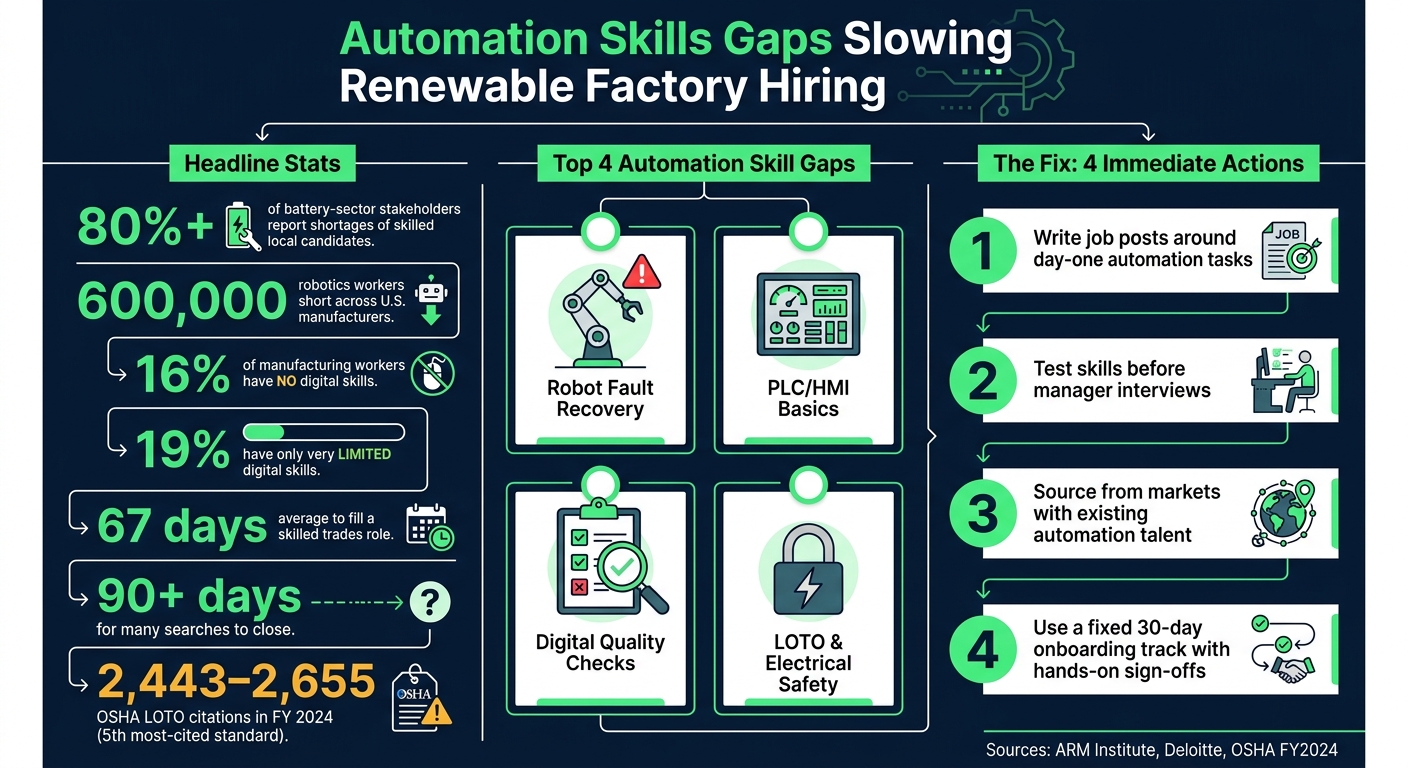
Renewable Factory Hiring Gaps: Key Stats & Skills Shortages
What Role Do Automation Systems Play in Renewable Energy Management?
sbb-itb-aa28329
The automation skill gaps creating hiring bottlenecks
These gaps tend to show up in three places: robot recovery, controls literacy, and automated quality and safety work. That’s where hiring starts to stall. People can apply, but they can’t get through the first hands-on automation checks.
Robot troubleshooting and safe line restarts
Most people applying for operator jobs can run a robot cell when everything is working as planned. The gap shows up the second something goes sideways. Can they move robot axes safely? Can they clear a fault caused by a crooked part or a bad sensor read? Can they restart the line without waiting on maintenance?
Those are the tasks that separate someone you can put on the floor from someone who will need weeks of catch-up training.
Hiring managers across automated renewable plants keep pointing to the same five weak spots:
- teach pendant navigation
- fault identification
- reset and homing steps
- basic gripper and fixture checks
- safe restart after minor stoppages
When plants can’t find people who can handle those tasks on their own, openings stay open longer and early turnover goes up.
The ARM Institute estimates U.S. manufacturers are short 600,000 qualified robotics workers. That shortage hits hardest in operator and junior technician jobs, where basic robot fluency on common platforms is now a standard screen, not a nice extra. The same issue carries over into controls and quality screening.
Controls fundamentals and digital system literacy
Controls knowledge depends on the job, but the gap is biggest for operators and maintenance technicians because they work with automated lines every day.
Operators need to read an HMI alarm screen, spot when a limit switch didn’t make contact, follow on-screen diagnostic prompts, and know what they should not touch before escalating. Maintenance technicians need more than that. They’re expected to trace inputs and outputs, read ladder logic at a basic level, verify signals with a multimeter, and work safely around 480V equipment and variable frequency drives.
Right now, 16% of U.S. manufacturing workers have no digital skills at all, and another 19% have very limited skills. On an automated renewable line, that’s a direct production risk.
Common control systems expect workers to log in, load the correct recipe, read alarms, and enter quality data without errors. A big share of applicants still misses that baseline. That’s why controls literacy often turns into an early screening filter.
Automated quality checks and safety training
On the quality side, the weak points usually center on vision systems, test equipment, SPC, and digital reporting. New operators often misread no-read or low-confidence results from a machine vision camera. Then one of two things happens: they override the check, or they stop the line. Neither option is great.
A lot of applicants also haven’t worked with a control chart or Cp/Cpk metric, so they don’t use SPC as an early warning sign. The result is pretty plain: more scrap, uneven pass/fail decisions, and quality data supervisors can’t rely on.
Safety gaps carry just as much weight. OSHA recorded 2,443–2,655 LOTO citations in FY 2024, making it the fifth most-cited standard, with manufacturing leading all sectors. Many candidates coming from general manufacturing have basic LOTO exposure, but they haven’t worked with the electrical, hydraulic, and pneumatic energy sources common on automated battery and wind lines.
Battery plants add another layer. Hazardous DC and AC voltages, plus arc-flash risk, mean workers need to understand electrical safety basics, not just general PPE rules. When candidates don’t have that background, they need close supervision in their first few weeks. That puts more strain on experienced staff and slows ramp-up for the whole line.
Once employers can see those gaps clearly, they can screen for them earlier and train for them sooner.
How employers can tighten hiring before roles stay vacant
A lot of these gaps can be handled much earlier in the process: at hiring. The big shift is simple. Stop posting broad, fuzzy job descriptions and start hiring for the exact automation skills the job needs on day one.
Write role-specific job requirements around must-have automation skills
Break each job posting into two buckets:
- Day-one requirements
- Skills you can teach after hire
That split matters. It tells candidates where the line is.
For operators, spell out the basics: PLC/HMI knowledge, LOTO awareness, and line start/stop sequences. For robot technicians, require experience with one major platform – FANUC, ABB, or KUKA – plus teach pendant use and fault recovery. Put site-specific software and path optimization under preferred skills.
Safety and credentials should be just as clear. List required certifications and training at the top, including OSHA 10/30, NFPA 70E, and equipment-specific credentials. When people can see what is required versus what can be taught, many will screen themselves out before anyone wastes time.
Once the posting is this specific, the next step is to test whether those claims hold up.
Use practical screening to verify skills early
A polished interview can hide a lot. In automation hiring, talk alone usually isn’t enough.
Start with a short skills screen before manager interviews. For operators, that might be a quick HMI exercise where the candidate reads alarms and picks the right response. For robot technicians, a simple task – like jogging a robot to a safe position or editing a pre-written program in offline software – often tells you more than a long conversation about old job titles.
If an on-site skills test isn’t possible, use scenario questions. For example:
how a candidate would diagnose a camera-based quality station that starts flagging parts that look acceptable.
That kind of prompt shows how the person thinks under normal plant conditions, not just how well they interview.
At the same stage, verify certifications with a short checklist tied to the role. That keeps the process tight and cuts down on late-stage surprises.
Use labor data and workforce platforms to find qualified workers faster
If stronger postings and better screening still don’t fill the role, the issue may be sourcing. At that point, it makes sense to look in labor markets where these skills already exist.
Skilled trades like maintenance technicians and CNC machinists take an average of 67 days to fill, and searches often run past 90 days.
Regional labor market data can help narrow the search. State workforce agencies and industry analytics can show where automation technicians are concentrated, which certifications show up most often in a metro area, and whether your pay lines up with the local market.
If you need another sourcing option, ABLEMKR can help. ABLEMKR matches renewable manufacturing employers with pre-vetted workers screened for certifications, safety training, availability, and location. Its compliance tracking lets hiring teams see worker status in real time, so they can move faster without losing sight of the details.
Build onboarding that closes gaps without slowing production
Hiring can screen for automation skills, but it rarely solves the whole problem. Some gaps still show up on day one. That means onboarding has to finish the job – and do it fast, without dragging down output.
Set up a first-30-day onboarding track for automated lines
Run one fixed 30-day track across every shift. That matters more than many plants think.
Days 1–3 should focus on safety first: LOTO procedures, arc flash awareness, machine guarding, and emergency stop protocols. Use plant-specific examples before anyone gets close to live equipment. In week one, add controls basics and line SOPs, including startup and shutdown sequences, alarm hierarchy, and HMI navigation in a training or sandbox mode.
Weeks two and three should move into supervised hands-on work. New hires perform clearly defined tasks while a lead watches closely, then earn sign-off as they show they can do the work the right way. By week four, the focus shifts to competency checks. And not just written tests. Use practical evaluations with documented sign-offs for critical tasks like line restarts and quality checks.
This is where many plants stumble: shift-to-shift variation. If each supervisor handles onboarding their own way, results will be all over the map. A single digital onboarding playbook, tied to the same competency checklists and sign-off rules, keeps standards steady no matter who is running the shift.
Train for the exact weak points causing downtime and rework
Don’t guess at training needs. Use downtime and quality data to spot the exact trouble points new hires are most likely to hit.
Pull the last 90 days of downtime logs and quality reports. Then find the top repeat failure modes, such as robot fault responses, missed HMI alarms, and incomplete quality documentation. Build short modules around those exact issues instead of stuffing everything into broad orientation.
A 60–90 minute module on the top 10 robot fault types, with simulated recovery drills, will do more than broad orientation.
The same goes for HMI training. Map the screens people use most, teach alarm acknowledgment and escalation, and let workers practice in a sandbox before they touch a live line. That kind of practice is far more useful than handing someone a manual and hoping it sticks.
Build upskilling paths with schools and internal leads
Onboarding should fix today’s gap, but it should also make the next hire easier.
Partnerships with community colleges and technical programs can help if they’re built around competency maps you provide. When those programs line up with your needs, candidates can come in with mechatronics basics, PLC fundamentals, and industrial safety already in place. Then your onboarding can stay focused on plant-specific SOPs instead of reteaching the basics from square one. That cuts ramp-up time and helps reduce how long jobs sit open.
Inside the plant, experienced operators and technicians already hold a lot of the know-how new hires need. Put that knowledge into a formal system. Set up train-the-trainer roles and stackable credentials in robotics, electrical basics, and quality systems. That gives workers a clear path to build skills and helps keep hard-earned knowledge from walking out the door.
Conclusion: Treat automation gaps as a staffing system problem
Hiring in renewable factories often slows down for a simple reason: having applicants isn’t the same as having people who are ready for automated production.
A candidate may know how to run basic machinery and still struggle to safely restart a robot cell, read a PLC alarm, or finish an automated quality check without help. That’s not just a hiring issue. It’s a system issue, and it calls for a system fix. The answer isn’t only more applicants. It’s a hiring and training setup built for automation.
The biggest trouble spots stay the same: robot recovery, controls basics, automated quality, and live-equipment safety. These aren’t edge cases. They’re day-to-day tasks that decide whether a line keeps moving or sits idle. In renewable factories, that shows up fast as slower startups, more overtime, and missed delivery windows.
Once those gaps are clear, the hiring process needs to deal with them before day one. Clear job requirements help screen in people with the right skills from the start. Practical screening checks those skills before an offer goes out. Structured onboarding helps close the gaps that remain. Then targeted upskilling, tied to actual downtime data and backed by technical school partnerships, helps keep the talent pipeline from drying up again.
When hiring, screening, and onboarding work as one system, ramp-up moves faster and supervisors spend less time doing hands-on oversight. The fastest factories treat automation readiness as part of hiring, not as a separate training issue – from the job post to the first production shift.
FAQs
Why is automation slowing hiring in renewable factories?
Automation can slow hiring for a simple reason: it cuts demand for some roles, but it also creates a need for people with more technical skills.
That shift changes the hiring picture. Teams may need workers who can handle robot programming, troubleshooting, and controls. The problem is that many applicants don’t have that background, and training current employees doesn’t happen overnight.
There’s another snag too. When training isn’t standardized, companies often take longer to hire and onboard people. At the same time, project downtime can grow as teams adjust to new workflows and figure out how the new setup works day to day.
Which automation skills matter most on day one?
The most important day-one automation skills are digital literacy, mechanical aptitude, and safety awareness.
On day one, workers should be able to use tablets, read digital drawings, and work with cloud-based tools without much hand-holding. They should also be ready to help with machine setup, perform basic sensor checks, troubleshoot simple hardware or software issues, and read task plans, digital models, or system logs to support quality and productivity.
How can employers close these skill gaps faster?
Employers can close automation skill gaps faster with internal upskilling, smart partnerships, and simpler digital rollout. Practical options like on-the-job training, hybrid apprenticeships, and cross-training workers from nearby trades such as HVAC or industrial maintenance can help fill technical roles without a long wait.
For faster mobilization, employers can use ABLEMKR to match pre-vetted, certified workers to job sites based on availability, location, and technical credentials. It also automates compliance tracking, which helps cut onboarding delays.


