
Oil and gas companies need more skilled workers, and apprenticeships are one of the clearest ways to fill that gap. I see the case in the numbers: more than 50% of the current workforce may retire within 10 years, while extraction employment fell from about 152,000 in 2022 to 141,000 by mid-2024. At the same time, employers still need people who can work safely on day one.
Here’s the short version:
- Apprenticeships turn training into hiring.
- Workers get paid while they learn, often around $40,000–$60,000 per year during training.
- Employers get a steadier talent pipeline for welding, electrical, maintenance, instrumentation, pipefitting, and facility support roles.
- Retention tends to be stronger: Registered apprenticeship programs report about 92% employment retention after completion.
- Pay can be strong after completion: completers earn about $77,000 in year one.
- Tracking matters: certifications, safety records, and site-readiness docs need to stay in one place so crews can be placed without delay.
If I had to sum it up in one line, it’s this: apprenticeships help oil and gas employers build workers instead of waiting for the labor market to fix itself.
What matters most is simple: pick the right roles, set clear skill steps, use mentors, track safety and credentials, and keep the admin side under control. That’s how a labor shortage turns into a repeatable hiring pipeline.
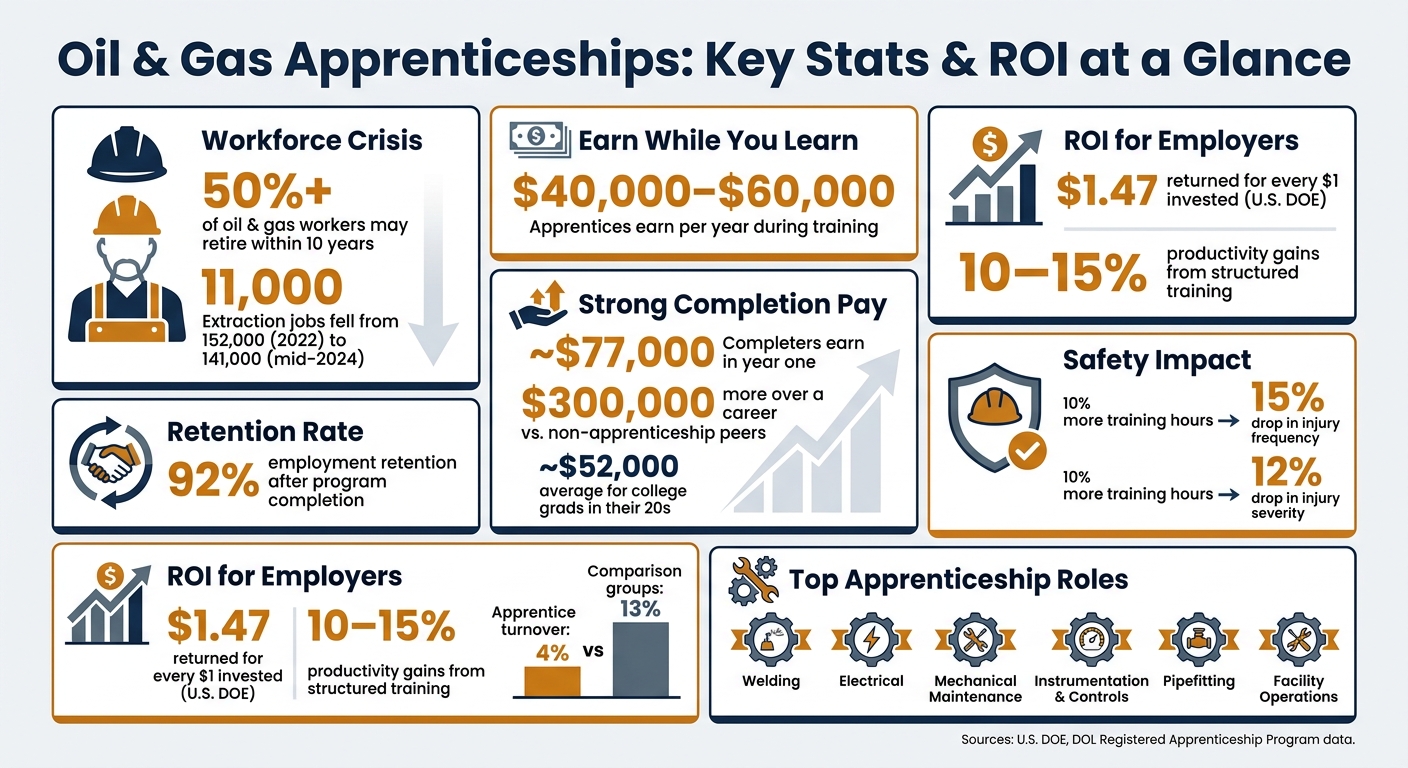
Oil & Gas Apprenticeships: Key Stats & ROI at a Glance
Plumbers & Pipefitters Apprenticeship Program Feeds Oil & Gas Industry | 3 Minutes With 9-7-21
Why apprenticeships work as a direct solution
An apprenticeship is paid, structured training that combines supervised learning on the job with classroom instruction. Workers start earning on day one and finish with a recognized credential or journeyman-level certification. For oil and gas, that setup makes a lot of sense. The work is high-risk, highly specialized, and shaped by site-specific rules. In a tight labor market, training becomes a hiring pipeline.
That’s a big difference from bringing in someone from the outside. A new hire may have broad experience, but they still need onboarding before they can work safely on a given site. Apprentices start by learning the company’s systems, safety habits, and documentation standards from the ground up.
How paid training builds job-ready skills faster
Working under a journeyman or senior technician, apprentices build hands-on skills on actual job sites. That often includes equipment handling, preventive maintenance, instrumentation basics, weld prep, and precise job and safety documentation.
The earn-while-you-learn model also makes entry easier for recent graduates and career changers who can’t step away for unpaid training or full-time school. In energy and related sectors, apprenticeship programs often pay $40,000 to $60,000 per year. That pay range helps bring more people into the hiring pool.
How structured progression improves retention and succession planning
Clear milestones are what set apprenticeship apart from informal training on the job. When workers can see a path from Apprentice I to Apprentice II to Journeyman Technician – with documented skills and pay increases tied to each step – they have a concrete reason to stay.
The numbers back that up. Registered apprenticeship completers earn about $77,000 in year one, which is well above the $52,000 average for workers in their twenties with a college degree. Over a full career, completers earn about $300,000 more than similar workers who did not go through an apprenticeship.
There’s another upside here too: succession planning. Late-stage apprentices can start shadowing lead operators, foremen, or supervisors before a role opens up. That gives companies time to build leadership readiness instead of scrambling when someone retires or leaves. As experienced staff exit the workforce, an internal pipeline with workers at different stages is far more dependable than relying on the outside market.
This kind of structure fits best in roles where tasks build step by step, safety rules are strict, and credentials can be measured.
Where apprenticeship pathways fit in oil and gas operations
Apprenticeships work best in oil and gas when the job builds in clear stages, safety rules are strict, and progress is easy to track. Put simply, they fit roles where people learn by doing, repeat the same core tasks, and move forward only after they’ve shown they can do the work safely.
That’s why the strongest apprenticeship targets are usually the jobs built around repeatable work, written procedures, and documented qualifications.
Roles that align well with apprenticeship models
The roles that line up best with apprenticeship models are welding and pipeline welding, industrial electrical work, mechanical maintenance, instrumentation and controls, pipefitting and gas system operations, and facility operations support. These are also the roles that can slow a project fast when crews are short.
Public programs make this pretty easy to see. MidAmerican Energy offers registered apprenticeship tracks for Certified Pipeline Welder, Journeyman Gas, Gas Technician, Instrument Technician, Gas Serviceman, and Substation Electrician. Colorado Springs Utilities shows a similar setup, with pathways for Gas Pipefitter, Instrument and Control Apprenticeship, Power Plant Electrician, Power Plant Mechanic, and Substation Technician.
| Role family | Core tasks learned through apprenticeship | Operational value |
|---|---|---|
| Welding / pipeline welding | SMAW, GTAW, FCAW processes; visual inspection; NDT basics | Pipeline fabrication, repair, integrity work |
| Electrical / instrumentation | Power distribution, control panels, PLC/DCS hardware, calibration | Controls, power systems, troubleshooting |
| Mechanical maintenance | Pump and compressor inspection, lubrication, precision repairs | Rotating equipment reliability |
| Pipefitting / gas system work | Valve maintenance, corrosion monitoring, leak detection | Distribution lines, stations, facility piping |
| Facility operations support | Start-up/shutdown routines, process monitoring, field safety checks | Readiness, basic operations, lead operator prep |
What ties these roles together? The work is hands-on, the standards are clear, and skill growth can be checked at each stage. That makes apprenticeship a strong fit.
Baseline requirements for site readiness
After the role is set, the next question is simple: is the apprentice ready to get on site and work under supervision?
In most cases, baseline readiness includes a high school diploma or GED, safety orientation, required site training, drug and alcohol screening, reliable transportation, and the physical ability to handle demanding field work.
These aren’t random boxes to check. They reflect the day-to-day reality of field work. On an oil and gas site, one missed step can lead to injury, equipment damage, or a shutdown. So employers need people who can meet the job’s physical demands and follow site rules from day one.
Why verified credentials and compliance matter in placement
Putting an unverified worker on site creates safety and compliance problems right away. Operators need to show that workers doing hot work, confined space entry, or electrical tasks hold current, documented certifications. Audits look at training records, and missing paperwork can lead to fines, stop-work orders, or lost contracts.
This is where recordkeeping matters more than people sometimes expect. If certifications, training, and worker availability are scattered across spreadsheets, emails, and paper files, placement gets messy fast.
ABLEMKR keeps verified certifications, safety training, availability, and location data in one system, so employers can place apprentices based on confirmed qualifications. That helps crews mobilize faster for shutdowns or pipeline repairs and gives operators a clear view of compliance across sites and teams.
sbb-itb-aa28329
How employers can build apprenticeship programs that scale
Start with role selection, partners, and training standards
Start by ranking open roles based on three things: how long they stay vacant, what that vacancy costs in downtime, and how much safety risk comes with being short-staffed. Focus first on the jobs that slow production and maintenance the most when crews are thin. If a role stays open for 60–90 days or more, that’s a clear warning sign. The best starting point is the group of roles that score highest across all three factors.
Next, check whether those roles appear on the DOL-approved apprenticeship occupations list. When they do, the work gets easier because the standards and required hours are already mapped out. Then bring in partners like community colleges, trade schools, unions, or workforce boards to help build the classroom side of the program. Those partnerships should spell out annual apprentice targets, the credentials apprentices will earn, and how credits line up.
Once the roles are picked and the partners are in place, the program can shift from planning into day-to-day rollout.
Build around mentors, milestones, and safety tracking
After that, the program needs a mentor setup that works in the field, not just on paper.
Assign journeyman-level or above employees who volunteer to mentor. In higher-risk field roles, keep the ratio at no more than 1–2 apprentices per mentor. Mentors should also get coaching training so they can teach each procedure step by step and give clear feedback tied to skill checkpoints.
Progress should mix time-based and competency-based standards. Set clear levels such as Apprentice I, II, III, and Journeyman, with defined hour requirements for each skill area and sign-offs before someone moves up. Safety should be part of that system, too. If someone has safety violations, they don’t advance. If they maintain a strong safety record, they may move faster within policy limits.
This kind of structure has shown solid results. In one DOL pipeline program case study, apprentice turnover was 4% versus 13% in a comparison group, and more than 90% of completers stayed with their sponsoring employer.
With mentors and milestones set, the next hurdle is the admin load that slows hiring, placement, and tracking.
Use workforce technology to reduce hiring and onboarding friction
Keep apprentice hours, certifications, safety training, and wage progression in one system. That cuts audit risk and helps avoid the back-and-forth that delays placement. For teams spread across multiple locations, ABLEMKR can match pre-vetted workers to open assignments using verified certifications, safety training, availability, and location. It confirms qualifications before anyone arrives on site.
That means employers can place apprentices faster for shutdowns, pipeline repairs, and other time-sensitive jobs.
That kind of day-to-day visibility is what helps turn apprenticeships into a workforce system that can grow with demand.
Business impact, common barriers, and next steps
What employers gain from investing in apprenticeships
Once the program is in place, the next question is simple: Does it pay off?
When apprenticeships are structured well and tracked over time, the return tends to show up in three places that matter to employers: retention, productivity, and safety. The U.S. Department of Energy reports an average return of $1.47 for every $1 invested in Registered Apprenticeship Programs, and RAPs have an average 92% employment retention rate after completion.
The upside isn’t just about dollars. Companies that put money into structured training report 10%–15% productivity gains. And in high-hazard settings like oil and gas, safety carries just as much weight. A 10% increase in training hours is linked to a 15% drop in injury frequency and a 12% drop in injury severity.
That changes the staffing picture fast. Instead of scrambling with reactive hiring, employers can build a steadier pipeline, ease staffing swings, and cut the risk of last-minute compliance problems.
What to fix first when programs stall
When an apprenticeship program stalls, the problem is usually in the day-to-day execution, not the big-picture plan. The most common issues are admin burden, uneven or overloaded mentorship, broken coordination with training partners, and weak competency or certification tracking.
Start with the competency map. If mentors and apprentices can’t use it with ease, the whole program starts to wobble. Vague milestones lead to uneven coaching, mixed expectations, and slower progress.
After that, look at partner coordination, mentorship, and tracking. If classroom instruction doesn’t match what the job site asks for, apprentices show up underprepared and supervisors start losing faith in the program. That gap can throw everything off.
A good reset usually includes:
- Reviewing the curriculum with training partners so it lines up with field work
- Agreeing on shared performance measures, like completion rates and certifications earned
- Tightening mentorship expectations so support stays steady
- Making tracking easier so employers can see progress without digging through scattered records
ABLEMKR can help by centralizing verified profiles, onboarding, and compliance tracking, which gives employers real-time visibility into task readiness.
Conclusion: Apprenticeships turn labor shortages into workforce pipelines
That is what turns a labor gap into a workforce pipeline.
The skilled labor gap in oil and gas is real, and it will not close on its own. Apprenticeships work because they combine paid, role-specific training with structured progression. The result is workers who are field-ready, safety-compliant, and more likely to stay.
When programs are built around clear competency maps, supported mentors, and digital credential tracking, they stop looking like a one-time hiring patch. They become a workforce pipeline that can keep feeding the business over time.
For oil and gas employers, that pipeline can mean the difference between scrambling to staff a crew before a scheduled shutdown and having the right people already vetted, trained, and ready to go.
FAQs
How long does an oil and gas apprenticeship usually take?
Oil and gas apprenticeships usually last 2 to 5 years, depending on the trade. Some roles can be finished in about 2 years. Broader trades, like electricians, often take 4 to 5 years.
The timeline also depends on how the program is set up. Some use a time-based model, some use a competency-based model, and some use a hybrid approach. In most cases, apprentices complete at least 2,000 hours of on-the-job training each year along with technical instruction.
Which oil and gas roles are best suited for apprenticeships?
Apprenticeships work especially well for oil and gas jobs that depend on hands-on technical skill and direct training from experienced workers.
That includes roles like plant operators, pipeline technicians, maintenance crews, rig workers, and skilled trades such as pipefitters, linemen, and electricians. The same approach also fits newer jobs in grid management, carbon capture, and automated systems maintenance.
What makes an apprenticeship program successful at scale?
Successful large-scale apprenticeship programs mix careful planning with hands-on learning and classroom teaching.
In most cases, the setup is pretty clear: apprentices complete at least 2,000 hours of on-the-job training and 144 hours of related instruction each year. That gives people time to learn by doing while also building the technical knowledge they need in the classroom.
These programs also tend to grow more smoothly when they rely on a few core pieces:
- Formal standards that keep training consistent
- Flexible credentialing that supports different paths and skill levels
- Broad occupational training that prepares apprentices for more than one narrow task
- Strong partnerships between employers, training providers, and other groups
- Digital tools to track certifications, compliance, onboarding, and project progress
Put simply, scale doesn’t happen by accident. It comes from a clear system that helps programs train people well and keep the moving parts under control.


