
AI-driven labor cost forecasting is transforming how industries like construction and energy manage project budgets. Traditional methods, such as spreadsheets and historical averages, are familiar and straightforward but struggle with accuracy, speed, and handling complex projects. AI, on the other hand, uses machine learning to analyze vast datasets, providing more precise, real-time predictions.
Key differences include:
- Accuracy: AI achieves 85–90% accuracy, compared to 70–80% for manual methods.
- Speed: AI updates continuously, while manual forecasts rely on static, periodic updates.
- Scalability: AI handles large, multi-site projects seamlessly; manual methods are limited by human capacity.
- Cost: Manual methods are cheaper upfront but lack the long-term efficiency of AI systems.
While AI offers significant advantages, it requires high-quality data, trust in its “black box” predictions, and upfront investment. A hybrid approach – combining human expertise with AI’s capabilities – balances precision with transparency, making it ideal for modern, complex projects.
Traditional Labor Cost Forecasting Methods
Core Techniques and Data Inputs
Traditional labor cost forecasting relies on three main approaches: bottom-up estimating, the unit rate method, and the percentage method. Here’s how each works:
- Bottom-up estimating: This method involves breaking a project into smaller tasks, assigning hours to each based on historical productivity data, and multiplying those hours by the fully burdened labor rate.
- Unit rate method: Historical costs per measurable unit of work – like cost per linear foot of piping – are used to estimate labor costs.
- Percentage method: Often used in early project stages, this approach applies a standard labor percentage of the total project cost to create a quick estimate.
All these methods depend on solid data inputs, such as historical wage rates, burden rates (which include FICA, Medicare, workers’ compensation, and unemployment insurance), union benefits, and past productivity records. It’s crucial to calculate using the fully burdened rate rather than just the base wage. For example, a worker earning $25/hour in base pay may cost between $33 and $40 per hour after accounting for taxes, insurance, and benefits.
While effective in straightforward scenarios, these methods struggle to keep up with the demands of more complex projects.
Where Traditional Methods Work Well
Despite their limitations, traditional forecasting methods remain useful in stable, regulated environments. The calculations – hours worked multiplied by the hourly rate – are simple and widely understood by both financial and operations teams.
“Traditional methods, while less agile, offer a level of familiarity and transparency that many organizations still value, particularly in industries with stable environments or heavy regulatory oversight.” – Adams Smith Williams, Obafemi Awolowo University
These methods are particularly suited to industries like government contracting or public infrastructure, where compliance and auditability are critical. Their structured nature aligns well with the requirements of incremental or zero-based budgeting. Additionally, traditional methods are cost-effective and require no specialized software or advanced technical skills, making them easy to explain to stakeholders.
Where Traditional Forecasting Falls Short
Problems emerge as projects grow in scale and complexity. Manual data entry, for instance, introduces an error rate of 1% to 4%, and these errors compound across larger teams and longer timelines. Another issue is the delay in time-tracking workflows, which can create a 7-to-14-day gap between field activities and their appearance in financial reports.
This lag can lead to significant financial consequences. For example, Dynamic Systems Inc. (DSI) uncovered $2.6 million in time variances that were hidden due to outdated tracking and forecasting processes. Manual systems also struggle to keep up with rapidly changing labor costs or trade-specific wage adjustments.
“A manual estimating process simply can’t process and adjust for all of these variables simultaneously at the speed the market demands.” – Provision
Another often-overlooked drawback is the loss of institutional knowledge when experienced estimators retire. These individuals take decades of pricing expertise with them, leaving teams without the insights that previously made traditional methods effective.
These challenges highlight the need for more adaptive, AI-driven forecasting tools to meet the demands of modern projects.
sbb-itb-aa28329
AI-Driven Labor Cost Forecasting
How AI Forecasting Works
AI forecasting is all about predicting future trends and offering actionable recommendations.
“AI forecasting answers ‘what is going to happen and what should we do about it?'” – Space AI Editorial Team
At its core, AI forecasting relies on machine learning models like Artificial Neural Networks (ANNs) and ensemble methods such as XGBoost. These tools analyze patterns across hundreds of past projects, trades, and schedules, identifying early signs of budget deviations that traditional spreadsheets often miss. By uncovering nonlinear patterns, these models provide insights that are otherwise difficult to detect.
AI draws from a wide range of data sources: payroll records, digital timecards, daily field logs, project schedules, RFIs, change orders, and even external factors like regional labor rates and commodity pricing. Some advanced systems go a step further, using Natural Language Processing (NLP) to extract cost data directly from PDF contracts and subcontractor bids, removing the need for manual data entry altogether.
Key Advantages of AI in Cost Forecasting
The difference in accuracy between AI-driven models and traditional methods is striking. Deep learning models achieve 85–90% accuracy, compared to traditional regression methods, which hover around 70–80%. Ensemble models like XGBoost have shown R² coefficients above 0.95 and Mean Absolute Percentage Errors (MAPE) as low as 9%. These levels of precision are nearly unattainable manually, especially for complex, multi-trade projects.
AI offers more than just accuracy. It continuously updates forecasts, eliminating the long reconciliation cycles that can delay decision-making. This is particularly valuable in industries like construction and energy, where outdated data can hide cost overruns. AI also manages variables that traditional models struggle with, such as seasonality, sudden demand spikes, and regulatory penalties. For example, in cities like Seattle, New York, and San Francisco, predictive scheduling laws require advance notice for shift changes. Violating these laws results in premium pay penalties. AI systems can account for these rules automatically, factoring potential penalties into forecasts before schedule changes are approved.
“AI does not replace field insight. It applies statistical methods to recurring patterns across projects, trades, and schedules.” – CMiC Global
While the advantages are clear, adopting AI forecasting comes with its own set of challenges.
Challenges of Implementing AI Forecasting
AI forecasting isn’t a plug-and-play solution – it depends heavily on data quality. If models are trained on incomplete or inconsistent data, the predictions will be unreliable. Companies that haven’t consistently tracked “actual vs. estimated” costs over time will need to build this foundation before they can see meaningful results.
Another challenge is the “black box” problem. Many AI algorithms don’t explain why they produce specific forecasts, which can make it difficult for project managers and CFOs to trust the results or justify them to stakeholders. Because of this, many firms prefer a “human-in-the-loop” approach, where AI provides insights, but experienced estimators make the final calls.
“AI offers efficiency gains, it must function as a human-assisted ‘copilot’ rather than a full substitute for expert judgment.” – Carlos Umoru, Florida A&M University
Finally, the upfront costs of implementation and the need for integration infrastructure can be significant. Companies must connect HRIS systems, timekeeping platforms, and project management tools into a unified data pipeline. For mid-sized firms without dedicated data engineering resources, this can be a major hurdle.
Will AI forever Change Forecasting? Lecture 3
Traditional vs. AI-Driven Forecasting: A Direct Comparison
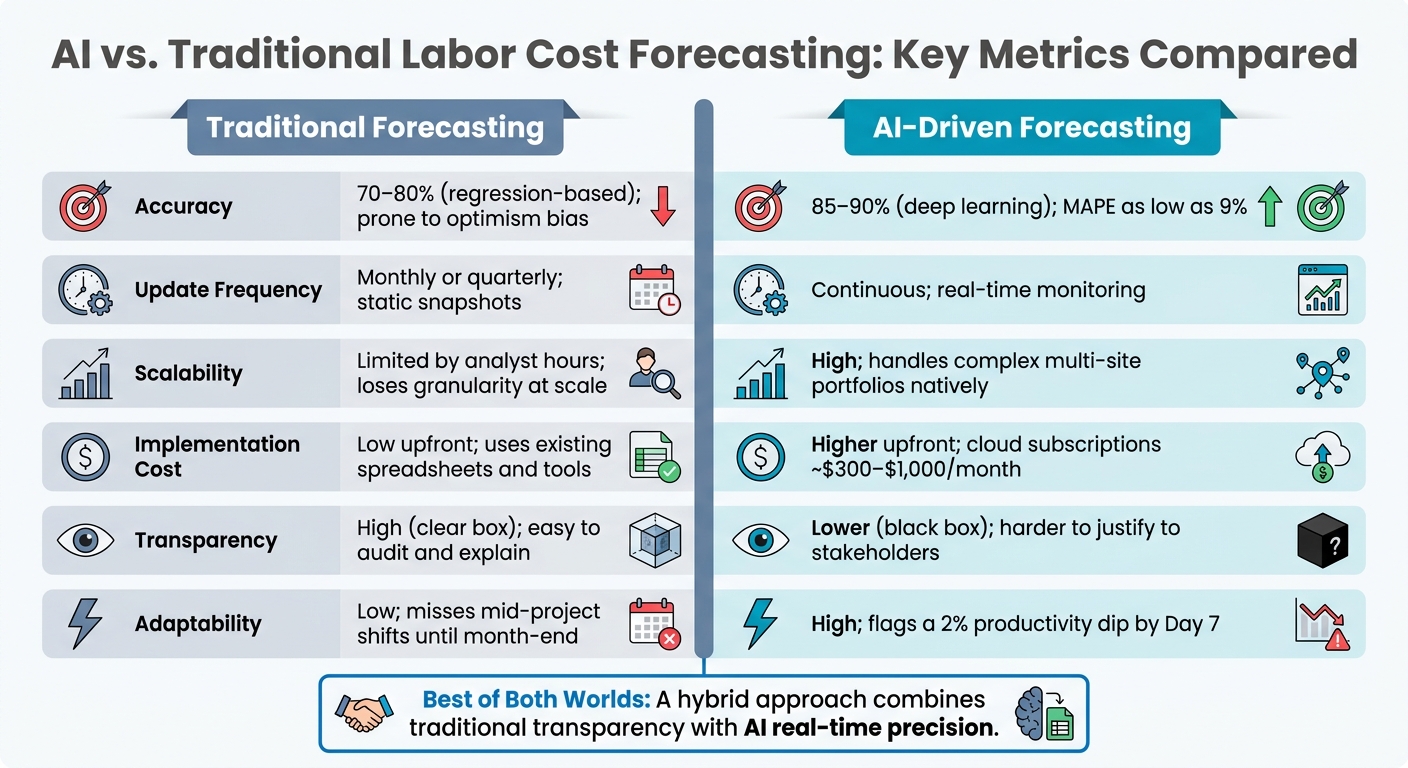
AI vs. Traditional Labor Cost Forecasting: Key Metrics Compared
Key Metrics for Comparison
When evaluating forecasting methods, several factors come into play: accuracy, update frequency, scalability, implementation cost, transparency, and adaptability. These metrics help determine how well a method predicts actual costs, adjusts to changes, scales across projects, stays within budget, remains auditable, and responds to unexpected shifts during a project.
Comparison Table
| Dimension | Traditional Forecasting | AI-Driven Forecasting |
|---|---|---|
| Accuracy | 70–80% (regression-based); prone to optimism bias | 85–90% (deep learning); 70–85% for deviation warnings |
| Update Frequency | Monthly or quarterly; static snapshots | Continuous; real-time monitoring |
| Scalability | Limited by analyst hours; loses granularity at scale | High; handles complex multi-site portfolios natively |
| Implementation Cost | Low upfront; relies on existing spreadsheets and tools | Higher upfront; cloud subscriptions from ~$300–$1,000/month |
| Transparency | High (“clear box”); easy to audit and explain | Lower (“black box”); harder to justify to stakeholders |
| Adaptability | Low; misses mid-project shifts until month-end | High; flags a 2% productivity dip by Day 7 |
The table summarizes the distinctions between the two approaches. Below, we explore their trade-offs and when each method is most effective.
Trade-Offs and When to Use Each Approach
Traditional forecasting works well for straightforward, short-term projects where cost data is predictable, and tools like spreadsheets provide quick and transparent results. It’s a practical choice for projects that don’t demand complex analysis or frequent updates.
On the other hand, AI-driven forecasting shines in large-scale, intricate projects – especially in industries like construction and energy. These sectors often deal with fluctuating labor availability, regulatory changes, and volatile commodity prices. For instance, McKinsey reports that large construction projects typically exceed budgets by up to 80%. By identifying cost deviations early, AI tools help prevent small issues from escalating into costly overruns.
A hybrid approach – combining traditional methods with AI’s real-time capabilities – offers a balanced solution. This strategy maintains the auditability of traditional tools while leveraging AI to monitor risks continuously. As HashLogics aptly stated:
“AI isn’t replacing the project manager – it’s giving them a superpower.” – HashLogics
Next, let’s explore how workforce platforms like ABLEMKR integrate with AI-driven forecasting to enhance project outcomes.
Using ABLEMKR to Support AI-Driven Workforce Forecasting
How Workforce Platforms Improve AI Forecasting
AI forecasting models are only as effective as the data they rely on. When manual reports are used, they often leave gaps that can delay the detection of cost overruns. Workforce platforms tackle this issue by providing a steady flow of real-world field data, such as real-time crew hours, completed tasks, and demand signals. This constant data stream keeps forecasts up-to-date, giving project managers the insights they need to address small variances before they turn into expensive problems. For example, businesses using automated forecasting tools have reported up to a 25% improvement in scheduling accuracy and a 20% reduction in overtime costs. ABLEMKR takes this a step further by using this continuous data to refine forecasts even more.
What ABLEMKR Brings to Cost Forecasting
ABLEMKR enhances cost forecasting by feeding AI models with highly accurate, detailed data. Its pre-vetted worker profiles include essential details like certifications, safety training, and wage information, ensuring that labor cost projections are based on actual figures rather than generalized averages. Even before shifts are published, ABLEMKR can identify potential budget overruns or breaches of overtime limits.
Geo-location data adds another layer of precision. By matching workers to job sites based on their proximity, AI algorithms can minimize travel delays and improve crew reliability. This is especially impactful for large-scale infrastructure projects like pipeline repairs in remote areas, mine development, or utility shutdowns. In these scenarios, accurate worker deployment has a direct influence on cost control. Companies adopting AI-driven workforce solutions often see labor cost reductions of 7% to 15%.
Compliance and Cost Transparency with ABLEMKR
Forecasting labor costs in high-risk industries isn’t just about predicting expenses – it’s also about ensuring compliance and audit readiness. ABLEMKR integrates compliance tracking to automatically flag potential issues, such as violations of predictive scheduling laws, overtime caps, and union agreements, before schedules are finalized. This is particularly important in cities like Seattle, New York, and San Francisco, where laws require advance notice for shift changes, and last-minute adjustments can result in hefty penalties.
Additionally, every schedule modification is recorded for regulatory transparency. With integrated payroll and invoicing features, ABLEMKR eliminates the need for manual reconciliations, offering complete visibility into labor costs. This level of transparency transforms forecasting from a reactive process into a proactive, data-driven strategy – one that aligns with the demands of modern workforce management.
Conclusion: Picking the Right Forecasting Approach
Traditional forecasting methods and AI-driven approaches aren’t at odds – they’re complementary tools, each suited to specific challenges. Traditional models shine in scenarios with stable, predictable variables. On the other hand, AI-driven forecasting thrives in more complex situations, especially when managing large teams, fluctuating labor markets, remote worksites, or stringent compliance demands. The flexibility and real-time insights AI provides go far beyond the static capabilities of spreadsheets, particularly in dynamic environments.
For example, deep learning models have demonstrated accuracy rates of up to 90% compared to traditional methods, highlighting their effectiveness in tackling intricate forecasting challenges. Companies adopting AI-driven forecasting often report reduced overtime costs and improved efficiency. As Anthony Presley, CEO of TimeForge, explains:
“AI forecasting has evolved from an intriguing option to an essential capability for U.S. organizations confronting labor market turbulence, regulatory complexity, and margin constraints.”
That said, AI isn’t a standalone solution. While it excels in processing large datasets and identifying patterns, human expertise remains critical. Experienced professionals are indispensable for interpreting site-specific conditions and managing the human aspects of projects. The most successful strategies blend AI’s computational power with human judgment, creating a hybrid model where both strengths are leveraged.
For industries like construction, oil & gas, and utilities, integrating AI forecasting with a workforce platform such as ABLEMKR bridges the gap between prediction and execution. Tools like ABLEMKR provide pre-vetted worker profiles, real-time geo-matching, and compliance tracking, feeding AI systems with the granular, real-time data they need to stay accurate. This combination transforms labor cost forecasting from a static exercise into a continuously refined, proactive process. By pairing AI-driven insights with human oversight, businesses can respond swiftly to changes while avoiding costly errors, ensuring their forecasting remains both precise and actionable.
FAQs
What data is needed for AI labor cost forecasting to work?
AI-driven labor cost forecasting thrives on a foundation of critical data inputs. To start, historical data – covering labor demand, wages, and project costs – helps identify patterns and trends over time.
Equally important is real-time data. This includes factors like labor availability, certifications, safety training records, and even geo-location details. These dynamic inputs ensure forecasts stay relevant to current conditions.
Finally, incorporating live project details – such as timelines, changes in scope, and workforce availability – adds another layer of precision. This combination of past insights and real-time updates allows for highly accurate and adaptable labor cost predictions.
How can we trust an AI forecast if it can’t explain its math?
Trusting AI forecasts hinges on transparency and a clear understanding of how they work. This is where Explainable AI (xAI) steps in, shedding light on the reasoning behind predictions. For example, it can highlight factors like seasonal trends or resource limitations, allowing users to validate the results.
Without these explanations, “black box” models – those that operate without revealing their internal logic – can erode trust. When people can’t see why an AI reached a certain conclusion, skepticism grows. By incorporating explainability, AI systems inspire confidence and lead to better decision-making. This is especially important in high-stakes areas like financial planning or construction cost estimation, where accuracy and trust are essential.
When does a hybrid approach beat AI-only or spreadsheets?
A mix of AI and human input works better than relying solely on AI or traditional spreadsheet methods, especially when advanced data processing needs to align with human judgment. This approach shines in fast-changing fields like construction cost forecasting. AI delivers precision and real-time updates, while human experience addresses unique challenges, such as sudden market changes or project-specific details. Together, they improve flexibility and decision-making in complicated situations.


