
AI is reshaping how we match people to jobs, focusing on skills instead of resumes. With millions of workers retiring annually and automation set to disrupt 30% of jobs by 2030, industries like construction and energy are facing critical skill gaps. AI offers solutions by identifying skill overlaps and bridging gaps, enabling faster hiring, better workforce planning, and improved career opportunities.
Key insights:
- AI-driven job matching focuses on verified skills like certifications and hands-on experience.
- Cross-skilling adds complementary skills, helping employees shift roles without starting over.
- AI tools analyze workforce data, map skills, and suggest training to fill gaps efficiently.
- Workers gain access to higher-paying roles, while businesses improve hiring speed and compliance.
AI-powered platforms, like ABLEMKR, are already enabling quick workforce deployment and skill transitions, making them critical for industries struggling with labor shortages. By 2030, these tools could contribute $2.9 trillion annually to the U.S. economy.
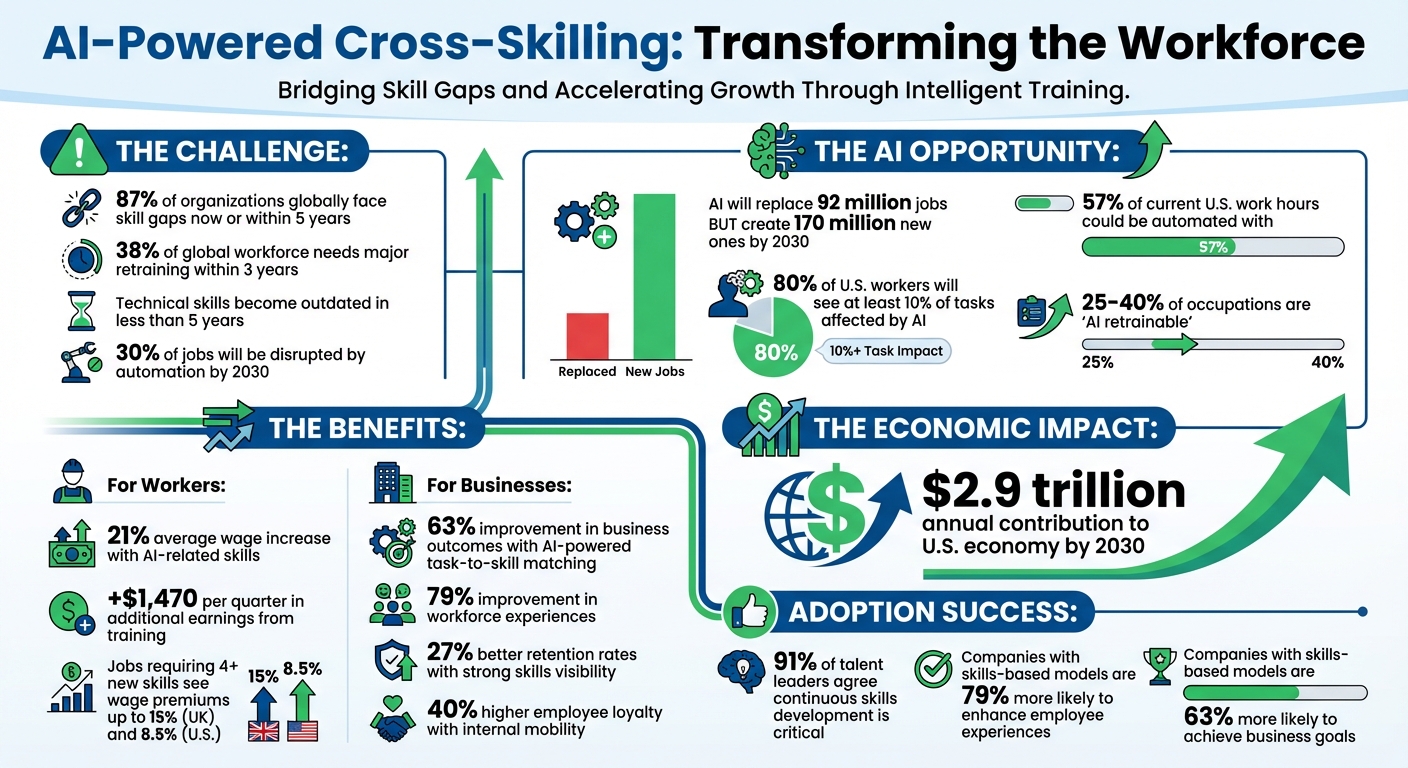
AI-Powered Cross-Skilling: Key Statistics and Economic Impact by 2030
What Is Cross-Skilling and Why Does It Matter?
Cross-skilling is all about broadening an employee’s skill set by adding complementary abilities that help them work across different areas. It’s different from upskilling, which focuses on deepening expertise in one field, or reskilling, which involves training for an entirely new role. Tony Holmes, Practice Lead for Public Sector Solutions Architects at Pluralsight, describes it this way:
“Cross-skilling is about adding breadth or taking what you already know and layering on adjacent, complementary skills that make you more effective in a changing environment.”
This approach creates adaptable teams that can handle unexpected changes, like sudden departures, while also encouraging collaboration by breaking down silos. For industries struggling with labor shortages, cross-skilling offers a flexible solution compared to hiring for highly specialized roles.
The numbers paint a clear picture of the urgency. 87% of organizations globally are already dealing with significant skill gaps or expect to face them within the next five years. Around 38% of the global workforce will need major retraining or replacement within three years to address these gaps. On top of that, technical skills often become outdated in less than five years. Cross-skilling helps bridge these gaps by enabling employees to transition between roles that might not seem connected at first glance, opening up opportunities that traditional hiring methods often miss.
The Growing Need for Multi-Skilled Workers
Industries like construction and energy are increasingly looking for employees who can handle a mix of responsibilities. This shift is largely driven by rapid technological advancements. For example, AI is estimated to replace 92 million jobs but create 170 million new ones by 2030. Meanwhile, 80% of U.S. workers could see at least 10% of their tasks affected by large language models.
In today’s job market, blending technical know-how with digital skills is essential. Workers need to pair their core expertise – whether it’s scientific, commercial, or otherwise – with digital capabilities to stay competitive. Jim Swanson, Executive Vice President and CIO at Johnson & Johnson, explained this during the company’s digital transformation for its 130,000 employees:
“To be relevant and future ready, you for instance need to have your commercial expertise and digital expertise. Scientific expertise and digital. You can have the best technology, but without that integrated way of thinking, it won’t transform anything.”
By March 2024, over 90% of J&J’s Technology group had engaged with the company’s “J&J Learn” platform, leading to a 20% increase in voluntary learning activities and better workforce planning. Being multi-skilled doesn’t just help employees stay relevant – it can also boost earnings. Roles that require a new skill pay about 3% more, while jobs needing four or more new skills can see wage premiums of up to 15% in the UK and 8.5% in the U.S.. Companies that prioritize internal mobility also see employees staying nearly twice as long as those that don’t.
Despite the growing demand for multi-skilled workers, traditional cross-skilling methods often fall short.
Problems with Traditional Cross-Skilling Methods
The old ways of cross-skilling come with plenty of challenges. Many traditional training programs are “supply-driven”, meaning they rely on a one-size-fits-all approach – what some call a “train-and-pray” strategy. These programs often don’t align with the specific needs of the business, leading to low adoption rates and minimal impact.
The hiring process itself can be a barrier. Tony Holmes points out:
“The hiring process is designed to filter people out instead of bringing in those who could grow into the role.”
Rigid job descriptions and hyper-specialized requirements often overlook candidates with transferable skills or valuable experience that doesn’t neatly fit into a standard resume. On top of that, fragmented data across HR systems (like ATS, LMS, and HRIS) makes it hard to get a clear view of an organization’s existing skills. Without this visibility, it’s nearly impossible to identify skill overlaps or build effective cross-skilling strategies. While 91% of talent leaders agree that continuous skills development is critical for business growth, nearly half admit they don’t fully understand the skills their workforce already has.
High costs and poorly targeted training programs add to the problem, frustrating employees and wasting resources. These inefficiencies highlight the potential for AI-driven systems to revolutionize cross-skilling. By aligning training with real-time business demands, modern AI tools can make skill development far more precise and impactful.
sbb-itb-aa28329
How AI Improves Job Matching for Cross-Skilling
AI is changing how job matching works by analyzing vast amounts of workforce data. Instead of relying on outdated job descriptions or guesswork, these systems can assess a worker’s current skills, identify what’s missing, and suggest ways to fill those gaps efficiently. With these capabilities, AI tools are reshaping how skill gaps are addressed.
AI-Driven Skill Mapping and Gap Analysis
AI evaluates worker skills using data from HR systems, recruiting platforms, and certifications. It goes beyond just reading resumes – natural language processing assigns a proficiency score (0–5) that reflects a person’s actual capabilities.
Johnson & Johnson’s Technology group provides a great example of this in action. Their system analyzed data from employees to assess 41 “future-ready” skills, eventually scaling this to 130,000 employees worldwide by March 2024.
Machine learning models like Word2Vec and fine-tuned BERT play a key role here. These models analyze historical job listings to understand how skills relate to one another. For instance, they can suggest adjacent skills that are easier to learn based on a worker’s existing expertise. A welder with pipeline experience, for example, might need only a short training course to qualify for specialized energy sector welding jobs that pay more.
AI also examines how new skills complement current ones. This approach can lead to wage increases of about 21% by combining new skills with existing expertise. Jim Swanson, Executive Vice President and Chief Information Officer at Johnson & Johnson, emphasized this point:
“To be relevant and future ready, you for instance need to have your commercial expertise and digital expertise. Scientific expertise and digital. You can have the best technology, but without that integrated way of thinking, it won’t transform anything.”
Companies often create a “skills taxonomy” – a list of key future-focused skills like robotic process automation or data engineering. AI compares a worker’s inferred skills to this taxonomy, highlighting specific gaps and providing a roadmap for targeted cross-skilling that aligns with both the worker’s abilities and the organization’s goals.
Real-Time Job Matching for Cross-Skilled Workers
AI-powered platforms operate almost in real time. Advanced systems use “nearline inference” to keep professional network data updated without requiring costly real-time infrastructure. LinkedIn’s “LinkSAGE” framework is a great example. It uses Graph Neural Networks (GNNs) to manage a massive job marketplace graph, enabling accurate and timely job matches.
One major benefit is reducing the gap between what employers need and what workers can offer. Many hiring processes are inefficient, but AI resolves this by analyzing internal data to clearly define skill requirements. This improves the clarity of job postings, eliminating vague terms like “familiar with”. AI also identifies emerging skills – those that may not yet appear in official taxonomies like O*NET or ESCO but are gaining traction in the job market. This is vital, as 46% of occupations experience task shifts over four years, even if their job titles remain unchanged.
For workers, this means better matches to jobs that align with their current skills and potential for growth. AI identifies “skill bridges” that connect unrelated job categories through specific combinations of knowledge and abilities. For instance, a construction equipment operator could transition to renewable energy installation with just a few additional certifications.
Case Example: How ABLEMKR Uses AI for Workforce Deployment
AI isn’t just theoretical – it’s delivering real results in industries like construction, energy, and extractives. ABLEMKR uses AI to match pre-vetted workers to job sites based on factors like certifications, safety training, availability, and location. This ensures crews can be deployed quickly, whether for emergency repairs, remote pipeline work, or scheduled projects.
The platform also identifies cross-skilling opportunities that might not be immediately obvious. For example, a pipeline welder with confined space certification could be matched to oil and gas maintenance roles requiring similar safety credentials but offering different challenges. By tracking certifications and training in real time, ABLEMKR recommends courses or credentials that qualify workers for better-paying jobs across multiple sectors.
Employers benefit from access to a larger talent pool with real-time updates on worker availability and compliance tracking. Meanwhile, workers gain flexible access to high-paying jobs and reliable, on-time payments. This AI-driven approach reduces the usual challenges of labor deployment by matching workers to jobs that fit their current skills while also pointing out clear paths for skill development. It’s especially useful in areas like energy corridors and major U.S. cities, where demand for multi-skilled workers is growing alongside the push for digital and green skills.
Benefits of AI-Powered Cross-Skilling for Businesses and Workers
AI-powered cross-skilling brings measurable benefits to both employers and employees. By optimizing task-to-skill matching, it has the potential to boost business outcomes by 63%, improve workforce experiences by 79%, and generate an estimated $2.9 trillion in annual economic value by 2030. These advantages translate into greater efficiency for businesses and meaningful career growth opportunities for workers.
For Employers: Efficiency, Scalability, and Compliance
AI simplifies workforce management by identifying transferable skills, enabling employees to shift from lower-value tasks to roles with higher impact. This is particularly important given that 57% of current U.S. work hours could theoretically be automated with existing technologies, underscoring the need to redeploy human talent toward more valuable contributions.
Take the example of the Mayo Clinic: in May 2025, they increased their radiology staff by over 50% by utilizing hundreds of AI models to focus on complex decision-making tasks. This demonstrates how AI can help businesses scale their operations effectively.
AI also makes scalability more manageable. With demand for “AI fluency” – the ability to effectively use and manage AI tools – growing sevenfold in just two years, organizations can quickly identify which employees are best suited to develop these capabilities. This ensures that businesses remain agile in a rapidly evolving landscape.
Compliance becomes less of a headache, too. Platforms like ABLEMKR provide real-time tracking of worker certifications, training, and availability. For industries like oil and gas or mining, this means employers can mobilize crews for urgent tasks, such as pipeline repairs, while ensuring regulatory requirements are met. For example, the system ensures that only workers with certifications like confined space training or pipeline welding credentials are assigned to those specific roles.
Beth Cobert, President of Affiliates and Strategic Partnerships at Strada Education Foundation, highlighted the evolving role of workers in AI-driven environments:
“If AI can handle some basic tasks, what you really need is judgment – knowledge of what works for your company and how you deliver value to customers.”
For Workers: Flexible Opportunities and Skill Growth
While businesses gain efficiency, workers reap financial and professional rewards. On average, workers with AI-related skills experience a 21% wage increase, with training adding an extra $1,470 per quarter to their earnings. Moreover, 25% to 40% of occupations are considered “AI retrainable”, allowing workers to pivot into higher-paying roles in AI-intensive fields.
AI-powered platforms create dynamic opportunity marketplaces, enabling workers to apply their full range of skills across various roles rather than being restricted by traditional job descriptions. For example, ABLEMKR helps identify cross-skilling opportunities that might not be immediately apparent. A construction equipment operator with safety certifications could transition into renewable energy installation with minimal additional training, unlocking access to better-paying roles across multiple industries.
These platforms also enhance worker confidence and well-being by offering clear, personalized career pathways. Instead of forcing workers to start from scratch, AI builds on their existing skills, empowering them to take control of their career growth.
One compelling example comes from a Strada Education Foundation partnership in San Diego. In October 2025, MiraCosta College collaborated with biotech companies to create a talent pipeline. By using shared lab facilities and expert-led training, over 90% of graduates secured high-quality biotech jobs. This model showcases how AI can align education, industry needs, and worker development, creating value for everyone involved.
The Future of Cross-Skilling with AI
Emerging Trends in AI Job Matching
AI is evolving to do more than just match skills to jobs – it’s now using predictive analytics to identify future talent gaps. Through machine learning and natural language processing, skills inference can assess proficiency by analyzing passive data like job histories and certifications. This makes it easier for workers to showcase their abilities without jumping through hoops.
The 2ACT Framework plays a key role here by highlighting specific combinations of Knowledge, Skills, and Abilities (KSAs) that connect seemingly unrelated occupations. For example, a pipeline welder with safety certifications could transition into renewable energy installation by mastering a few additional skills. AI systems map out these pathways clearly, showing workers exactly which new skills can lead to better-paying roles.
Another advancement, skill complementarity modeling, evaluates how one skill’s value increases when paired with others. This helps workers identify which digital skills best complement their technical expertise, potentially leading to an average wage increase of 21%.
Jim Swanson, Executive Vice President and CIO at Johnson & Johnson, emphasizes the importance of combining expertise:
“To be relevant and future ready, you for instance need to have your commercial expertise and digital expertise. Scientific expertise and digital. You can have the best technology, but without that integrated way of thinking, it won’t transform anything.”
These tools and strategies are paving the way for AI to reshape skill-based operations across various industries.
Scaling AI Solutions Across Industries
The move from job-focused structures to skills-based operating models is gaining momentum, especially in high-demand fields. Companies adopting this approach are 79% more likely to improve workforce satisfaction and 63% more likely to achieve meaningful results. For sectors like construction, energy, and mining, this shift means prioritizing skills over traditional job titles.
The twin forces of digital transformation and the green energy shift – referred to as the twin transition – are creating new opportunities for workforce mobility. AI-driven platforms now help workers from traditional oil and gas roles transition into renewable energy by identifying transferable skills and suggesting micro-credentials to fill gaps. With demand for AI fluency skyrocketing – growing sevenfold in just two years – those who combine technical expertise with AI knowledge stand to earn the highest wage premiums.
To scale these solutions effectively, industries need a shared skills taxonomy. A unified system makes it easier to match workers across sectors. Platforms like ABLEMKR are tackling this by maintaining detailed worker profiles, including certifications, safety training, and availability. This allows for real-time matching, such as when utility companies need emergency crews for storm restoration. The system can quickly identify qualified workers from construction or pipeline backgrounds with the required safety credentials.
The economic upside is massive. By 2030, AI-powered tools and robots could contribute about $2.9 trillion annually to the U.S. economy if companies redesign workflows to encourage human-AI collaboration. While it’s possible to automate up to 57% of U.S. work hours with current technologies, the real value lies in redirecting human talent to higher-impact tasks rather than simply replacing jobs.
In high-risk industries, this means workers can focus on critical decision-making and problem-solving, while AI takes care of routine tasks like compliance and scheduling. Research shows that an augmentative approach – where AI enhances human capabilities – can lead to higher-level job placements. In contrast, automation-focused strategies often push workers toward lower-tier roles.
Conclusion
AI-powered job matching is changing the way we think about hiring, moving beyond job titles to focus on actual skills. This is a big deal, especially since 87% of organizations are either dealing with skill gaps now or expect to face them within the next five years. By using skills inference and real-time matching, businesses can uncover talent they might have overlooked and put it to work where it’s needed most – whether that’s solving immediate staffing challenges or supporting long-term growth.
The advantages are clear for both employers and employees. Companies with strong skills visibility see retention rates improve by up to 27%. On the flip side, employees who make internal career moves are 40% more likely to stay loyal over three years. In industries like construction, energy, and mining, this means faster crew deployment, better compliance tracking, and lower hiring costs. Plus, AI-driven skill development can boost wages by an average of 21%, creating more opportunities for career growth.
AI also helps identify “skill bridges”, which make it easier for workers to transition into higher-paying roles with minimal training. ABLEMKR has built its strategy around this concept, enabling industries with high demand to deploy workers more efficiently. This approach not only addresses immediate skill shortages but also lays the groundwork for a workforce that’s better prepared for the future. Companies that adopt skills-based models are 79% more likely to enhance employee experiences and 63% more likely to hit their business goals.
As automation continues to reshape the job market – potentially eliminating 14% of jobs globally and transforming another 32% over the next 15–20 years – the ability to quickly reassign and upskill talent will be critical. Businesses that invest in AI-driven cross-skilling will gain a clear edge, reducing dependence on external hiring and staying productive as job roles evolve.
The shift toward skills-based workforce management is already happening, with 91% of talent leaders agreeing that continuous skills development is key to business growth. Adopting AI-powered cross-skilling isn’t just a smart move – it’s essential to staying competitive. The real challenge now is how fast your organization can make the transition.
FAQs
How does AI verify skills beyond a resume?
AI goes beyond traditional resumes to evaluate real-world skills by leveraging tools like skill embeddings, natural language processing (NLP), and machine learning. These technologies analyze certifications, proven competencies, and transferable abilities, giving a deeper understanding of what a candidate can bring to the table. Instead of relying solely on job titles or keyword matches, AI emphasizes the context of skills, which leads to more precise and fair assessments in workforce development.
What’s the fastest way to cross-skill into a higher-paying role?
The quickest way to move into a higher-paying role is by leveraging AI-powered reskilling tools. These tools can help pinpoint transferable skills that are in demand, based on what you already know. To make the most of this, focus on areas with high growth potential, like STEM fields or digital skills. Enroll in targeted training programs to build expertise where it counts. Staying committed to learning and keeping up with changing job requirements can make the transition smoother and save you time and energy.
How can ABLEMKR help employers track certifications and compliance?
ABLEMKR simplifies the process of managing certifications and compliance by handling worker credential verification, keeping tabs on renewal deadlines, and automating updates via comprehensive digital profiles. This gives employers real-time insights into their workforce’s qualifications, helping them stay aligned with safety requirements and industry regulations.


