
AI is transforming how construction companies hire and manage workers. Traditional staffing methods often involve time-consuming tasks like verifying certifications, juggling phone calls, and dealing with no-shows. AI-powered platforms streamline these processes, saving time and ensuring qualified workers are matched to jobs quickly.
Here’s how it works:
- Worker Profiles: AI builds verified profiles with certifications (e.g., OSHA 10/30), performance data, and insurance coverage.
- Job Postings: Employers specify project needs, and AI filters candidates based on skills, certifications, and availability.
- Fast Matching: Workers are matched and notified within 24-48 hours, with same-day placements possible for urgent needs.
- Onboarding: Automated tools handle paperwork, verify credentials, and prepare workers for the job site.
- Tracking: GPS-based check-ins and performance ratings improve accountability and workforce management.
AI platforms like ABLEMKR are helping construction companies address labor shortages, deploy workers faster, and reduce administrative burdens – all while ensuring compliance and safety.
THIS AI Tool Will Change Everything You Know About Workforce Management | Lou Perez
sbb-itb-aa28329
How AI Matches Workers to Jobs
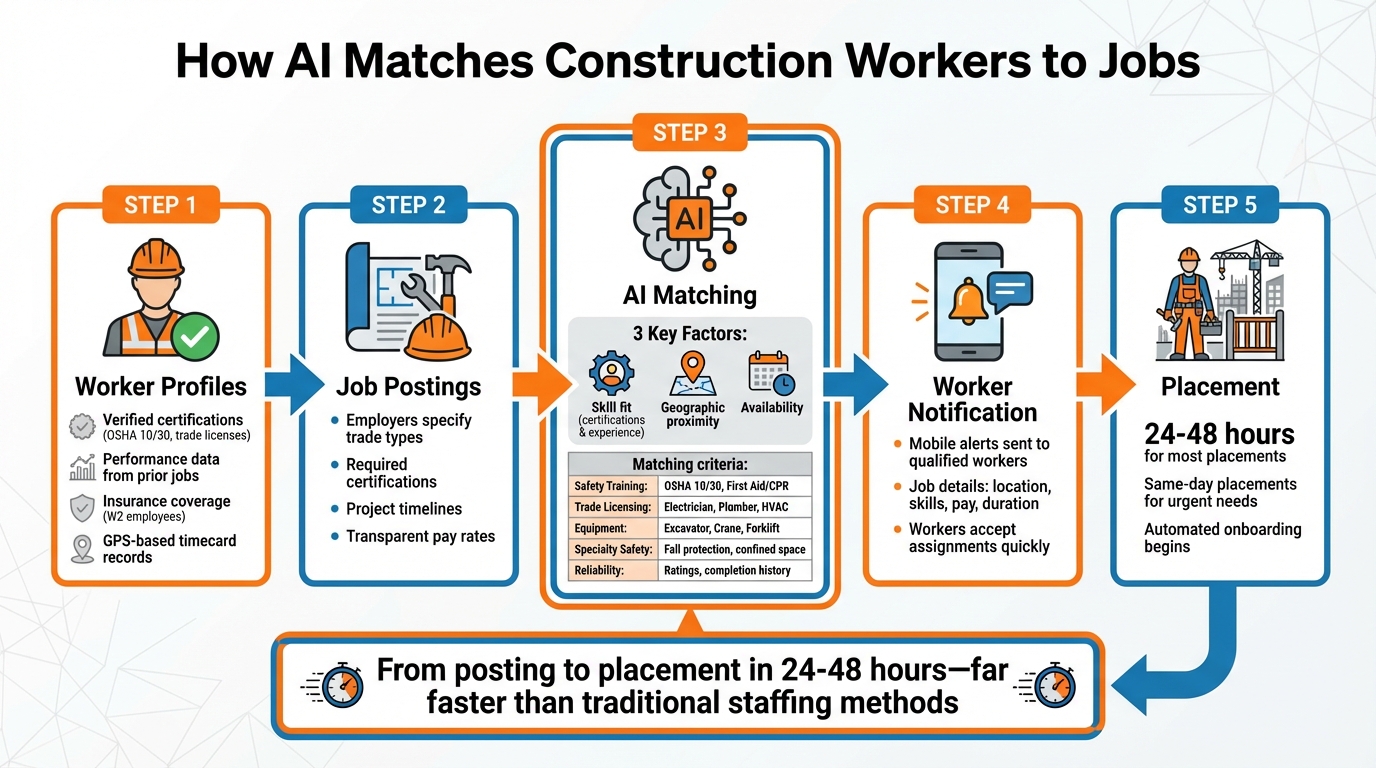
How AI Matches Construction Workers to Jobs in 5 Steps
AI-driven staffing platforms streamline the process of connecting construction projects with qualified workers. It begins with verified worker profiles, progresses through detailed job postings, and culminates in quick matches that can place workers on-site in as little as 24 to 48 hours.
Building Verified Worker Profiles
Worker profiles are the backbone of AI matching. These profiles include verified certifications such as OSHA 10/30, trade licenses, and heavy equipment certifications. The system also tracks specialized safety qualifications like fall protection, confined space entry, trenching, and rigging certifications.
But it doesn’t stop at credentials. AI platforms integrate performance data from prior jobs, including supervisor ratings and GPS-based timecard records, to ensure reliability.
Matched workers are provided as insured W2 employees, complete with workers’ compensation and general liability coverage. This eliminates the headache for contractors of verifying insurance certificates and employment status. By automating these compliance checks, the platform ensures every worker is legally ready to work before being matched to a job.
Once worker profiles are set, employers can refine the process further by detailing their specific job requirements.
Posting Detailed Job Requirements
Employers input their project needs directly into the platform, specifying trade types (e.g., carpenters, equipment operators, or concrete finishers), required certifications, project timelines, and pay rates. The more precise the job posting, the better the AI can filter candidates. For instance, if a project calls for a confined space certification or forklift operators with at least three years of experience, the system prioritizes workers who meet those exact criteria.
"Specify what you need, and we’ll only show you workers who already have those credentials." – ABLEMKR
Contractors can also set transparent pay rates, which helps attract workers who meet the skill and budget requirements. The platform displays proposed rates without hidden fees, so workers know exactly what they’ll earn before accepting a role.
With both worker profiles and job details in place, the AI gets to work matching candidates.
Automated Job Matching
Once a job is posted, AI algorithms compare the requirements against thousands of worker profiles. Candidates are ranked based on three key factors: skill fit (matching certifications and experience), geographic proximity (workers close enough to commute), and availability (who can start immediately or within the required timeframe).
Workers receive mobile alerts with concise job details, including location, skills required, pay, and duration, allowing them to accept assignments quickly.
The system evaluates candidates using a range of criteria, including safety training, trade licenses, equipment operation expertise, specialty certifications, and reliability metrics:
| Matching Criteria | Specific Data Points |
|---|---|
| Safety Training | OSHA 10, OSHA 30, First Aid/CPR |
| Trade Licensing | Journeyman/Apprentice Electrician, Plumber, HVAC |
| Equipment Operations | Excavator, Bulldozer, Crane, Forklift |
| Specialty Safety | Fall protection, confined space, trenching, rigging |
| Reliability Metrics | Peer ratings, job completion history, GPS timecard data |
For urgent situations, the platform can even arrange same-day placements depending on location and worker availability. Most job postings receive qualified applicants within 24 to 48 hours – far faster than traditional staffing methods that rely on manual credential checks and lengthy phone calls.
Simplifying Onboarding and Deployment
When a job offer is accepted, ABLEMKR gets to work right away, streamlining the onboarding process. Traditional onboarding often drags due to manual tasks like paperwork and certification checks. ABLEMKR’s AI-powered platform automates these steps, cutting through the delays to get workers ready for the job site faster.
Real-Time Onboarding
ABLEMKR’s platform takes over the repetitive tasks that typically bog down onboarding. It automatically verifies licenses, processes e-signatures, and pre-fills forms, minimizing errors along the way. Workers can complete safety training, watch site-specific videos, and take orientation quizzes right from their mobile devices before even stepping on-site. This means they’re ready to hit the ground running as soon as they arrive.
Using AI for onboarding doesn’t just save time – it significantly reduces HR’s workload. For example, the administrative time spent on each new hire can drop from 20 hours to 12 hours. The platform also makes credential management a breeze. QR codes and mobile scans instantly confirm certifications like OSHA compliance, trade licenses, or specialized safety training at the site entrance. Automated alerts notify workers and managers when certifications are about to expire, avoiding compliance hiccups. Plus, AI chatbots are available 24/7 to answer common questions about benefits, site rules, or equipment, easing the load on HR teams. Companies adopting AI-driven hiring and onboarding systems have reported a 35% reduction in cost per hire. And once onboarding is complete, geo-fenced check-ins simplify the next step: getting workers on-site.
Geo-Fenced Check-Ins and Deployment
Adding to the efficiency of onboarding, ABLEMKR’s geo-fencing technology streamlines site check-ins. GPS creates virtual boundaries around job sites, and as soon as a worker enters the area, the system automatically logs their arrival. This eliminates the need for manual time clocks and prevents buddy punching.
For project managers, this real-time tracking is a game-changer. Through a mobile app, they can instantly review GPS-enabled timecards and spot any discrepancies. This visibility ensures accurate labor costs and reliable deployment records since check-ins only register when workers are physically present. It’s a simple yet effective way to maintain accountability and keep operations running smoothly.
Improving Workforce Management with AI
Once workers are deployed, ABLEMKR’s AI doesn’t stop – it keeps fine-tuning staffing processes in the background. By using real-time data and predictive analytics, the platform continuously improves how workers are matched, managed, and deployed. Instead of just filling positions, it refines staffing decisions based on feedback from each project.
Tracking Worker Performance
The ABLEMKR mobile app offers real-time tracking and alerts for any discrepancies. GPS data ensures workers are on-site and provides accurate labor tracking. A rating and review system also drives performance improvements. After each project, employers evaluate workers on reliability, skill, and professionalism. These ratings feed into the AI’s algorithm, helping prioritize top-performing workers and maintain a high-quality workforce.
To make hiring decisions easier, employers can access worker flash cards that display historical ratings. Real-time data also helps managers resolve payroll discrepancies on the spot, cutting down on administrative delays. One site superintendent from a general contractor shared:
"The app made managing daily timecards and weekly payroll simple, saving us countless admin hours"
By combining these performance insights with predictive analytics, staffing strategies are continuously refined.
Using Predictive Analytics for Staffing Needs
Predictive analytics takes workforce management a step further by forecasting staffing needs. By analyzing historical project data and real-time trends, the system can predict labor shortages before they impact timelines. This allows managers to adjust staffing levels proactively, keeping projects on schedule. The AI also optimizes work schedules by matching workers to tasks that suit their skills and availability, reducing downtime and improving productivity.
The challenges are clear: in 2025 alone, over 439,000 new workers were needed, and nearly 70% of companies struggled to find qualified labor. Adding to this, more than 20% of the construction workforce is over 55 and nearing retirement. Predictive analytics helps bridge these gaps by identifying patterns in worker availability and project timelines. For instance, BAM Ireland used BIM 360 Construction IQ from 2023 to 2025 to manage project risks. The system flagged documentation issues overlooked by human teams, leading to a 20% boost in on-site quality and safety, while staff spent 25% more time on high-risk tasks instead of admin work.
Allison Scott, Director of Construction Thought Leadership at Autodesk, highlighted this shift:
"What technology like data analytics… is doing for us is unlocking our ability to harness the project data – organize it, interpret it to uncover patterns faster"
These forecasts not only address immediate staffing needs but also feed back into the system, ensuring continuous improvement in job matching and workforce management.
Conclusion
AI is reshaping how construction staffing works. Instead of spending countless hours juggling phone calls and paperwork, platforms like ABLEMKR streamline the entire process. From matching workers to jobs to managing GPS-verified timecards and payroll, everything is handled with precision and efficiency. This shift replaces outdated manual recruitment methods with faster, more reliable solutions.
Patrick Wallain, President and CEO of ABLEMKR, summed up this transformation perfectly:
"The technology has really increased who we can find and how quickly we can find them. The future of recruitment, the future of project-based staffing, I think, lies there."
For contractors, this means fewer headaches: less time wasted on no-shows, faster crew deployment, and lower administrative costs. Workers also reap the benefits – transparent pay rates, W2 employment with workers’ compensation coverage, and access to competitive opportunities across the U.S. The platform takes care of the details, from certifications and safety training to geo-location matching, freeing up both sides to focus on the work itself.
ABLEMKR isn’t stopping with construction. The platform is expanding into industries like energy and extractives, bringing its mobile-first technology to high-demand, high-risk sectors. Whether it’s a last-minute shutdown, a remote pipeline repair, or a planned mine development, AI-powered staffing ensures teams are deployed quickly and managed effectively.
This approach meets the modern needs of construction and industrial operations, offering a smarter, more efficient way to connect workers and projects.
FAQs
How does AI confirm that construction workers are properly certified and qualified?
AI plays a crucial role in confirming that construction workers have the proper certifications and qualifications. It does this by analyzing profiles that detail certifications, safety training, and work history. This process ensures workers meet industry standards and safety requirements before being assigned to a job.
By automating verification, AI reduces errors, speeds up the process, and ensures only qualified workers are sent to job sites. This helps employers uphold compliance and maintain safety across their projects.
How does AI help save time and reduce costs when onboarding construction workers?
AI makes onboarding construction workers faster and more efficient by automating job matching. It uses factors like skills, certifications, and location to quickly connect workers with the right roles. This eliminates the need for time-consuming manual reviews of applications.
AI-powered platforms also streamline verification processes and enable real-time job placements. Companies can fill open positions much faster, sometimes reducing hiring times by as much as 60%. By cutting down on inefficiencies and lowering administrative tasks, AI not only saves time but also helps reduce hidden costs, improving how effectively the workforce is deployed.
How does AI help solve construction labor shortages?
AI addresses construction labor shortages by leveraging predictive analytics to evaluate data like worker skills, certifications, and project needs. This helps identify potential workforce gaps and align qualified workers with jobs before shortages become an issue.
By optimizing hiring and deployment processes, AI helps construction projects stay on track, cuts down on downtime, and enables companies to quickly assemble skilled teams – whether for emergency repairs or planned projects. This forward-thinking approach keeps operations running smoothly and reduces delays in the fast-paced construction industry.


