
Construction still needs about 499,000 to 501,000 new workers in 2026, and AI hiring tools help contractors fill jobs in hours instead of days. I’d sum it up this way: these tools cut time spent sorting resumes, check skills and certs before dispatch, and help crews show up ready to work.
If you need the short answer, here it is:
- Labor gaps are still large: about 94% of contractors report trouble filling roles
- The hardest jobs to fill are skilled trades and field leads
- Manual hiring is too slow for same-day or next-day crew needs
- AI tools screen workers fast by skill, certification, location, and availability
- The main results to track are fill rate, time-to-fill, and no-show rate
- Compliance checks matter too: expired credentials can sink a shift before it starts
What stands out to me is simple: AI hiring does not fix the labor shortage by itself. But it helps contractors use the labor they can find with less delay, less guesswork, and fewer gate-check problems.
Here’s the core comparison:
| Area | Manual hiring | AI-assisted hiring |
|---|---|---|
| Screening | Calls, spreadsheets, email | Automated matching |
| Speed | Often days or weeks | Often same day or within hours for urgent needs |
| Worker fit | Mixed | Ranked by role match |
| Cert checks | Manual | Built into workflow |
| Last-minute fills | Hard to manage | Easier to dispatch nearby workers |
| Admin time | Higher | Lower |
So if you’re asking what changes on the jobsite, my answer is: faster fills, better crew readiness, and fewer shifts that look covered but fail in the field.
How AI hiring tools reduce the staffing bottleneck
AI hiring tools cut a big chunk out of the staffing bottleneck by automating screening and matching. That means open requisitions can turn into confirmed workers in hours instead of days. Instead of a site admin working down a contact list, or an HR team sorting through a stack of applications, the platform searches a pre-vetted worker database right away, checks candidates against the role, and returns a ranked shortlist. Screening can happen in seconds based on things like availability, location, and certifications.
Faster candidate matching for trade and field roles
For trade and field hiring, speed matters. AI hiring systems use text parsing to pull role-specific skills and credentials from worker profiles, including operators, welders, electricians, and foremen. After that, the system compares those details with the open role and ranks candidates by fit.
So the superintendent doesn’t get a pile of unfiltered applications. They get a ranked shortlist.
That matters because construction hiring has a major filtering problem. There’s a lot of noise to cut through. AI matching helps by surfacing only trade-verified profiles that meet the exact needs of the role, whether that’s an NCCCO-certified crane operator or another worker with the right trade skills and project background.
Better matches using skill, certification, and availability data
This is where AI hiring tools move past manual review. A person working under time pressure will often check a few basics, usually credentials and location. An AI matching engine can review many factors at once:
- trade skills
- years of experience in specific project types
- current certification status, including expiration tracking
- preferred shift types
- earliest start date
All of that happens before a single call is made.
That mix helps close the readiness gap. A worker might have a valid OSHA 30 card but not be free until next week. Someone else might be available tomorrow, but their confined space training expired last month. In both cases, the system filters them out on its own.
What the contractor gets is a shortlist of workers who are ready for that role that day. Platforms like ABLEMKR match pre-vetted workers to job sites by certification, safety training, availability, and location, helping contractors mobilize crews fast without losing compliance.
Location filters then take that shortlist one step further, moving it from qualified to deployable.
sbb-itb-aa28329
The features that matter most on construction sites
After workers are matched by skill and certification, the next test is simple: how fast can they get on site? The best tools fill roles fast with people who can start right away. With nearly half a million open roles still weighing on the industry, speed isn’t a nice extra – it’s a must.
Skill matching and certification tracking for job-ready workers
Unvetted labor pools create compliance risk on regulated sites. If an unqualified worker gets sent to a regulated role, the problem starts before the shift even begins.
Skill matching helps fix that. It compares worker profiles against the exact needs of the role, including trade experience, equipment familiarity, and safety credentials. Then it shows only the workers who fit.
Certification tracking goes a step further. A strong platform stores each worker’s credentials, tracks expiration dates, and filters out anyone whose training has lapsed. Construction roles often need proof of OSHA training, forklift credentials, fall protection, and other project-specific documents. A strong platform checks for OSHA 30, NCCER certifications, and safety paperwork before a worker is matched, so contractors don’t have to scramble through compliance checks at the gate.
Location filters that speed up worker deployment
Proximity cuts fill time. A worker who’s far from the job site is more likely to miss the shift, especially for short-notice work, one-day assignments, or jobs in remote industrial zones. Location filters narrow the pool to workers already within a practical travel radius, which makes same-day fills far more realistic.
This matters a lot for corridor-based infrastructure work, utility restoration, and urban buildouts where crews may need to be on site within hours. Instead of searching across the state and hoping someone makes the drive, the system pushes nearby workers to the top. That keeps the focus on how fast a qualified person can reach the site, not just whether one is out there.
Filling last-minute crew needs for shift changes and urgent site work
Call-offs, weather delays, and emergency repairs don’t wait for a good time. When labor is already thin, losing even one crew member in the middle of a project can throw off the schedule. AI-assisted staffing helps teams find qualified replacements in minutes instead of hours.
Mobile-first platforms make that process even faster because workers can accept assignments straight from their phones. The shift goes live, the worker accepts, and the crew keeps moving. For shutdowns, punch-list pushes, and storm recovery work – where the timeline is already tight – that kind of response helps keep the project on track. It also shows up in the numbers that contractors care about most: higher fill rates, shorter fill times, and fewer no-shows.
That speed is what contractors measure in fill rate, fill time, and no-show reduction.
How contractors measure results from AI-assisted hiring
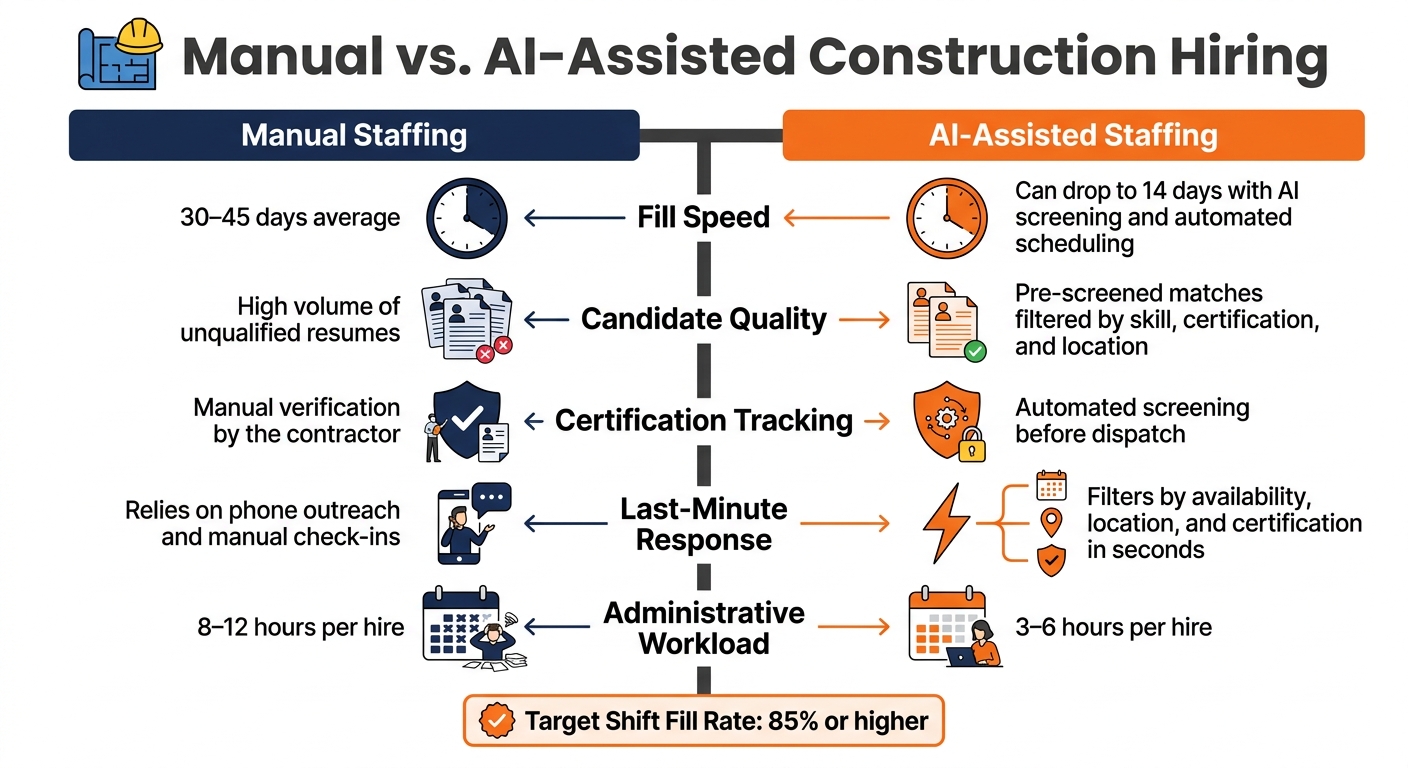
Manual vs. AI-Assisted Construction Hiring: Key Metrics Compared
AI hiring only matters if it helps fill open roles fast enough to keep crews moving. The key is to track the numbers that show whether labor gaps are shrinking in the field, not just whether more candidates are entering the system. And once a worker is matched, contractors still need proof that the fill holds up on site.
Shift fill rate, fill speed, and no-show reduction
Shift fill rate is the clearest metric to watch. It measures the share of required labor slots filled by workers who are qualified, confirmed, and who actually show up. A solid benchmark is 85% or higher. It also helps to break fill rate down by crew type, trade, jobsite, and time window, so specialized shortages don’t get buried in the total number. That shows whether skill matching, location filters, and cert tracking are working where it counts, not just during the match itself.
One detail matters a lot here: confirmed shifts and completed shifts are not the same thing. A shift may look covered in the system and still fall apart if the worker never arrives. That’s why no-show rate needs to sit right next to fill rate. When teams track no-shows by worker, trade, jobsite, or assignment type, they can start to see where the issue lives: matching, confirmation, or attendance. For repeat work, it’s also worth tracking how often the same qualified workers come back for similar jobs.
Time-to-fill adds another layer. AI-assisted hiring can cut time-to-fill sharply, especially for urgent and specialized roles.
Live visibility into worker status and credential status
Seeing a shift marked as “filled” isn’t enough. Project managers need live status on each worker: available, confirmed, en route, on site, or cancelled. If someone accepted the assignment but hasn’t checked in, that gap is still open until the worker is actually on site.
Compliance data should sit in that same view. If a needed certification has expired, or a site orientation hasn’t been done, the worker may be turned away at the gate even though the shift appears covered. Teams can also track readiness by measuring how many workers arrive with pre-verified credentials versus those cleared only through on-site verification. Platforms like ABLEMKR build compliance tracking into the workflow by monitoring credential expiration dates, onboarding status, and site-specific clearances before dispatch. That keeps the staffing picture accurate instead of overly hopeful.
Manual staffing vs. AI-assisted staffing
Manual staffing eats up more time and leaves more room for coverage gaps. These metrics help show whether staffing is improving field execution, not just bringing in more applicants.
| Metric | Manual Staffing | AI-Assisted Staffing |
|---|---|---|
| Fill speed | 30–45 days average | Can drop to 14 days with AI screening and automated scheduling |
| Candidate quality | High volume of unqualified resumes | Pre-screened matches filtered by skill, certification, and location |
| Certification tracking | Manual verification by the contractor | Automated screening before dispatch |
| Last-minute response | Relies on phone outreach and manual check-ins | Filters by availability, location, and certification in seconds |
| Administrative workload | 8–12 hours per hire | 3–6 hours per hire |
The result is faster fills, cleaner compliance, and fewer last-minute crew failures.
Conclusion: What AI hiring tools change for contractors and workers
The earlier numbers all point in the same direction: labor gaps shrink when hiring moves at the speed of the jobsite. Construction labor shortages are still pushing contractors to fill key roles fast, with far less room for manual screening.
Speed helps, but it only counts if the worker can clear compliance checks too. AI tools match open roles with structured worker profiles that include trade skills, certifications, availability, and proximity. That turns last-minute staffing into a faster, more accurate process.
There’s also a simple downside contractors can avoid. If a credential has expired, the system can block that assignment automatically. That means contractors are less likely to send someone to a site only to have them turned away at the gate. The result is pretty clear: faster fills, fewer no-shows, and cleaner compliance.
That’s where connected hiring and compliance workflows matter most. ABLEMKR brings hiring, onboarding, compliance, and payroll into one mobile workflow. For contractors, that means fewer handoffs, cleaner compliance, and crews ready to work.
FAQs
How does AI verify certifications before dispatch?
AI checks certifications through centralized digital records that track worker credentials, safety training, and expiration dates in real time.
When a project calls for specific qualifications, the system scans pre-vetted profiles, matches current credentials to the role, flags renewals before they lapse, and helps stop workers with missing or expired certifications from being sent out.
Can AI hiring tools reduce no-shows?
Yes. AI hiring tools can help cut no-shows and absenteeism by spotting warning signs early and improving scheduling.
They use past data and worker profiles to flag attendance risk, track live status and availability, and match pre-vetted workers based on job needs, certifications, and location.
What jobs benefit most from AI hiring in construction?
AI hiring tools can support hiring across construction. But they tend to work best for roles with strict skill requirements, licenses, or safety standards.
That includes jobs like industrial electricians, certified welders, and safety managers.
They’re especially useful in high-risk, mission-critical fields like oil and gas, utilities, and heavy infrastructure. In those settings, speed matters. So does getting the match right the first time.
You need to know whether someone has the right skills, the right credentials, and the right availability. AI tools can help hiring teams sort that out faster and with less guesswork.


