
The green construction industry faces a major challenge: a lack of skilled workers to meet growing demand. Without proper training, advanced energy-efficient technologies fail to deliver their full benefits, leading to higher costs and missed energy-saving opportunities. Here’s a quick guide to tackling this issue:
- Identify Skill Gaps: Conduct workforce audits and modernize construction staffing to evaluate knowledge of HVAC, insulation, and energy modeling tools.
- Offer Hands-On Training: Focus on practical skills for installing systems like heat pumps and zero-energy designs.
- Certifications Matter: Credentials like ENERGY STAR or LEED ensure compliance and open doors to better projects.
- Leverage Technology: Use digital platforms to deliver and track training progress.
- Partner with Organizations: Collaborate with trade schools and associations to create apprenticeships.
- Support Continuous Learning: Leadership involvement and ongoing education systems keep skills current.
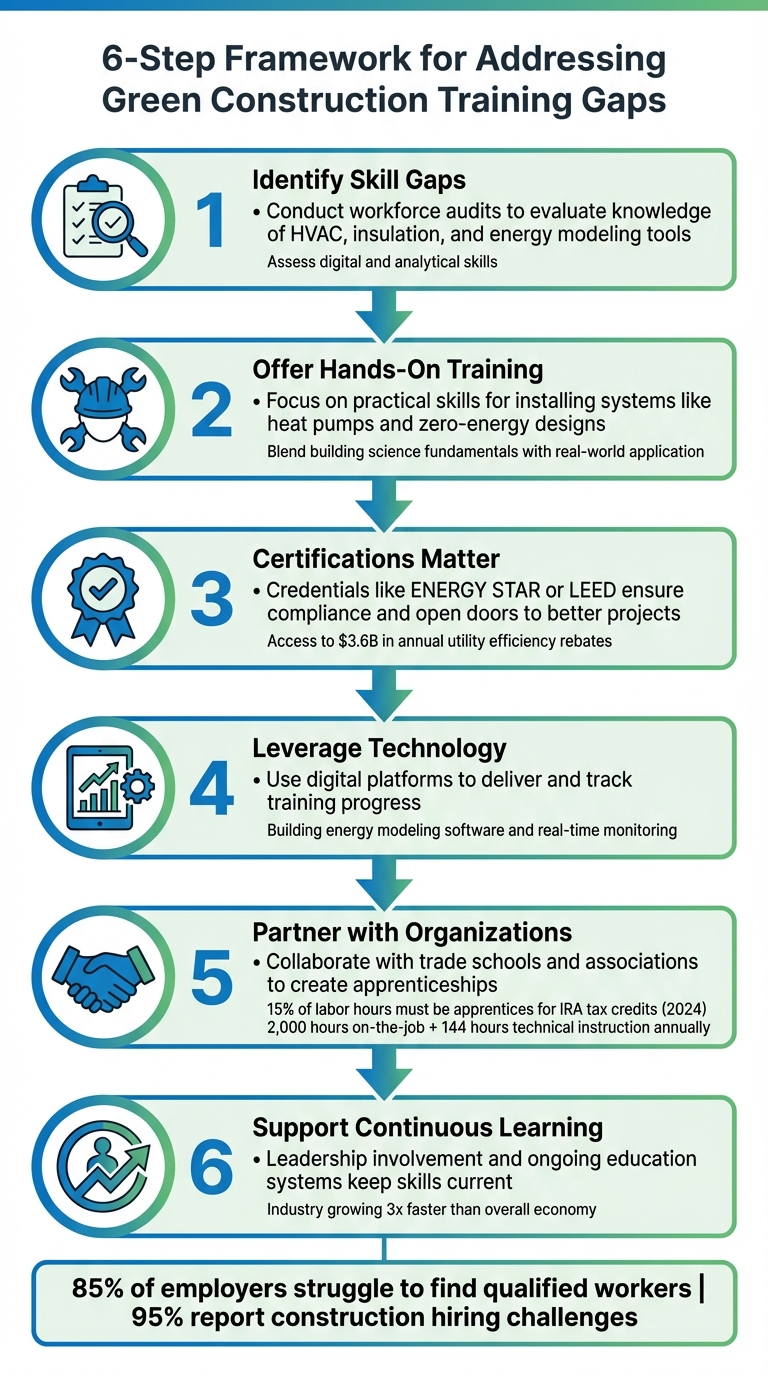
6-Step Framework for Addressing Green Construction Training Gaps
How to Identify Training Deficiencies in Green Construction
Conduct Workforce Skill Audits
Start by evaluating your team’s understanding of essential building science concepts, such as HVAC systems, insulation, and how building envelopes interact. Poor installation can compromise the energy efficiency of both residential and commercial buildings. You’ll also want to assess their technical expertise with green technologies like ENERGY STAR–certified insulation, lighting, and HVAC systems. Additionally, look for specialized skills in areas like zero-energy home design, mechanical ventilation, and cold-climate heat pump installation. The Department of Energy’s Energy Skilled Program offers a helpful framework to pinpoint the specific skills required for these emerging roles.
Don’t overlook digital and analytical skills. Modern green construction increasingly relies on tools like energy modeling software, data analytics, and cybersecurity measures as buildings become more interconnected.
These skill audits serve as a critical first step in aligning your team’s abilities with the demands of your projects.
Match Skill Gaps to Project Requirements
When energy-efficient technologies don’t perform as expected, it’s often due to a mismatch between your team’s skills and the project’s technical demands. For example, installation errors can undermine the effectiveness of advanced systems. Review past project outcomes to pinpoint where skill gaps may be causing performance issues. Field studies can help validate whether technologies are delivering the anticipated energy and cost savings.
Once you’ve identified these gaps, compare your findings to industry standards.
Compare Against Industry Benchmarks
Leverage tools like the Green Buildings Career Map to measure your team’s skills against established industry standards. Another excellent resource is the Building Science Education Solution Center, which provides a library of training materials and curricula designed to set clear competency benchmarks.
Professional certifications can also act as reliable benchmarks. For instance, compare your team’s qualifications to certifications like ENERGY STAR for HVAC and insulation work, LEED standards, or Home Energy Score Assessor training. It’s also important to ensure your team’s knowledge aligns with advanced state and local energy codes to maintain compliance and prepare for future industry shifts. Consider ongoing education programs, such as AIA Learning Units and ICC Continuing Education Units, to help your team stay up to date.
sbb-itb-aa28329
How to Build Effective Training Programs
Provide Hands-On Training for Green Building Methods
On-the-job training is a must. Even the most advanced technologies can fall short if installed incorrectly. By addressing skill gaps identified through workforce audits, hands-on training prepares workers to tackle real-world challenges effectively.
Your training should blend building science fundamentals with practical application. Workers need to grasp how systems like HVAC, insulation, and building envelopes work together to manage moisture, ensure air quality, and maximize energy efficiency. Prioritize high-impact installations such as cold-climate heat pumps, high-performance insulation, and zero-energy home designs. This practical focus allows workers to immediately implement their knowledge on job sites, cutting down on expensive mistakes and rework.
"Without proper installation, efficient technologies cannot deliver their full energy savings potential." – U.S. Department of Energy
Once workers master hands-on skills, certifications can further validate their expertise.
Include Certifications and Accreditation
Certifications do more than just validate skills – they open doors to more lucrative projects. Industry-recognized credentials like ENERGY STAR for HVAC and insulation, LEED credentials (especially for Indoor Air Quality credits), and Home Energy Score Assessor training demonstrate expertise. Additionally, Continuing Education Units (CEUs) from organizations like AIA or ICC help workers stay up to date with evolving energy codes.
Certifications are often a requirement for accessing utility efficiency rebates, which total $3.6 billion annually across the U.S.. These credentials not only align with industry standards but also ensure compliance with changing energy regulations.
Use Technology to Deliver and Track Training
Beyond hands-on learning and certifications, technology can streamline training delivery and tracking. Tools like building energy modeling software teach workers to evaluate a building’s performance and provide data-supported recommendations to clients. Digital platforms also make it easier to deliver training modules and monitor progress in real time.
Platforms like ABLEMKR simplify training management by tracking certifications, safety courses, and skill development. They help ensure workers remain qualified for the specialized demands of sustainable construction projects while maintaining compliance with green building standards. This tech-enabled approach ensures measurable results and keeps your workforce ready for the complexities of modern green building.
"As buildings become more automated, digitized, and interconnected, the workforce that supports the design, build, operation, and maintenance of these buildings must also evolve." – Sarah Truitt, Researcher, NREL
NextGenerationEU: Equipping Ireland’s construction industry with green skills (no subtitles)
How to Partner with Educational and Industry Organizations
Teaming up with vocational schools, trade associations, and government programs can significantly boost your training capacity. These partnerships provide access to established frameworks, funding opportunities, and talent pipelines, offering practical ways to address training gaps.
Create Apprenticeships and Internships
Registered Apprenticeship Programs are a great way to teach green construction skills while meeting federal guidelines. Starting in 2024, projects aiming to qualify for full federal tax credits under the Inflation Reduction Act must ensure that 15% of total construction labor hours are completed by Registered Apprentices.
You can choose between two types of apprenticeship programs:
- Individual Programs: These give you full control over training.
- Group-Sponsored Programs: Managed by trade associations like the Associated Builders and Contractors or the National Electrical Contractors Association, these are ideal for smaller firms looking for streamlined compliance.
Both types require apprentices to complete at least 2,000 hours of on-the-job training and 144 hours of technical instruction annually.
You can also tailor Department of Labor Work Process Schedules by up to 25% to focus on green skills like solar installation, EV charging systems, or high-efficiency HVAC. Apprentices typically begin earning 40–60% of a journeyworker’s wage, with scheduled pay increases. Covering classroom expenses, such as tuition and materials, can improve program completion rates.
Align Training with Current Industry Needs
To stay relevant, training programs must adapt to both current and future industry demands. This approach builds on earlier workforce audits, ensuring programs remain aligned with technological advancements and updated building codes, which are evolving faster than traditional training methods can keep up.
Collaborate with groups like the ACE Network or the Building Performance Association to create energy efficiency apprenticeships for specialized roles such as Energy Auditors or Residential Energy Control Inspectors. The Department of Labor’s Partner Finder is a helpful tool for locating potential sponsors and training providers.
Competency-based training models are also becoming more popular, allowing apprentices to advance by demonstrating specific skills rather than meeting fixed hour requirements. Additionally, standardizing job codes for energy-related skills can simplify career pathways, making it easier for workers to transition between projects and employers without requiring extensive retraining.
Find Training Grants and Funding
Funding opportunities can greatly enhance your training programs. Utility efficiency rebates, which currently total around $3.6 billion annually, and projected electricity efficiency spending of up to $6.8 billion by 2030, provide ample resources to tap into. After registering your program with the Department of Labor, consider registering with the Department of Veterans Affairs as well. This allows veteran apprentices to access GI Bill benefits. State-level grants and incentives like the Commercial Buildings Energy Efficiency Tax Deduction can also help secure additional funding.
Platforms like ABLEMKR are useful for tracking certifications and ensuring your workforce meets the specialized requirements for green building projects. Staying compliant with these standards ensures your team remains eligible for projects tied to green building regulations and funding opportunities.
How to Build a Culture of Continuous Learning
Creating a workplace that prioritizes ongoing education in green construction isn’t just a nice-to-have – it’s a must. It takes leadership that actively backs sustainability goals, workers who can regularly update their skills, and recognition for employees who invest in advancing their green building expertise.
Get Leadership Support
When it comes to training programs, leadership involvement can mean the difference between success and failure. Executives who collaborate with educators, training experts, and industry stakeholders create an environment where learning and career growth thrive. For example, updating apprenticeship programs to include clean energy technologies, building efficiency methods, and digital tools like data analytics ensures green skills aren’t treated as optional extras.
Leaders also play a key role in simplifying the transition from training to real-world jobs and long-term career progression. With over 85% of industry employers struggling to find qualified workers – and 95% reporting hiring challenges in construction specifically – investing in workforce development isn’t just smart; it’s a necessity to stay competitive. Leadership’s commitment lays the foundation for continuous skill development across the board.
Set Up Ongoing Education Systems
A solid continuous learning system fits seamlessly into everyday work. Instead of pulling workers away from job sites for long periods, education on building science can be integrated into on-the-job tasks. This hands-on approach allows workers to build practical expertise with efficiency technologies while staying productive.
Short training formats are especially effective. Webinars or courses offering Continuing Education Units (CEUs) – like 1.5 AIA LUs for a 90-minute session – make it easier for workers to maintain certifications without overwhelming their schedules. Resources like the Department of Energy’s Building Science Education Solution Center and Better Buildings Workforce Accelerator offer ready-made materials that can be quickly implemented. Prioritizing "getting it right the first time" avoids costly rework, keeps projects on schedule, and ensures energy performance goals are met – all of which protect your bottom line and reputation. Adding practical incentives to these learning opportunities solidifies the shift to sustainable construction practices.
Reward Workers for Green Skills
Competitive pay and clear career pathways motivate workers to develop critical green skills. Offering higher wages for specialized certifications shows that organizations value expertise and are committed to building a well-compensated workforce.
Tools like Career Maps can help employees see how gaining green construction skills leads to better job opportunities and long-term growth. When workers understand that properly installing energy-efficient technologies directly results in measurable energy savings, they see the tangible impact of their skills. Framing green construction as a forward-thinking career – one that incorporates cutting-edge digital tools, robotics, and data analytics – enhances its appeal and draws in talent eager to contribute to climate solutions.
Conclusion
The green construction industry is grappling with significant training challenges. Improper installation and maintenance often prevent energy-efficient technologies from achieving their full potential. To address this, companies need to take proactive steps: assess workforce skills, develop practical training programs focused on building science basics, collaborate with educational institutions for apprenticeship opportunities, and secure leadership backing for workforce development initiatives.
To bridge these gaps, firms should implement focused training and certification strategies. Comprehensive programs should cover critical areas like HVAC systems, insulation techniques, and how building components interact. Partnering with vocational schools and trade associations can help create apprenticeships tailored to industry demands. It’s essential to ensure workers have a solid grasp of building science principles and hold certifications that meet industry standards. Regularly evaluate training programs to quickly address any skill deficiencies.
ABLEMKR offers a solution by connecting businesses with pre-screened, skilled workers who hold necessary certifications and safety training. The platform also provides real-time compliance tracking, making it easier to mobilize projects efficiently.
As industry spending continues to rise, the demand for a skilled workforce in green construction will grow even more. With this sector expanding three times faster than the overall economy, companies that invest in addressing training gaps now will position themselves as leaders in this rapidly advancing field.
FAQs
What key skills are essential for working on green construction projects?
Green construction projects call for a combination of technical skills, environmental understanding, and digital know-how. Workers need to grasp energy-efficient design principles, water management strategies, and renewable energy systems, as these are now central to modern building standards. Knowing how to calculate heat loss, work with high-performance building envelopes, and implement ENERGY STAR-rated systems is essential for meeting sustainability goals.
Expertise in sustainable materials – like recycled steel or low-carbon timber – and familiarity with certifications such as LEED are highly sought after. The industry is also leaning heavily on digital tools like building information modeling (BIM) and IoT systems for energy tracking and regulatory compliance. Beyond technical expertise, strong safety awareness, project management abilities, and clear communication are critical, especially since green construction often involves coordinating across diverse teams. Together, these skills help address training gaps and advance the transition to more sustainable building practices.
How can technology help close training gaps in green construction?
Technology is transforming how training gaps in green construction are addressed, making learning more accessible, efficient, and aligned with industry demands. Data-driven platforms are a game-changer, enabling managers to monitor certifications, safety training, and on-site performance in real time. This helps pinpoint skill gaps and deliver targeted training, ensuring workers stay current with sustainable building practices. The result? Reduced downtime, smoother workflows, and projects that stay on budget.
Mobile-first tools bring learning directly to the job site. Features like geofencing can confirm training completion before workers even clock in. These tools also provide on-the-spot resources, such as instructional videos or augmented reality demonstrations, guiding workers through eco-friendly techniques as they go. Instant communication features further enhance collaboration, allowing remote experts to offer real-time feedback and share updates on energy-efficient methods.
As green construction continues to advance, new roles in areas like renewable energy and grid modernization demand fresh digital skills. Platforms like ABLEMKR streamline this shift by connecting workers with projects, tracking certifications, and integrating compliance into scheduling and payroll systems. By turning training into a continuous, data-informed process, technology not only speeds up the adoption of sustainable construction practices but also benefits both workers and employers.
Why are certifications important in green construction?
Certifications are a key component in green construction, serving as proof that workers have the expertise required for energy-efficient and eco-friendly building methods. Beyond initial qualifications, they also promote continuous learning through ongoing education programs, ensuring workers stay up to date with industry advancements.
For employers, certifications are equally important. They not only help meet regulatory requirements but also signal that their teams are equipped to deliver projects aligned with industry standards for low-carbon and environmentally conscious construction.


