
If you need crews on-site fast after a storm, outage, or shutdown, the main question is simple: can you fill jobs fast without losing track of safety, payroll, and records? This comparison shows that ABLEMKR is built to help employers dispatch pre-vetted workers in 24–72 hours, track hours with GPS timecards, verify job-required credentials before arrival, and keep worker status visible in one place.
Here’s the short version:
- Speed: ABLEMKR can send shortlists in 24–72 hours; old-school staffing often takes several days of calls, texts, and callbacks.
- Verification: ABLEMKR checks items like TWIC, HAZWOPER, IICRC, RRP, OSHA, NCCER, and MSHA before dispatch.
- Location fit: ABLEMKR uses GPS-based proximity matching to find nearby qualified workers.
- Visibility: Employers can see whether workers are confirmed, en route, on-site, or checked out.
- Payroll and records: GPS timecards and payroll exports help cut manual entry and keep audit records cleaner.
- Risk control: Better worker matching and cleaner records can help lower delays, pay issues, and paperwork problems during high-pressure recovery work.
In plain terms, I’d say the article’s core point is this: ABLEMKR gives you more control during emergency staffing, while manual staffing leans on scattered paperwork, phone trees, and delayed updates. That gap matters when downtime can cost $100,000s to $1,000,000+ per day.
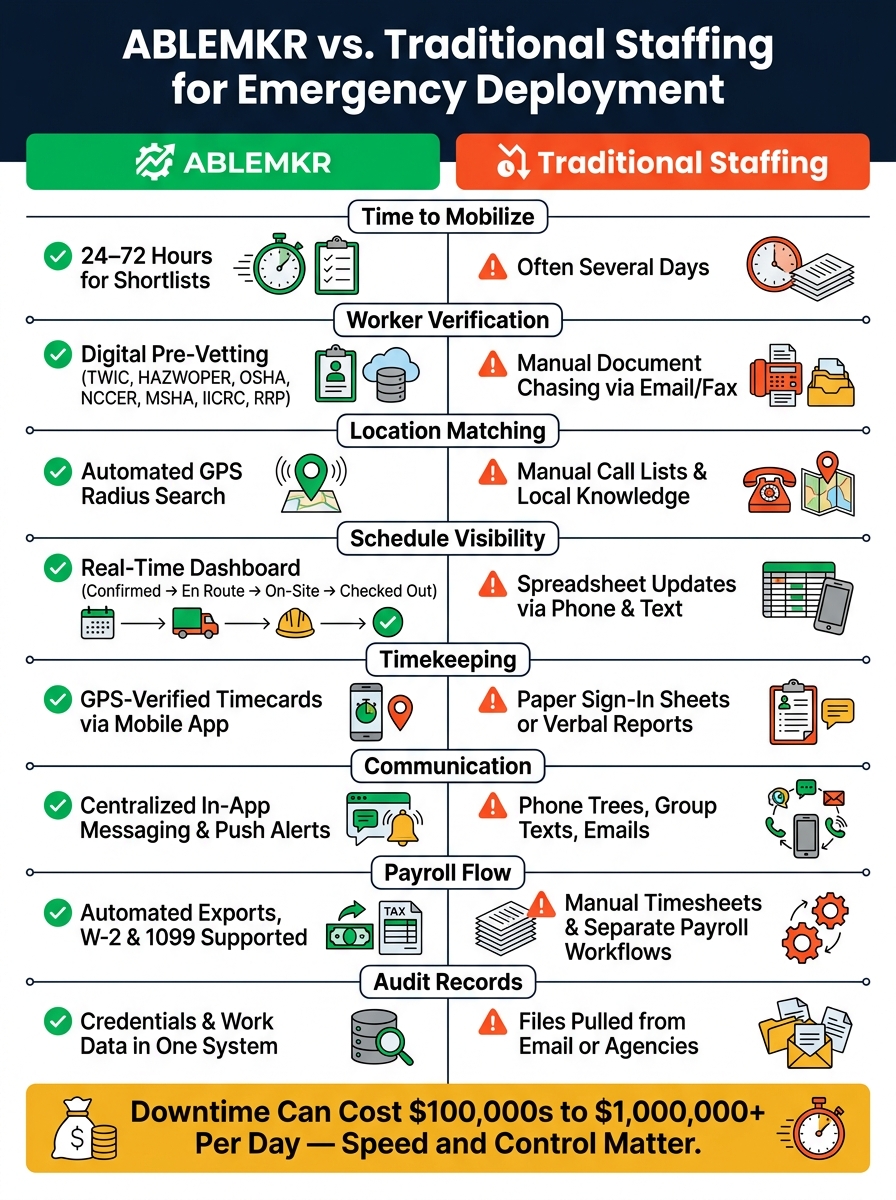
ABLEMKR vs. Traditional Staffing: Emergency Workforce Deployment Comparison
Quick Comparison
| Criteria | ABLEMKR | Traditional Staffing |
|---|---|---|
| Time to mobilize | 24–72 hours for shortlists | Often days |
| Worker checks | Digital pre-vetting before dispatch | Manual document chasing |
| Location matching | GPS/radius-based matching | Call lists and manual review |
| Status tracking | Live app/dashboard updates | Spreadsheets, calls, texts |
| Timekeeping | GPS timecards | Paper sheets or verbal reports |
| Communication | In-app alerts and messaging | Phone trees and group texts |
| Payroll flow | Built-in exports and tracked hours | Separate manual workflows |
| Audit records | Credentials and work data in one system | Files pulled from email or agencies |
If you’re comparing emergency staffing options, this article helps you see where the biggest gaps show up: fill time, worker checks, crew visibility, and payroll recordkeeping.
sbb-itb-aa28329
ABLEMKR for Urgent Workforce Deployment
ABLEMKR is an on-demand workforce deployment platform for construction, energy, utilities, mining, and heavy infrastructure. In an emergency, it helps teams move qualified crews fast without so much manual coordination. The result is a more organized dispatch process instead of a last-minute scramble.
How ABLEMKR Speeds Up Crew Mobilization
Instead of trying to recruit, screen, and onboard people in the middle of an active emergency, employers can pull from a pre-vetted worker pool.
ABLEMKR sorts candidates by certifications, safety training records, availability, and location. For urgent jobs like unplanned shutdowns, pipeline repairs, or utility restoration, that means employers can find qualified candidates without the usual back-and-forth that slows hiring down. ABLEMKR can typically provide shortlists of pre-vetted technicians within 24–72 hours.
That credential matching matters a lot in recovery work. The platform checks key recovery credentials – including HAZWOPER, IICRC, RRP, TWIC, and ISNetworld – before dispatch. If a site needs specific safety training or access credentials, pre-verifying those qualifications can cut delays and help prevent the wrong crew from being sent out.
Workers can get job details, confirm availability, and accept assignments from their phones. When time is tight, that kind of direct communication helps crews mobilize faster.
What Employers and Workers Gain During Urgent Recovery Work
Once crews are matched, the next job is making sure work is tracked the right way. For employers, the main gains are faster fill times, real-time worker visibility, and less admin hassle. GPS timecards track location and hours automatically, which cuts down on manual payroll entry.
For workers, emergency assignments come with a clearer acceptance process, flexible access to short-notice opportunities, and more dependable on-time pay. ABLEMKR supports W-2 and 1099 workers, which keeps deployment flexible without adding payroll friction. That way, fast mobilization under pressure doesn’t create new compliance gaps.
How Conventional Staffing Works in Emergencies
In an emergency, conventional staffing usually begins with a phone call. An operations manager reaches out to HR or a staffing firm, and then a coordinator starts piecing together a roster from call lists and email threads. They contact workers, note who might be available, and build a crew one person at a time.
It’s a very manual process. And that slows the response before the first crew is even locked in.
Where Delays and Friction Usually Happen
The bottlenecks stack up fast. One of the biggest is credential collection. Credentials are often spread across inboxes and HR systems, so coordinators end up asking for the same paperwork again and again.
Then comes location matching, which adds yet another snag. Figuring out which workers can actually get to the site during road closures or fuel shortages often means manually checking call lists against maps and local knowledge. In many cases, workers are assigned before anyone has confirmed they can even make it to the location.
Visibility is another weak spot. Coordinators update a spreadsheet as calls come in, but field supervisors are often looking at old information. If a worker drops out or a shift time changes, that update has to be passed around manually. That takes time, and some workers still arrive with the wrong details.
Final credential checks often happen only when workers show up. By then, if there’s a problem, it’s too late to find a replacement fast. That’s where delays, mistakes, and lost visibility start piling up under pressure.
These delays are exactly what the next comparison section puts side by side with ABLEMKR’s faster deployment model.
ABLEMKR vs. Conventional Staffing: Speed, Visibility, and Deployment Control
Here’s how ABLEMKR stacks up against conventional staffing on speed, visibility, and deployment control. The table makes the difference pretty clear: ABLEMKR shifts the process from manual back-and-forth to tighter deployment control.
| Criteria | ABLEMKR | Conventional Staffing |
|---|---|---|
| Time to Mobilize | Post a job and receive shortlists in 24–72 hours | Often takes days; manual calls and callbacks required |
| Worker Verification | Pre-vetted digital profiles with OSHA, NCCER, MSHA, TWIC, and HAZWOPER certifications digitally verified | Manual document collection via email, fax, or photos; often re-requested for each project |
| Proximity Matching | Automated radius search surfaces the closest available, qualified workers by GPS location | Based on available contacts and manual callbacks; location is only loosely considered |
| Schedule Visibility | Real-time dashboard shows confirmed, en route, on-site, and checked-out status | Spreadsheet updates by phone and text; field supervisors often see stale data |
| Worker Status Tracking | GPS-enabled timecards via mobile app; automated check-in and check-out | Paper sign-in sheets or verbal confirmation from site leads |
| Communication Flow | Centralized in-app messaging, push notifications, and documented safety alerts | Phone trees, group texts, and emails – easy to miss during emergencies |
| Administrative Workload | Automated timecards, payroll exports, and digital onboarding documents | Manual timesheets and invoice reconciliation |
What the Side-by-Side Comparison Shows
The three gaps that matter most are speed, visibility, and verification.
Say a utility contractor needs qualified linemen within 50 miles of a storm-damaged substation. ABLEMKR’s proximity matching can surface the closest available workers automatically. A conventional agency may lean on a familiar crew located 300 miles away just because they already know them. That adds a full day of travel before work even starts.
The same pattern shows up in the office. Integrated workflows cut back-office time and reduce payroll errors, which helps teams keep deployment control from the first crew request through final payroll.
That control also extends into payroll, compliance, and audit tracking during recovery work.
Compliance, Payroll, and Risk Control in Recovery Operations
Once crews are dispatched, the next job is keeping credentials, hours, and records in order. In hazardous recovery sites, that part matters just as much as getting people on-site. If it falls apart, closeout can stall, audits can follow, and liability can pile up.
With traditional staffing, certification checks usually mean asking for paper copies or scanned files, then manually comparing them against job requirements. That sounds simple. In practice, it’s slow, uneven, and easy to miss when a team is under pressure. ABLEMKR pre-verifies OSHA HAZWOPER, IICRC, EPA Lead-Safe, Bloodborne Pathogens, and Asbestos credentials in each worker profile. It then matches workers to jobs based on the exact credentials required, so teams get the qualifications the project calls for.
That’s the point where recovery work either stays organized or starts to drift.
| Compliance Area | ABLEMKR | Traditional Staffing |
|---|---|---|
| Compliance Verification | Automated matching for required certifications and safety training | Manual verification via phone or email |
| Onboarding Consistency | Mobile app-based profile review and faster deployment | Manual paperwork and agency coordination |
| Payroll Coordination | Integrated GPS timecards and automatic weekly payroll | Manual timecard collection and separate payroll workflows |
| Audit Visibility | Real-time access to worker credentials and ratings in-app | Files must be requested directly from the agency |
Payroll is another place where things can get messy, fast. On large recovery jobs, manual timecard collection and separate payroll workflows put extra strain on already busy teams. ABLEMKR uses GPS-verified timecards that flow straight into automated payroll workflows. It also supports both W-2 and 1099 worker classifications, depending on how a restoration company is set up. That means fewer payroll mistakes and cleaner records if someone needs to review the documentation later.
Conclusion: Why ABLEMKR Fits Emergency Response Better
Emergency staffing doesn’t leave room for slow handoffs or patchwork systems. When a major disaster hits or a large-loss response needs immediate action, the teams that can mobilize verified crews fast – and manage them cleanly from day one – are in a much better position to keep recovery under control.
ABLEMKR brings proximity matching, pre-vetted credentials, real-time visibility, and integrated payroll into one mobile-first platform. It targets the areas that most often slow emergency staffing: speed, compliance accuracy, and day-to-day control.
FAQs
How fast can crews actually be mobilized?
ABLEMKR helps crews get to job sites fast by connecting pre-vetted workers to projects in real time through its mobile-first platform. Most job posts get qualified matches within 24 to 48 hours, and urgent openings can sometimes be filled the same day.
It also cuts down the usual back-and-forth. By automating credential checks, background checks, and safety orientations, ABLEMKR reduces delays so workers can show up ready to get started.
What credentials can be verified before dispatch?
Before dispatch, ABLEMKR checks credentials to help support compliance and make sure crews are ready for the job.
That includes trade licenses, equipment certifications, and safety training like OSHA 30-hour, First Aid, CPR, and confined space entry.
ABLEMKR also reviews restoration certifications such as IICRC, EPA Lead-Safe, and HAZWOPER. On top of that, it checks drug testing, background check status, and job-specific requirements like TWIC cards and H2S training.
How does GPS time tracking help with payroll?
GPS-verified time tracking makes payroll a lot easier because supervisors can see crew arrivals and on-site activity in real time.
When hours are logged directly in the ABLEMKR platform, billing and payroll become more accurate. It cuts down on manual guesswork and helps prevent admin delays.


