
In Nevada construction, a 1099 label does not decide workers’ comp. The job relationship does. If you direct the worker’s hours, tasks, tools, and day-to-day work, that person will often be treated like an employee for workers’ comp purposes.
Here’s the short version:
- W-2 workers are usually covered by the employer’s workers’ comp policy.
- True independent contractors usually carry their own policy.
- On Nevada construction sites, the principal contractor can end up responsible if a subcontractor or 1099 worker does not meet the state test or lacks coverage.
- Misclassification can lead to back premiums, claim liability, stop-work trouble, and fines, including up to $5,000 per misclassified worker for later willful violations and up to $15,000 for failing to secure coverage.
- A 2018 report found about 12,700 Nevada construction workers were misclassified or unreported, with costs nearing $50 million.
If I were checking risk on a Nevada job site, I’d focus on a few things right away:
- Who is the employer of record
- Whether each crew has an active Nevada workers’ comp policy
- Whether the subcontractor is a separate business in practice, not just on paper
- Whether payroll and job classifications match the work being done
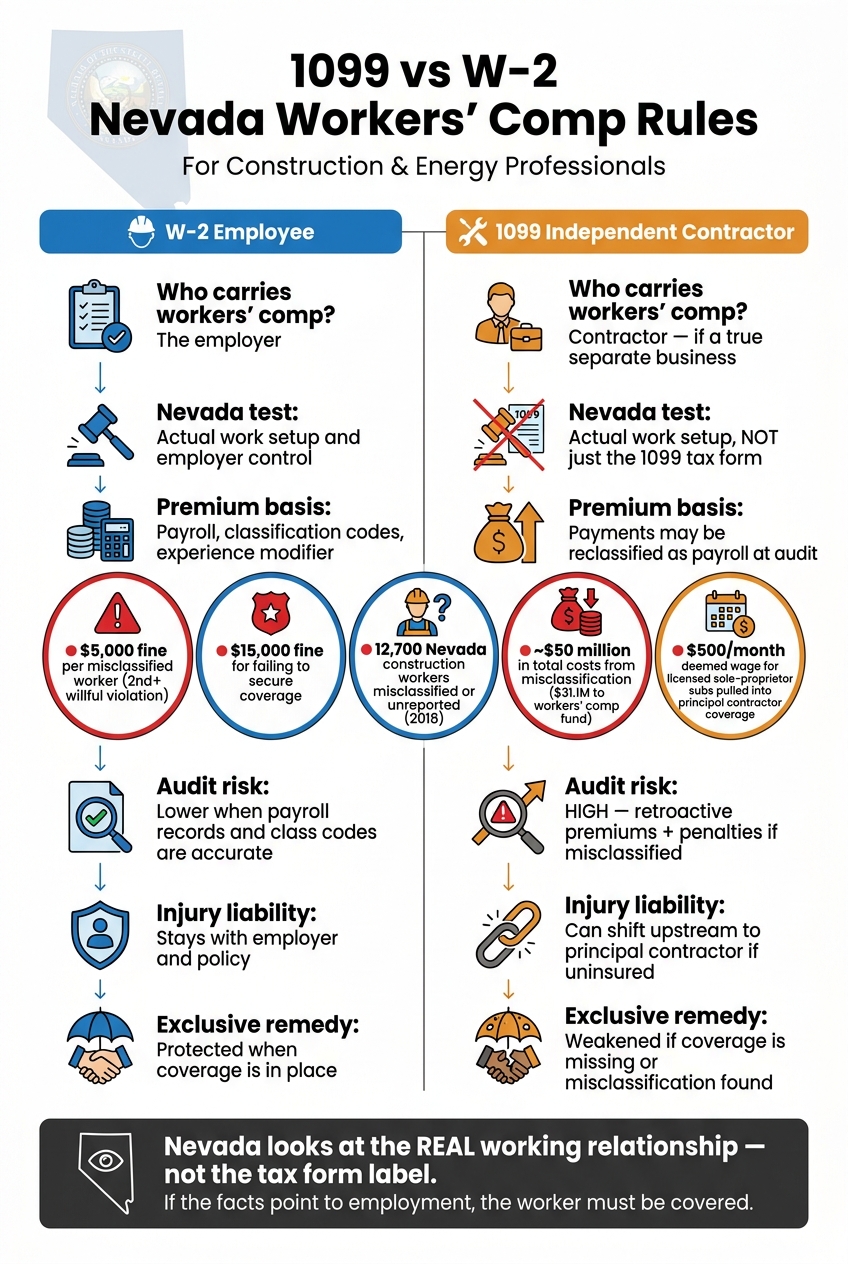
1099 vs W-2 Nevada Workers’ Comp: Key Rules at a Glance
Can "independent contractors" sue for work-related injuries?
sbb-itb-aa28329
Quick Comparison
| Issue | W-2 Worker | 1099 Worker |
|---|---|---|
| Who usually carries workers’ comp? | Employer | Contractor, if the contractor is a separate business |
| What does Nevada look at? | Actual work setup | Actual work setup, not just the 1099 form |
| Main test | Employer control | Contractor controls how work is done |
| Risk on construction sites | Lower if coverage is in place | High if uninsured or misclassified |
| Audit impact | Standard payroll review | Payments may be pulled into payroll and billed later |
| Injury claim exposure | Usually stays with employer/policy | Can shift to the principal contractor |
Put simply, if you use 1099 workers on a Nevada construction or energy project, I would not rely on the tax form alone. I’d verify the business setup, the insurance, and the level of control before work starts.
Nevada Workers’ Comp Basics for Construction and Energy
Before you compare 1099 and W-2 duties, it helps to start with Nevada’s ground rules on these job sites.
Nevada requires almost every employer with at least one employee to carry workers’ comp insurance unless a statutory exclusion applies. In Nevada, workers’ comp usually starts when a worker is hired under an employment agreement and is mandatory under NRS Chapters 616A–616D. Nevada makes coverage mandatory for most employers and employees. That starting point matters because worker classification decides who has to secure coverage.
Core Nevada Rules and Agencies
In Nevada, two agencies do most of the enforcement and compliance work. DIR and the Workers’ Compensation Section handle coverage enforcement and reporting. The Nevada Division of Insurance handles self-insurance approvals and wrap-up programs on large projects.
Employers deal with these agencies through required workplace postings and claim paperwork. That includes the Form D-1 "Notice to Employees" and injury reporting forms like the Form C-3 Employer’s Report of Industrial Injury or Occupational Disease.
One detail matters a lot in construction: the casual-labor shortcut that may apply in some other industries does not apply here. So even short-term or low-cost labor setups can still trigger a coverage duty.
How Coverage Is Typically Set Up on Construction and Energy Projects
On construction and energy projects, the way coverage is set up affects how risk is assigned, especially when a crew includes both employees and contractors.
Most contractors carry a private workers’ comp policy from a licensed insurer in Nevada. Larger employers can apply for certified self-insurance under NRS 616B.300–616B.446. That lets them pay claims directly, but only under state oversight.
On large Nevada projects, coverage is often centralized through a wrap-up program. Under NRS 616B.710–616B.737, a project owner or principal contractor can set up an Owner-Controlled Insurance Program (OCIP) or Contractor-Controlled Insurance Program (CCIP) to cover workers’ comp for all eligible contractors and subcontractors under one policy. The application must be submitted to the Division of Insurance at least 60 days before work begins.
| Coverage Method | How It Works | Best Fit |
|---|---|---|
| Private carrier policy | Employer buys coverage from a licensed Nevada insurer | Most contractors |
| Certified self-insurance | Employer pays claims directly under state oversight | Large employers |
| OCIP / CCIP wrap-up | One program covers all eligible contractors on a project | Large projects |
How Nevada Defines W-2 Employees and 1099 Contractors
In Nevada, workers’ comp depends on the actual working relationship, not the label on a tax form. That’s the key idea behind the coverage split below.
What Makes Someone a W-2 Employee in Nevada
Nevada defines an employee broadly as any person in the service of an employer under a contract of hire. If a foreman controls the worker’s tasks, the order of the work, the tools, and the schedule, that worker is likely an employee for workers’ comp purposes.
A few other facts point the same way:
- The company provides most of the tools and equipment.
- The worker is part of the normal crew rotation and shift setup.
- Pay runs through regular payroll with tax withholding.
For example, a solar installer who reports to your superintendent, works your shifts, and uses your equipment is an employee even if there’s an independent contractor agreement in the file.
When those facts are in place, the employer has the duty to provide coverage.
What Nevada Expects from a True 1099 Independent Contractor
A true independent contractor controls the means, manner, and timing of the work. The hiring company controls only the final result.
Signs that point to a real contractor setup include a business name or EIN, required licenses, owned equipment, money invested in the business, and work for more than one client. Think of a licensed crane company that shows up at your Nevada job site with its own crane, operator, riggers, and workers’ comp policy, while also working for several general contractors. That fits the profile. By contrast, a worker doing the same job as your in-house crew but getting paid on a 1099 usually does not.
Nevada also applies an independent enterprise rule. Under that rule, a subcontractor must run as a separate business and carry workers’ comp for its own employees. If it doesn’t, the principal contractor may be treated as the employer.
If those facts aren’t there, the worker usually belongs on payroll, not on a 1099.
Why Misclassification Is Common in Construction and Energy
On Nevada job sites, a few warning signs show up again and again.
- Crew lead treated as a contractor: A foreman who attends management meetings, directs in-house laborers, and follows the hiring company’s HR policies is acting like an employee, even if they get a 1099 at year-end.
- Mixed payroll and 1099 pay: Some workers are paid partly through payroll and partly by 1099, often to move overtime hours off the books.
- Subcontractors with no real business setup: No license, no equipment, no separate premises, and no workers’ comp policy of their own.
Nevada’s enforcement setup treats these arrangements as deliberate or negligent efforts to avoid workers’ comp, overtime, unemployment insurance, and payroll taxes. Under NRS 608.400, a second or later willful misclassification violation brings a $5,000 fine for each misclassified employee. In high-risk trades, that can add up fast.
Those mistakes set up the side-by-side coverage rules in the next section.
1099 vs W-2 Nevada Workers’ Comp Rules: Side-by-Side Comparison
Here’s the practical split: who carries coverage, who gets swept into it, and where audit risk tends to land on Nevada job sites. This comparison stays focused on project-level exposure, not just whatever label a worker has on paper.
| Dimension | W-2 Employee | 1099 Independent Contractor |
|---|---|---|
| Worker status and coverage | W-2 workers are covered through the employer. On Nevada construction projects, 1099 crews may be treated as employees of the prime contractor unless they qualify as a true independent enterprise. | True independent enterprises usually carry their own coverage, but uninsured 1099s on construction projects can end up covered under the principal contractor’s policy. |
| Multi-employer projects | If a staffing firm is the employer of record, it carries coverage; the project owner or prime contractor may still face statutory exposure on construction sites. | Usually treated as employees for workers’ comp on construction projects unless a narrow exception applies. |
| Premium and audit impact | Premiums are based on payroll, classification codes, and experience modifier. | If a 1099 worker is misclassified or uninsured, payments can be reclassified as payroll at audit, which can create retroactive premiums and possible penalties and interest. |
| Reclassification exposure | Lower when payroll records and class codes are accurate. | High – Nevada can impose administrative fines of up to $5,000 per misclassified worker for second or later offenses. |
| Exclusive-remedy protection | Proper coverage helps preserve immunity from civil suits. | Missing coverage or misclassification can weaken that protection and increase tort exposure. |
W-2 Workers: Employer Coverage Duties in Nevada
Nevada employers must secure workers’ compensation coverage for all employees, including W-2 workers on construction and energy projects. Premiums are tied to total payroll, classification codes, and the employer’s experience modifier.
When a staffing firm acts as the employer of record, that firm usually carries the workers’ comp policy and reports payroll under the right class codes. On Nevada construction jobs, though, the general contractor may still be treated as a statutory employer for injury and immunity purposes.
1099 Workers: When Contractors Need Their Own Coverage
On Nevada construction projects, 1099 crews can get pulled into the prime contractor’s workers’ comp exposure unless they meet the narrow independent-enterprise test. If they do not carry their own policy, audit reclassification can lead to retroactive premiums and penalties.
Nevada also assigns a deemed wage of $500 per month for licensed sole-proprietor or partnership subcontractors who are pulled into the principal contractor’s coverage under NRS 616A.210(2).
How W-2 Staffing Platforms Can Close Compliance Gaps
One practical way to cut through this mess is to use a W-2 staffing model. In that setup, workers are employed directly by the staffing provider instead of being engaged as 1099s.
ABLEMKR uses this model: workers are employed by the platform, matched to jobs based on certification and availability, and covered under the platform’s workers’ comp policy. On fast-moving Nevada job sites, that setup can reduce classification gaps.
Misclassification Risk, Project-Level Duties, and Key Takeaways
Misclassification Consequences in Nevada
A 2018 report found that 12,700 Nevada construction workers – about 11% of the workforce – were either misclassified or not reported at all. The cost was steep: nearly $50 million, including $31.1 million tied to the workers’ comp fund. On high-risk projects, that kind of exposure usually hits the employer of record first.
If Nevada regulators find misclassification, the employer can be on the hook for:
- Retroactive premiums
- Fines of up to $15,000 for failing to secure coverage
- Full liability for injury costs during any uninsured period
- Gross-misdemeanor exposure for knowing violations
That’s not a paperwork problem. It’s a direct cost and liability problem.
Coverage Duties on Multi-Employer and Staffed Projects
On multi-employer job sites, project managers need to look past the contract and check each crew on the ground. Before work starts, confirm who the employer of record is for every crew on site, whether that company has an active Nevada workers’ comp policy, and whether payroll is being reported under the right class codes.
| Worker Type | Employer of Record | Who Typically Carries Workers’ Comp | Principal Contractor Risk |
|---|---|---|---|
| Direct-hire W-2 | Direct employer | Direct employer | Low |
| Subcontracted crew | Subcontractor | Subcontractor | High if the sub is uninsured |
| 1099 labeled as employee | Unclear or disputed | Depends on the actual relationship | High – reclassification can shift liability upstream |
| Staffed W-2 labor | Staffing/EOR entity | Staffing provider | Low if EOR structure is documented |
The practical move is simple: track each worker by employer, policy, and certification before the job begins. A W-2 staffing model helps keep the employer of record and workers’ comp coverage lined up from day one.
Once that employer-of-record issue is settled, the next step is plain enough: every worker on site needs to connect to a valid policy.
Key Takeaways for Nevada Construction and Energy Teams
The main rule is straightforward: Nevada looks at the real working relationship, not just the 1099 or W-2 label. If the facts point to employment, the worker must be covered. A 1099 form by itself doesn’t push liability away.
Construction rules also come with a built-in fallback. If a subcontractor or independent contractor has no coverage and a worker gets injured, the principal contractor can end up paying the actual cost of the claim plus administrative fees. That’s why certificate collection and subcontractor vetting matter so much.
A compliant W-2 staffing model can cut a lot of this risk. When the staffing provider is the employer of record, carries the policy, and tracks certifications, workers stay inside a covered employment setup from the start. ABLEMKR supports that model by matching pre-vetted workers to jobs and tracking compliance by assignment.
FAQs
Can a 1099 worker still be considered an employee in Nevada?
Yes. In Nevada, a worker labeled as a 1099 contractor may still be classified as an employee if the actual working relationship shows economic dependence on the employer.
The label by itself doesn’t settle the issue. If the company controls how, when, or where the work gets done, the worker may legally be treated as an employee.
When is a principal contractor liable for a subcontractor’s workers’ comp?
In Nevada construction, a principal contractor can be on the hook for workers’ compensation coverage for independent contractors. And because construction employers with one or more employees must carry coverage, the principal contractor has to make sure those workers are covered.
A signed independent contractor agreement or a 1099 does not erase that duty. Nevada looks at the actual working relationship and how much control the contractor has over the worker.
What records should I check before a Nevada job starts?
Before a Nevada job starts, verify the paperwork and keep records for both the project and each worker.
For the project, keep signed contracts, required disclosures, permits, and subcontractor certificates of insurance.
For workers, check OSHA cards, trade certifications, background checks, and the right tax form: W-4 for W-2 employees or W-9 for contractors. You should also keep job descriptions and records that back up your classification decision.


