
If you work in the oil and gas industry, OSHA training is essential to ensure safety and meet federal requirements. The two main options are the 10-hour course for entry-level workers and the 30-hour course for supervisors or safety managers.
- OSHA 10-Hour: Focuses on basic safety practices like hazard recognition, PPE use, and emergency procedures. Ideal for field workers starting their careers.
- OSHA 30-Hour: Designed for supervisors, covering advanced topics like safety leadership, hazard management, and regulatory compliance.
Both courses require a passing score of at least 70% and provide a Department of Labor certification card upon completion. Your choice depends on your role – whether you’re looking to build a foundation in safety or take on leadership responsibilities.
Quick Comparison
| Feature | OSHA 10-Hour Training | OSHA 30-Hour Training |
|---|---|---|
| Audience | Entry-level workers | Supervisors, safety managers |
| Training Length | ~10 hours (2 days) | ~30 hours (4 days) |
| Focus | Basic hazard prevention | Advanced safety management |
| Cost | Lower cost | $160–$190 |
| Exam | Shorter assessment | 100 questions, 70% to pass |
Choosing the right training ensures you meet job site requirements and advance in your career.
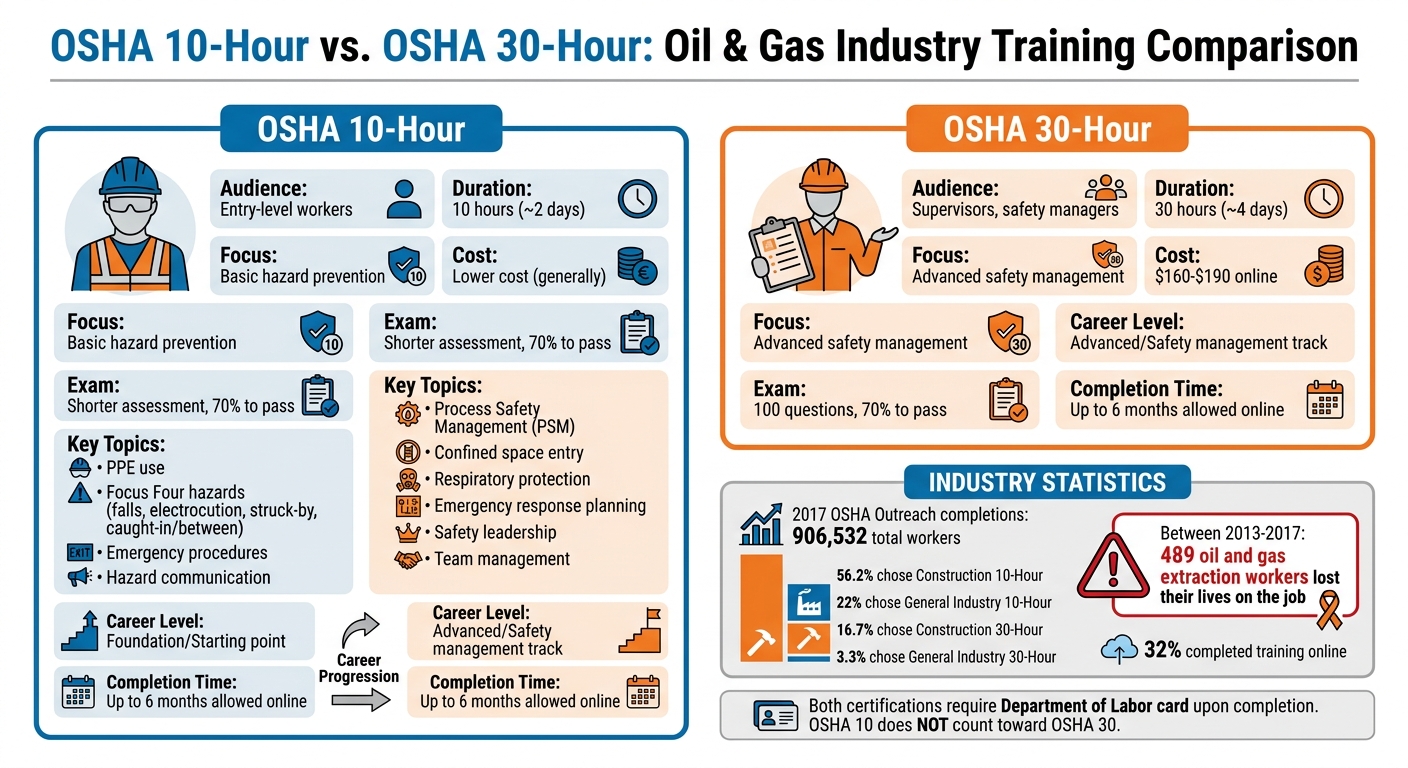
OSHA 10-Hour vs 30-Hour Training Comparison for Oil and Gas Workers
OSHA 30 Hour Oil and Gas Safety and Health
sbb-itb-aa28329
OSHA 10-Hour Training: Entry-Level Safety Basics
The OSHA 10-hour training is designed for entry-level, non-supervisory workers in the oil and gas industry. Its goal? To help workers recognize and prevent hazards on rigs, pipelines, and production facilities.
This training is especially important in an industry known for its risks. Between 2013 and 2017, 489 oil and gas extraction workers lost their lives on the job. The course equips participants to identify and address dangers like vehicle accidents, explosions, fires, and falls.
What the 10-Hour Program Covers
The program focuses on teaching workers how to spot and respond to common hazards. One major emphasis is on the "Focus Four" dangers: falls, electrocution, struck-by incidents, and caught-in/between hazards. It also covers:
- Proper use of personal protective equipment (PPE), such as flame-resistant clothing, eye protection, and hearing protection.
- Fall protection for work on derrick floors and elevated platforms.
- Electrical safety, including lockout/tagout procedures.
- Safe practices for confined space entry, like accessing storage tanks.
- Hazard communication (GHS), including how to read and understand safety data sheets.
Health risks unique to oil field work, such as silica exposure during hydraulic fracturing and exposure to drilling fluids and production chemicals, are also addressed. Additionally, the training highlights workers’ rights and employer responsibilities under the Occupational Safety and Health Act.
To earn your Department of Labor OSHA 10-hour card, you’ll need to score at least 70% on each module. This card serves as proof of your safety knowledge and is a great starting point for anyone beginning a career in oil and gas.
Who Should Take the 10-Hour Course
This course is a must for entry-level workers looking to build a strong safety foundation. Whether you’re a roustabout, derrickhand, or floorhand, completing the training shows employers that you understand workplace hazards, safety standards, and regulations. It also signals your commitment to maintaining a safe work environment.
Holding an OSHA 10 card is often a requirement for site access, as many oil and gas operators view it as proof of safety competence.
If you’re considering a future in leadership, pairing OSHA 10 with OSHA 30 training can help you prepare for supervisory roles. For now, the OSHA 10-hour course provides the essential groundwork to safely navigate the challenges of the oil and gas field.
OSHA 30-Hour Training: Safety Training for Supervisors
The OSHA 30-hour program is tailored for supervisors, foremen, safety coordinators, and team leaders responsible for ensuring their crews’ safety. Unlike the 10-hour course, which is aimed at entry-level workers, the 30-hour training focuses on leadership roles in safety management. This is especially critical for supervisors working in high-risk environments like oil rigs, pipelines, or production facilities.
"OSHA 30 is a more comprehensive safety training course, designed for supervisors, managers, and the more responsible employees on site." – LearnTastic
The course spans 30 hours of instruction, covering advanced safety management topics that go beyond basic hazard recognition. Participants gain skills to implement safety programs, manage hazard prevention, and maintain compliance with OSHA standards. To pass, participants must score at least 70% on a final exam, typically consisting of 100 questions. Online courses generally range in price from $160 to $190, though costs can vary.
Additional Topics in the 30-Hour Program
The 30-hour course builds on general safety knowledge, introducing advanced topics that are essential for managing complex safety challenges. These modules are designed to prepare supervisors for the realities of overseeing high-risk operations.
- Process Safety Management (PSM): Focuses on identifying, evaluating, and controlling hazards linked to highly hazardous chemicals.
- Confined Space Entry: Covers permit systems, atmospheric monitoring, and the roles of entrants, attendants, and supervisors.
- Respiratory Protection: Teaches supervisors how to select the right equipment and manage fit testing programs for gases like hydrogen sulfide (H2S).
Other critical areas include emergency response planning, which involves preparing for fires, chemical spills, and natural disasters, as well as safety management systems that foster a proactive safety culture. Environmental safety practices, such as Spill Prevention, Control, and Countermeasure (SPCC) plans, are also part of the curriculum. These advanced skills are crucial for keeping teams safe and operations running smoothly.
Designed for Team Leaders and Safety Personnel
The 30-hour training equips supervisors not just with technical knowledge but also with the mindset needed for overseeing team-wide safety. As supervisors take on roles with greater responsibility, their focus must shift from individual safety to preventing hazards across entire teams.
"Walking onto a job site with supervisory duties changes your perspective. You’re no longer just looking out for yourself; you’re scanning for potential hazards that could affect your entire team." – Able Safety Consulting
For those aspiring to roles like foreman, safety officer, or site manager, OSHA 30 certification is a clear indicator of readiness to handle both legal and operational challenges. While OSHA cards do not officially expire at the federal level, many employers require supervisors to update their training every 3–5 years to stay aligned with current safety standards.
10-Hour vs. 30-Hour: Side-by-Side Comparison
Deciding between OSHA 10 and OSHA 30 training comes down to your role and responsibilities on the job site. The 10-hour course is designed for workers focused on their personal safety, while the 30-hour program is geared toward those responsible for the safety of others, such as supervisors and managers.
The main difference lies in the scope of responsibility. As HSI explains: "The 10 Hour courses are intended for entry level workers and the 30 Hour courses for supervisors or those workers with some safety responsibilities". This distinction ensures that training aligns with the varying levels of responsibility found in the oil and gas industry. Below is a detailed comparison to help clarify the differences between these two courses.
Time commitment also sets these courses apart. The 10-hour course typically takes two days in a classroom setting, while the 30-hour course requires four full days.
Comparison Table
| Feature | OSHA 10-Hour Training | OSHA 30-Hour Training |
|---|---|---|
| Primary Audience | Entry-level field workers | Supervisors, managers, safety personnel |
| Training Length | 10 hours (approx. 2 days) | 30 hours (approx. 4 days) |
| Core Focus | Hazard recognition and prevention | Safety leadership and OSHA standards |
| Key Topics | PPE, emergency procedures, basic hazards | Team management, detailed compliance, safety culture |
| Career Level | Foundation / Starting point | Advanced / Safety management track |
| Online Completion | Up to 6 months allowed | Up to 6 months allowed |
| Typical Cost | Generally lower | $160–$190 online |
| Exam Requirements | Shorter assessment | 100 questions, 70% passing score |
The numbers reveal training preferences across the industry. In 2017, 906,532 workers completed OSHA outreach courses. Of these, 56.2% opted for Construction 10-Hour, 22% for General Industry 10-Hour, 16.7% for Construction 30-Hour, and only 3.3% for General Industry 30-Hour. Additionally, 32% of trainees completed their courses online that year, a trend that has only grown in recent years. These statistics highlight the training choices most commonly made by workers and supervisors, providing a clear picture of industry trends.
How to Choose the Right OSHA Training
Field Workers vs. Supervisors
The type of OSHA training you need depends on your job role. For entry-level oil and gas workers – like laborers, roustabouts, or equipment operators – the OSHA 10-hour course is a solid starting point. This program focuses on fundamental safety practices, including the proper use of personal protective equipment (PPE), basic emergency response procedures, and identifying workplace hazards.
If you’re a supervisor, foreman, or part of the safety team, the OSHA 30-hour certification is better suited for your responsibilities. While the 10-hour course is tailored to entry-level workers, the 30-hour program is designed for those managing safety protocols or overseeing crews. It provides a deeper dive into regulatory requirements and safety management strategies, helping you protect your team and ensure compliance on-site. For anyone aspiring to take on leadership roles, this program is a crucial step.
This distinction between training levels ensures that workers and supervisors are prepared to handle the specific challenges of oil and gas sites.
Oil and Gas Safety Requirements
In addition to role-specific training, oil and gas operations require specialized safety measures. These environments come with high-risk scenarios that demand thorough preparation. For instance, a scaffolding collapse in Sabine Pass, Texas, in April 2025 tragically resulted in three fatalities and two injuries. Workers fell from approximately 85 feet, underscoring the need for advanced hazard recognition and safety management training. The OSHA 30-hour course expands on basic fall protection by offering in-depth training on managing these types of risks.
Before signing up for a course, check your job site’s specific training requirements. Some high-risk sites or government contracts may require all personnel – not just supervisors – to complete the 30-hour certification. Additionally, many roles in the oil and gas industry call for training beyond general OSHA courses. For example, workers may need specialized instruction in areas like Benzene safety, confined space entry, or Hydrogen Sulfide (H2S) awareness to address the unique chemical and environmental hazards they face.
Certification Process and Workforce Management
Getting Your OSHA Certification Card
Once you complete the OSHA 10- or 30-hour training with an OSHA-authorized trainer, you’ll receive a Department of Labor (DOL) course completion card. This card acts as proof that you’ve met the necessary safety training standards for working in the oil and gas industry. The OSHA Outreach Training Program is the primary system responsible for issuing these certifications.
Although OSHA cards don’t have an official expiration date, many employers request periodic refresher training to ensure workers stay updated on the latest safety practices. Supervisors, in particular, often pursue additional training more frequently since they’re responsible for crew safety and meeting regulatory requirements.
Keep your OSHA card accessible – most job sites require it during onboarding. A digital copy can also serve as proof when needed. For larger projects, managing and verifying these certifications manually can become a time-consuming task.
Managing Compliance with ABLEMKR

Tracking certification cards for large teams can be a logistical headache, but ABLEMKR’s platform simplifies compliance management. For energy companies juggling dozens or even hundreds of workers across multiple sites, manual tracking is inefficient. ABLEMKR’s platform offers real-time insights into worker certifications, making it easy to confirm that every crew member has the required OSHA training before stepping onto a job site.
The platform doesn’t just track certifications – it matches pre-vetted workers to projects based on their qualifications, training, availability, and location. This ensures crews can be mobilized quickly, whether it’s for emergency shutdowns or routine pipeline maintenance.
With embedded compliance tracking, the system verifies each worker’s credentials in real time, streamlining hiring and onboarding processes. This is especially valuable for high-risk operations where safety credentials are non-negotiable. Workers also benefit – they gain quicker access to well-paying opportunities without repeatedly proving their qualifications at every new site.
Conclusion
The choice between OSHA 10-hour and 30-hour training depends on your role and responsibilities. OSHA 10 is designed for entry-level workers, offering a foundation in safety basics like hazard awareness, worker rights, and prevention strategies. OSHA 30, on the other hand, is geared toward supervisors and safety personnel, covering advanced topics such as risk management, electrical safety, and leadership responsibilities. While OSHA 10 serves as a concise introduction, OSHA 30 provides a deeper dive into safety protocols over a longer timeframe.
In high-risk industries like oil and gas, these certifications can directly influence career progression. For instance, OSHA 30 signals readiness for leadership roles, making it a valuable step for those aiming to move into supervisory positions. It’s important to note that OSHA 10 and OSHA 30 are independent certifications – completing OSHA 10 does not count toward OSHA 30. If leadership is your goal, starting with OSHA 30 may save time compared to completing both separately.
These certifications also benefit employers by simplifying compliance. Managing large teams across multiple sites can be challenging, especially when verifying worker certifications. That’s where our ABLEMKR platform comes in. It streamlines compliance by matching pre-vetted workers with the necessary certifications, ensuring teams are mobilized quickly and safely – whether for routine maintenance or emergency shutdowns.
Ultimately, choosing the appropriate OSHA training supports both personal safety and operational success in demanding oil and gas environments. These certifications not only protect workers and reduce job site incidents but also meet regulatory standards and enhance career opportunities. Whether you’re just starting out or stepping into a leadership role, the right OSHA training ensures you’re ready for the challenges of the job.
FAQs
Which OSHA course do most oilfield employers require?
In the oil and gas industry, safety is a top priority, and most employers expect workers to complete the OSHA 30-hour training. This program dives deep into safety protocols, offering more comprehensive guidance compared to its 10-hour counterpart. While the OSHA 10-hour course covers the basics of workplace safety, the 30-hour course is often required because it equips workers with the knowledge needed to handle the unique risks and hazards found in oilfield environments.
Do I need OSHA 30 if I’m not a supervisor yet?
No, OSHA 30 isn’t mandatory if you’re not in a supervisory role. This course is mainly targeted at individuals in leadership positions or those looking to move into such roles. While completing it can boost your resume and show dedication to workplace safety, non-supervisory workers usually only need to take the OSHA 10-hour course, which covers essential safety training and compliance basics.
How long is my OSHA card accepted before I need a refresh?
The duration of validity for an OSHA card isn’t explicitly mentioned in the available information. To ensure compliance, it’s best to consult your employer or refer directly to OSHA guidelines for details on renewal requirements.


